 VIPSolutions
give answer in 2 step with explanation at the end of each step and final answer at the end:A particle P moves on the x-axis from the O with an initial velocity of —20ms The acceleration ams at time 7s after leaving O' 1s gi 12-2¢ (a) Sketch a velocity-time graph for 0 nd the total distance travelled by P in the interval 0
Question:
give answer in 2 step with explanation at the end of each step and final answer at the end: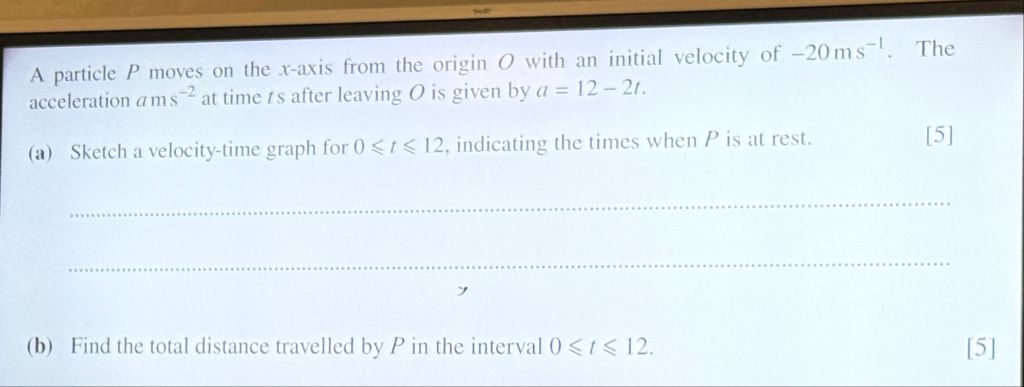 A particle P moves on the x-axis from the O with an initial velocity of —20ms The
acceleration ams at time 7s after leaving O' 1s gi 12-2¢
(a) Sketch a velocity-time graph for 0
nd the total distance travelled by P in the interval 0
This is AI generated Response.
Asked by: Rahul
Created at: 2026-02-06 06:07:03
Asked by: Rahul
Created at: 2026-02-06 06:07:03
Final Answer:
Rendered
Raw Text
Did you like this answer?
Let's solve **part (b)** step by step as requested:
---
### Step 1: Find the velocity function and when the particle is at rest
Given:
- Initial velocity \( v_ = -20 \) m/s
- Acceleration: \( a = 12 - 2t \)
Recall:
\( a = \frac{dv}{dt} \)
Integrate to get velocity:
\[
\frac{dv}{dt} = 12 - 2t
\]
\[
dv = (12 - 2t)dt
\]
Integrate both sides:
\[
\int dv = \int (12 - 2t)dt
\]
\[
v = 12t - t^2 + C
\]
Use initial condition at \( t= \), \( v = -20 \):
\[
-20 = 12() - ()^2 + C \implies C = -20
\]
So,
\[
v(t) = 12t - t^2 - 20
\]
#### When is the particle at rest?
Set \( v(t) = \):
\[
12t - t^2 - 20 =
\]
\[
-t^2 + 12t - 20 =
\]
\[
t^2 - 12t + 20 =
\]
\[
t = \frac{12 \pm \sqrt{144 - 80}}{2} = \frac{12 \pm \sqrt{64}}{2} = \frac{12 \pm 8}{2}
\]
\[
t_1 = 2,\quad t_2 = 10
\]
**Explanation:**
We found the velocity function and determined the times (\( t=2 \) and \( t=10 \)) when the particle is at rest (velocity = ).
---
### Step 2: Find total distance traveled (\( \leq t \leq 12 \))
Total distance = sum of **absolute values** of displacements in each interval (since velocity changes sign).
\[
\text{Displacement} = \int v(t)dt
\]
Find \( s(t) \) by integrating \( v(t) \):
\[
v(t) = 12t - t^2 - 20
\]
\[
s(t) = \int (12t - t^2 - 20)dt = 6t^2 - \frac{1}{3}t^3 - 20t + D
\]
Let \( s() = \Rightarrow D = \), so:
\[
s(t) = 6t^2 - \frac{1}{3}t^3 - 20t
\]
Now, calculate displacement for each interval, using the rest points:
- From \( t= \) to \( t=2 \)
- From \( t=2 \) to \( t=10 \)
- From \( t=10 \) to \( t=12 \)
#### Calculate \( s(2), s(10), s(12) \):
**At \( t= \):**
\[
s() =
\]
**At \( t=2 \):**
\[
s(2) = 6(2^2) - \frac{1}{3}(2^3) - 20(2) = 24 - \frac{8}{3} - 40 = -16 - \frac{8}{3} = -\frac{56}{3}
\]
**At \( t=10 \):**
\[
s(10) = 6(100) - \frac{1}{3}(100) - 200 = 600 - 333.33 - 200 = 66.67
\]
**At \( t=12 \):**
\[
s(12) = 6(144) - \frac{1}{3}(1728) - 240 = 864 - 576 - 240 = 48
\]
**Now find distance for each segment:**
- From \( t= \) to \( t=2 \): \( |s(2) - s()| = |-56/3 - | = 56/3 \)
- From \( t=2 \) to \( t=10 \): \( |s(10) - s(2)| = |66.67 - (-56/3)| \)
\[
66.67 + 18.67 = 85.34
\]
- From \( t=10 \) to \( t=12 \): \( |s(12) - s(10)| = |48 - 66.67| = 18.67 \)
**Total distance:**
\[
\text{Total distance} = \frac{56}{3} + 85.34 + 18.67 \approx 18.67 + 85.34 + 18.67 = 122.68~\text{m}
\]
---
## **Final Answer**
\[
\boxed{122.7~\text{m}}
\]
**Explanation:**
We integrated the velocity to get the position function, evaluated the position at the turning points, and summed the absolute values of the displacements to get the total distance traveled.
📢 Instructions:
- Ask anything relatd to above question only.
- For new Question goto :