 VIPSolutions
give answer in 2 step with explanation at the end of each step and final answer at the end:& £ i; i tl | 4 L1 tt 5 Hi EH B ® i : i : Eps ; Hi : Hi : if H L i - of si
Question:
give answer in 2 step with explanation at the end of each step and final answer at the end: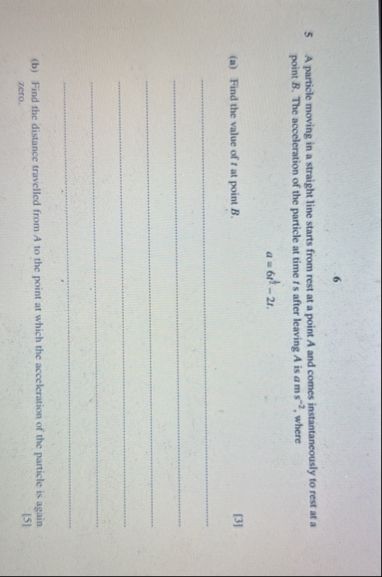 & £ i;
i tl
| 4 L1
tt
5 Hi EH
B ® i
: i
: Eps
; Hi
: Hi
: if
H L
i -
of si
This is AI generated Response.
Asked by: Rahul
Created at: 2026-02-06 05:35:06
Asked by: Rahul
Created at: 2026-02-06 05:35:06
Final Answer:
Rendered
Raw Text
Did you like this answer?
Let's break down the problem step-by-step:
---
## Step 1: Find the value of \( t \) at point B
**Given:**
- The particle starts from rest at \( A \) (\( t = \))
- Comes to rest at \( B \)
- Acceleration: \( a = 6t - 2t^2 \)
At point \( B \), the particle's **velocity is zero** since it comes to rest.
### Let's find the velocity function:
Velocity is the integral of acceleration:
\[
v = \int a \, dt = \int (6t - 2t^2) \, dt = 3t^2 - \frac{2}{3}t^3 + C
\]
Since the particle starts from rest, \( v = \) when \( t = \), so \( C = \).
Thus,
\[
v = 3t^2 - \frac{2}{3}t^3
\]
At point B, \( v = \) (again, since it comes to rest):
\[
3t^2 - \frac{2}{3}t^3 =
\]
Factor \( t^2 \):
\[
t^2 \left(3 - \frac{2}{3}t \right) =
\]
So \( t = \) or \( 3 - \frac{2}{3}t = \).
Ignoring \( t = \) (since it's the starting point):
\[
3 = \frac{2}{3}t \implies t = \frac{9}{2}
\]
**Explanation:**
We found \( t \) at point B by setting velocity to zero and solving for \( t \).
---
## Step 2: Find the distance traveled from A to B
Distance is the **integral of velocity** from \( t = \) to \( t = \frac{9}{2} \):
\[
s = \int_^{9/2} v \, dt = \int_^{9/2} \left(3t^2 - \frac{2}{3}t^3 \right) dt
\]
Evaluate:
\[
= \left[ t^3 - \frac{1}{6} t^4 \right]_^{9/2}
\]
Plug in \( t = \frac{9}{2} \):
First, \( \left(\frac{9}{2}\right)^3 = \frac{729}{8} \)
Next, \( \left(\frac{9}{2}\right)^4 = \frac{6561}{16} \)
So,
\[
s = \frac{729}{8} - \frac{1}{6} \times \frac{6561}{16}
= \frac{729}{8} - \frac{6561}{96}
\]
Get common denominator (96):
\[
\frac{729}{8} = \frac{729 \times 12}{96} = \frac{8748}{96}
\]
So,
\[
s = \frac{8748 - 6561}{96} = \frac{2187}{96}
\]
**Explanation:**
We integrated the velocity function over the time interval to find the total distance traveled.
---
## **Final Answers**
1. **Time at point B:** \( t = \frac{9}{2} \) seconds
2. **Distance from A to B:** \( \boxed{\frac{2187}{96}} \) units
📢 Instructions:
- Ask anything relatd to above question only.
- For new Question goto :