 VIPSolutions
give answer in 2 step with explanation at the end of each step and final answer at the end:Consider the following image. (a) The figure shows the electric field lines near two charges, q, (left) and g, (right). What is the ratio of their magnitudes? (b) Sketch the electric field lines a long distance from the charges shown in the figure. (Submit a file with a maximum size of 1 MB.)
Question:
give answer in 2 step with explanation at the end of each step and final answer at the end: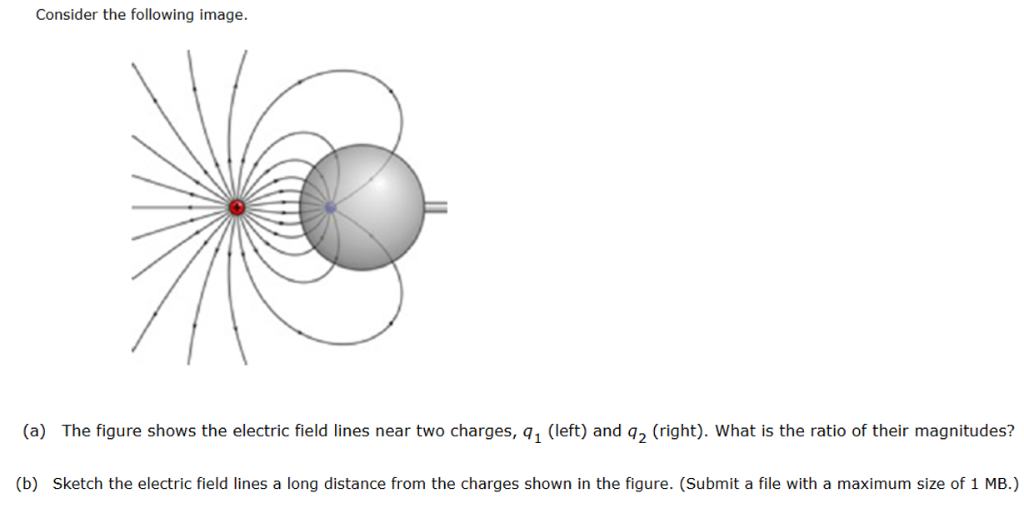 Consider the following image.
(a) The figure shows the electric field lines near two charges, q, (left) and g, (right). What is the ratio of their magnitudes?
(b) Sketch the electric field lines a long distance from the charges shown in the figure. (Submit a file with a maximum size of 1 MB.)
This is AI generated Response.
Asked by: Rahul
Created at: 2026-02-06 05:16:15
Asked by: Rahul
Created at: 2026-02-06 05:16:15
Final Answer:
Rendered
Raw Text
Did you like this answer?
## (a) Ratio of Magnitudes (\(q_1/q_2\))
### **Step 1: Count the Electric Field Lines**
- The number of electric field lines is proportional to the magnitude of the charge.
- From the image:
- \(q_1\) (left, red): 8 field lines emanating.
- \(q_2\) (right, gray): 4 field lines terminating.
**Explanation:**
Field lines start from positive charges and end on negative charges. The count represents the relative magnitudes.
---
### **Step 2: Calculate the Ratio**
- Ratio of magnitudes:
\[
\frac{|q_1|}{|q_2|} = \frac{\text{Number of lines from } q_1}{\text{Number of lines to } q_2} = \frac{8}{4} = 2
\]
**Explanation:**
The ratio is simply the ratio of field lines, assuming each line represents the same amount of charge.
---
### **Final Answer (a):**
\[
\boxed{2}
\]
The magnitude of \(q_1\) is twice that of \(q_2\).
---
## (b) Sketch of Electric Field Lines Far from the Charges
### **Step 1: Analyze the System Far Away**
- At a large distance, the two charges act like a single charge with net charge \(q_1 + q_2\).
- Since \(q_1\) is positive and \(q_2\) is negative but smaller in magnitude, the net charge is positive.
**Explanation:**
Far from the charges, the field lines behave as if they are from a single charge equal to the algebraic sum.
---
### **Step 2: Draw the Field Lines**
- Draw straight radial lines outward from a central point (representing a net positive charge).
- The number of lines is proportional to \((q_1 - |q_2|)\).
**Explanation:**
The field will look like that of a single positive charge because the positive charge is larger.
---
### **Final Answer (b):**
**The field lines far away will look like those of a single positive charge, spreading radially outward.**
---
**Sketch Example:**
```
\ | /
\ | /
-- o --
/ | \
/ | \
```
*(o = combined center, lines radiate outward)*
---
Let me know if you need a digital sketch for part (b)!
📢 Instructions:
- Ask anything relatd to above question only.
- For new Question goto :