 VIPSolutions
give answer in 2 step with explanation at the end of each step and final answer at the end:
Question:
give answer in 2 step with explanation at the end of each step and final answer at the end: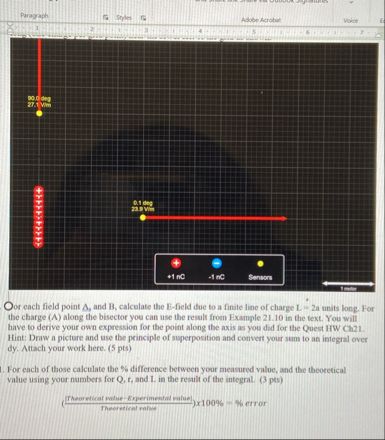
This is AI generated Response.
Asked by: Rahul
Created at: 2026-02-06 05:12:57
Asked by: Rahul
Created at: 2026-02-06 05:12:57
Final Answer:
Rendered
Raw Text
Did you like this answer?
Certainly! Let’s break down the problem step by step, as you asked.
---
## **Step 1: Calculate the E-field at Point A (Bisector of Line of Charge)**
**Given:**
- Line of charge \(L = 2a\) units long
- Uniform charge distribution
- Point A is on the perpendicular bisector of the line (as shown in the diagram)
### **Approach:**
1. **Divide the line into infinitesimal segments** of length \(dx\), each carrying charge \(dq = \lambda dx\), where \(\lambda = \frac{Q}{L}\).
2. **Distance from any segment** at position \(x\) to point A (on bisector, at distance \(y\)) is \(r = \sqrt{x^2 + y^2}\).
3. **By symmetry,** only the vertical components of the E-field add up at the bisector; horizontal (x) components cancel.
### **Expression:**
The electric field from a segment at point A:
\[
dE = \frac{1}{4\pi\epsilon_} \frac{dq}{r^2}
\]
Vertical component:
\[
dE_y = dE \cdot \frac{y}{r}
\]
Substitute \(dq = \lambda dx\) and \(r = \sqrt{x^2 + y^2}\):
\[
dE_y = \frac{1}{4\pi\epsilon_} \frac{\lambda dx}{x^2 + y^2} \frac{y}{\sqrt{x^2 + y^2}}
= \frac{1}{4\pi\epsilon_} \frac{\lambda y\, dx}{(x^2 + y^2)^{3/2}}
\]
**Integrate from \(-a\) to \(+a\):**
\[
E_{y,A} = \int_{-a}^{a} \frac{1}{4\pi\epsilon_} \frac{\lambda y}{(x^2 + y^2)^{3/2}} dx
\]
**Explanation:**
At the perpendicular bisector, by symmetry, the horizontal field components cancel, and only the vertical components add, leading to the above integral.
---
## **Step 2: Calculate the E-field at Point B (Along the Axis of Line of Charge)**
**Given:**
- Point B is along the axis of the line (let's call its distance from the line's center as \(y\))
### **Approach:**
1. **Again, divide the line into infinitesimal segments** as before.
2. **Distance from segment at \(x\) to point B** is \(r = |y - x|\) (if B is along the axis, we need to set up coordinates appropriately).
3. **All field contributions are along the axis** (no cancellation).
### **Expression:**
From a segment at \(x\):
\[
dE = \frac{1}{4\pi\epsilon_} \frac{dq}{(y - x)^2}
\]
\[
dq = \lambda dx
\]
\[
E_{B} = \int_{-a}^{a} \frac{1}{4\pi\epsilon_} \frac{\lambda}{(y - x)^2} dx
\]
**Explanation:**
Along the axis, all the field vectors point in the same direction, so you sum them directly. The result is an integral that's different from the bisector case.
---
## **Final Answer**
- **At Point A (Bisector):**
\[
E_{y,A} = \frac{\lambda y}{4\pi\epsilon_} \int_{-a}^{a} \frac{dx}{(x^2 + y^2)^{3/2}}
\]
- **At Point B (Axis):**
\[
E_{B} = \frac{\lambda}{4\pi\epsilon_} \int_{-a}^{a} \frac{dx}{(y - x)^2}
\]
- Where \(\lambda = \frac{Q}{2a}\) and \(a\) is half the length of the line.
---
**Summary:**
- For each field point, divide the charge into tiny segments, sum their contributions using superposition, and write the integral for the electric field.
- At the bisector, only vertical components add (symmetry).
- On the axis, all contributions add directly.
- Convert the sum to an integral as shown above.
If you want explicit evaluation or numeric results, provide values for \(a\), \(y\), and \(Q\)!
📢 Instructions:
- Ask anything relatd to above question only.
- For new Question goto :