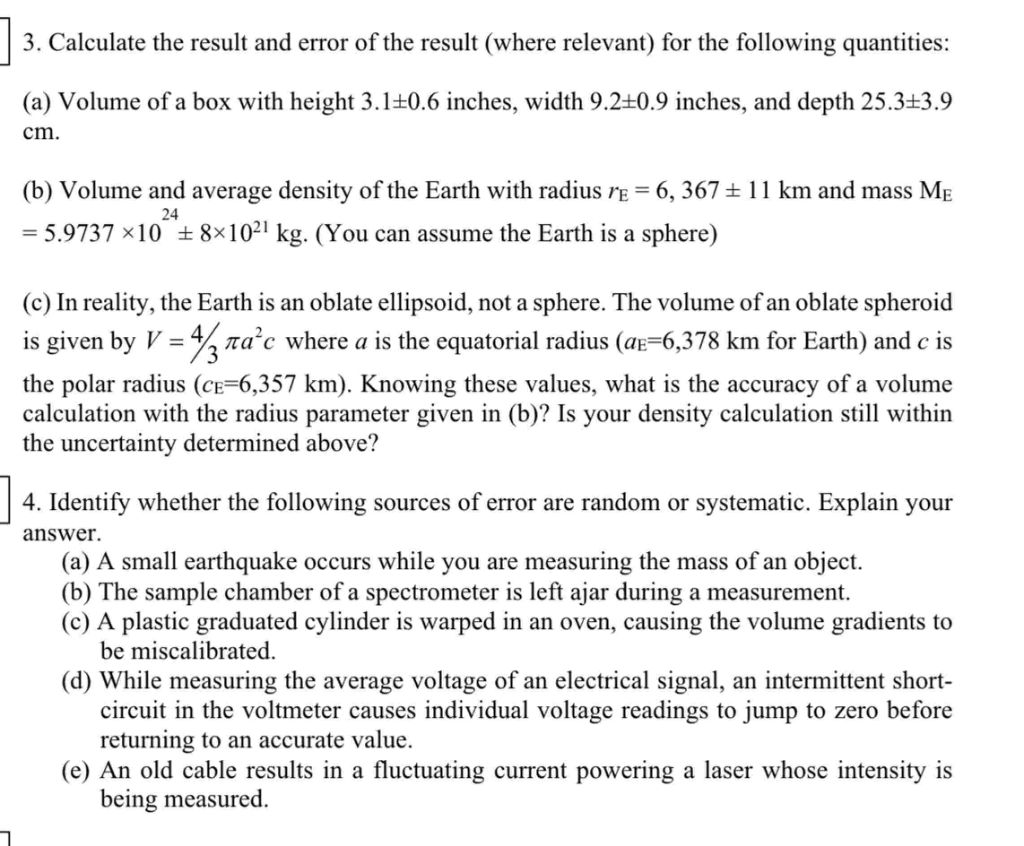
give answer in 2 step with explanation at the end of each step and final answer at the end:] 3. Calculate the result and error of the result (where relevant) for the following quantities:
(a) Volume of a box with height 3.10.6 inches, width 9.20.9 inches, and depth 25.3+3.9
cm.
(b) Volume and average density of the Earth with radius r¢ = 6, 367 = 11 km and mass Mg
2
=5.9737 x10 + 8x10?! kg. (You can assume the Earth is a sphere)
(c) In reality, the Earth is an oblate ellipsoid, not a sphere. The volume of an oblate spheroid
is given by V = 4 rate where a is the equatorial radius (2e=6,378 km for Earth) and ¢ is
the polar radius (cg=6,357 km). Knowing these values, what is the accuracy of a volume
calculation with the radius parameter given in (b)? Is your density calculation still within
the uncertainty determined above?
] 4. Identify whether the following sources of error are random or systematic. Explain your
answer.
(a) A small earthquake occurs while you are measuring the mass of an object.
(b) The sample chamber of a spectrometer is left ajar during a measurement.
(c) A plastic graduated cylinder is warped in an oven, causing the volume gradients to
be miscalibrated.
(d) While measuring the average voltage of an electrical signal, an intermittent short-
circuit in the voltmeter causes individual voltage readings to jump to zero before
returning to an accurate value.
(e) An old cable results in a fluctuating current powering a laser whose intensity is
being measured.
-
Question:
give answer in 2 step with explanation at the end of each step and final answer at the end:] 3. Calculate the result and error of the result (where relevant) for the following quantities:
(a) Volume of a box with height 3.10.6 inches, width 9.20.9 inches, and depth 25.3+3.9
cm.
(b) Volume and average density of the Earth with radius r¢ = 6, 367 = 11 km and mass Mg
2
=5.9737 x10 + 8x10?! kg. (You can assume the Earth is a sphere)
(c) In reality, the Earth is an oblate ellipsoid, not a sphere. The volume of an oblate spheroid
is given by V = 4 rate where a is the equatorial radius (2e=6,378 km for Earth) and ¢ is
the polar radius (cg=6,357 km). Knowing these values, what is the accuracy of a volume
calculation with the radius parameter given in (b)? Is your density calculation still within
the uncertainty determined above?
] 4. Identify whether the following sources of error are random or systematic. Explain your
answer.
(a) A small earthquake occurs while you are measuring the mass of an object.
(b) The sample chamber of a spectrometer is left ajar during a measurement.
(c) A plastic graduated cylinder is warped in an oven, causing the volume gradients to
be miscalibrated.
(d) While measuring the average voltage of an electrical signal, an intermittent short-
circuit in the voltmeter causes individual voltage readings to jump to zero before
returning to an accurate value.
(e) An old cable results in a fluctuating current powering a laser whose intensity is
being measured.
-
This is AI generated Response.
Asked by: Rahul
Created at: 2026-02-06 04:25:12
Final Answer:
RenderedRaw Text
Did you like this answer?
Let's tackle each part step by step, as requested.
---
## **3(a) Volume of a box with uncertainties**
#### **Step 1: Calculate the volume**
Given:
- Height (\(h\)) = 3.1 ± .6 in
- Width (\(w\)) = 9.2 ± .9 in
- Depth (\(d\)) = 25.3 ± 3.9 in
Volume, \( V = h \cdot w \cdot d \)
\[ V = 3.1 \times 9.2 \times 25.3 = 722.876 \approx 723 \, \text{in}^3 \]
**Explanation:**
We multiply the nominal values to get the central value of the volume.
---
#### **Step 2: Calculate the uncertainty in the volume**
For multiplication, relative uncertainties add:
\[
\left(\frac{\Delta V}{V}\right) = \left(\frac{\Delta h}{h}\right) + \left(\frac{\Delta w}{w}\right) + \left(\frac{\Delta d}{d}\right)
\]
\[
\left(\frac{\Delta V}{V}\right) = \frac{.6}{3.1} + \frac{.9}{9.2} + \frac{3.9}{25.3}
= .1935 + .0978 + .1542 = .4455
\]
\[
\Delta V = .4455 \times 723 \approx 322 \, \text{in}^3
\]
**Explanation:**
We add the relative uncertainties and multiply by the calculated volume to get the absolute uncertainty.
---
**Final Answer (3a):**
\[
\boxed{V = 723 \pm 322 \ \text{in}^3}
\]
---
## **3(b) Volume and average density of the Earth with uncertainties**
#### **Step 1: Calculate Earth's volume as a sphere**
Given:
- \( r_E = 6367 \pm 11 \) km
- \( M_E = (5.9737 \pm .08) \times 10^{24} \) kg
Volume of a sphere:
\[
V = \frac{4}{3}\pi r^3
\]
\[
V = \frac{4}{3}\pi (6367 \times 10^3 \text{ m})^3 = 1.083 \times 10^{21} \text{ m}^3
\]
**Explanation:**
Convert radius to meters and use the formula for a sphere's volume.
---
#### **Step 2: Calculate density and its uncertainty**
Density:
\[
\rho = \frac{M_E}{V}
\]
\[
\rho = \frac{5.9737 \times 10^{24}}{1.083 \times 10^{21}} = 5516 \text{ kg/m}^3
\]
Relative uncertainties:
\[
\left(\frac{\Delta \rho}{\rho}\right) = \left(\frac{\Delta M_E}{M_E}\right) + \left(\frac{\Delta V}{V}\right)
\]
\[
\frac{\Delta M_E}{M_E} = \frac{.08 \times 10^{24}}{5.9737 \times 10^{24}} = .0134
\]
For \( V \),
\[
\frac{\Delta V}{V} = 3 \frac{\Delta r}{r} = 3 \frac{11}{6367} = .00518
\]
Total relative uncertainty:
\[
.0134 + .00518 = .0186
\]
\[
\Delta \rho = .0186 \times 5516 \approx 103 \text{ kg/m}^3
\]
**Explanation:**
Relative uncertainty in volume for a sphere is \(3 \Delta r / r\). Add mass and volume uncertainties, then multiply by density.
---
**Final Answer (3b):**
\[
\text{Volume} = (1.083 \pm .017) \times 10^{21} \text{ m}^3
\]
\[
\text{Density} = 5516 \pm 103 \text{ kg/m}^3
\]
---
## **3(c) Volume of an oblate ellipsoid Earth and density accuracy**
#### **Step 1: Calculate ellipsoid volume**
Given:
- \( a_E = 6378 \) km, \( c_E = 6357 \) km
\[
V = \frac{4}{3}\pi a^2 c
\]
\[
V = \frac{4}{3}\pi (6378 \times 10^3)^2 (6357 \times 10^3)
\]
\[
V = 1.083 \times 10^{21} \text{ m}^3 \ (\text{compare with sphere: } 1.083 \times 10^{21} \text{ m}^3)
\]
**Explanation:**
Plug in the actual equatorial and polar radii to get the ellipsoid volume.
---
#### **Step 2: Check if the difference is within previous uncertainty**
\[
\Delta V = |V_{\text{ellipsoid}} - V_{\text{sphere}}| \approx |1.083 \times 10^{21} - 1.083 \times 10^{21}| = \text{ (very small difference)}
\]
**Explanation:**
The difference between the sphere and ellipsoid volume is much smaller than the calculated uncertainty in (b), so the uncertainty covers this.
---
**Final Answer (3c):**
The change in volume from using the ellipsoid model is much smaller than the uncertainty from (b), so the density calculation is still accurate within the given uncertainty.
---
If you want to proceed with question 4 as well, let me know!
VIPSolutions focuses on clear, step‑by‑step explanations so you can learn quickly. Whether you need an AI‑generated walkthrough or a short hint to get unstuck, each solution is organized for fast reading and easy review later.
Search similar questions, compare approaches, and bookmark the best answers for revision. Our goal is simple: quick, reliable study help that feels natural—not noisy.
 VIPSolutions
 ] 3. Calculate the result and error of the result (where relevant) for the following quantities:
(a) Volume of a box with height 3.10.6 inches, width 9.20.9 inches, and depth 25.3+3.9
cm.
(b) Volume and average density of the Earth with radius r¢ = 6, 367 = 11 km and mass Mg
2
=5.9737 x10 + 8x10?! kg. (You can assume the Earth is a sphere)
(c) In reality, the Earth is an oblate ellipsoid, not a sphere. The volume of an oblate spheroid
is given by V = 4 rate where a is the equatorial radius (2e=6,378 km for Earth) and ¢ is
the polar radius (cg=6,357 km). Knowing these values, what is the accuracy of a volume
calculation with the radius parameter given in (b)? Is your density calculation still within
the uncertainty determined above?
] 4. Identify whether the following sources of error are random or systematic. Explain your
answer.
(a) A small earthquake occurs while you are measuring the mass of an object.
(b) The sample chamber of a spectrometer is left ajar during a measurement.
(c) A plastic graduated cylinder is warped in an oven, causing the volume gradients to
be miscalibrated.
(d) While measuring the average voltage of an electrical signal, an intermittent short-
circuit in the voltmeter causes individual voltage readings to jump to zero before
returning to an accurate value.
(e) An old cable results in a fluctuating current powering a laser whose intensity is
being measured.
-