 VIPSolutions
give answer in 2 step with explanation at the end of each step and final answer at the end:1 The diagram blow shows several electric ii lie paterns. Which of these ptens are correst (circle the answers) (1 pO). Dugemh Dag DagenC Dagend Dagemt 2 (pe rw lcd ns oh hing hr cfm Flo 9 east roi re pa a oral. @ ® +0 i @ 20 Q
Question:
give answer in 2 step with explanation at the end of each step and final answer at the end: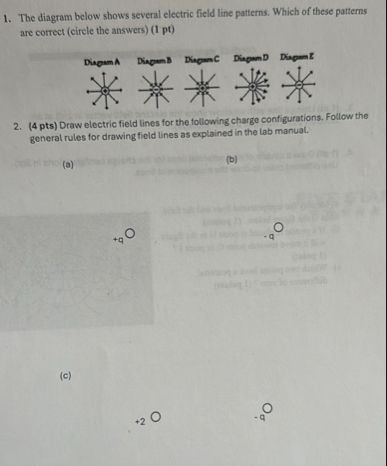 1 The diagram blow shows several electric ii lie paterns. Which of these ptens
are correst (circle the answers) (1 pO).
Dugemh Dag DagenC Dagend Dagemt
2 (pe rw lcd ns oh hing hr cfm Flo 9
east roi re pa a oral.
@ ®
+0 i
@
20 Q
This is AI generated Response.
Asked by: Rahul
Created at: 2026-02-06 04:18:00
Asked by: Rahul
Created at: 2026-02-06 04:18:00
Final Answer:
Rendered
Raw Text
Did you like this answer?
## Step 1: Analyze the Electric Field Line Patterns (Question 1)
Let's examine each diagram:
- **Diagram A:** Field lines are radiating outward from the charge. This matches the pattern for a **positive point charge** (lines go out).
- **Diagram B:** Field lines are radiating inward toward the charge. This matches a **negative point charge** (lines go in).
- **Diagram C:** Field lines both enter and leave the charge, which is **not possible**—electric field lines should only go out (for positive) or in (for negative), not both.
- **Diagram D:** Field lines start and end at infinity, not at the charge, which is **incorrect**.
- **Diagram E:** Field lines come in, but do not radiate evenly, and some lines cross each other, which is **not allowed** (field lines never cross).
**Explanation:**
- Correct field line patterns for a point charge: lines should either all go out (positive) or all go in (negative), and lines should not cross.
**Correct Diagrams:**
- **Diagram A** (positive charge)
- **Diagram B** (negative charge)
---
## Step 2: Draw Electric Field Lines for Charge Configurations (Question 2)
### (a) +q
- Draw several lines **radiating outward** from the charge, evenly spaced.
- **Explanation:** Field lines for a positive charge move outward; the number of lines should be symmetric.
### (b) -q
- Draw several lines **converging inward** to the charge, evenly spaced.
- **Explanation:** Field lines for a negative charge move inward; lines point toward the charge.
### (c) +2, -q
- Draw more lines (**twice as many**) emanating outward from the +2 charge as are converging inward to the -q charge.
- Connect some outward lines from +2 to the -q (showing attraction).
- **Explanation:** The field lines should start from +2 and end at -q, with the +2 charge having twice as many lines since its magnitude is double. The remainder of lines from +2 go out to infinity.
---
## **Final Answers:**
### 1. **Correct patterns:**
- **Diagram A** and **Diagram B**
### 2. **Field lines:**
- (a) Outward lines from +q.
- (b) Inward lines to -q.
- (c) Twice as many outward lines from +2 as inward to -q; some lines go from +2 to -q.
---
**Summary:**
Correct electric field patterns are A and B. Draw lines outward from positive charges, inward to negative charges, and proportionally to the magnitude of the charge.
📢 Instructions:
- Ask anything relatd to above question only.
- For new Question goto :