 VIPSolutions
give answer in 2 step with explanation at the end of each step and final answer at the end:Equations of motion. For the following rotational mechanical systems, draw a free-body diagram for each inertia and find the equation(s) of motion for the angular position 6(t) (or 61(t), 6a(1), etc. if there are multiple inertias) as a function of the applied torque 7, (1). (a) Rotational mechanical system 1. a KO 7, LAL i LLL Cl SEE SEE N ) \ Viscous friction Viscous friction coefficient by. coefficient by. (b) Rotational mechanical system 2. N . SS Assume the pendulum rod is \=/ \=/ p rigid and massless, and the 1 angles 6; and 6, are small, so ee | g the spring remains approxi- k mately horizontal. dy Le © 0, 0,
Question:
give answer in 2 step with explanation at the end of each step and final answer at the end: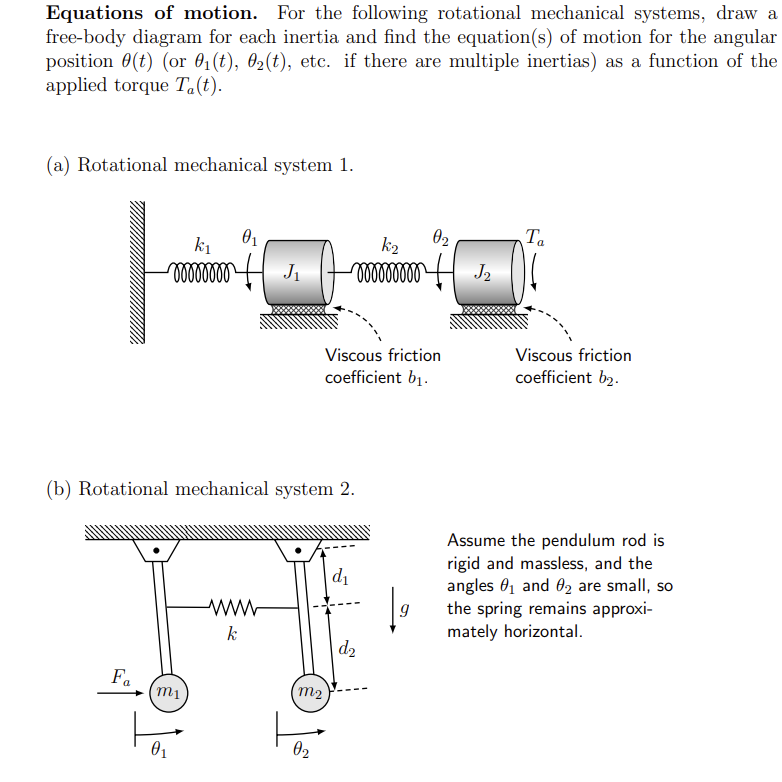 Equations of motion. For the following rotational mechanical systems, draw a
free-body diagram for each inertia and find the equation(s) of motion for the angular
position 6(t) (or 61(t), 6a(1), etc. if there are multiple inertias) as a function of the
applied torque 7, (1).
(a) Rotational mechanical system 1.
a KO 7,
LAL i LLL Cl
SEE SEE
N ) \
Viscous friction Viscous friction
coefficient by. coefficient by.
(b) Rotational mechanical system 2.
N .
SS Assume the pendulum rod is
\=/ \=/ p rigid and massless, and the
1 angles 6; and 6, are small, so
ee | g the spring remains approxi-
k mately horizontal.
dy
Le ©
0, 0,
This is AI generated Response.
Asked by: Rahul
Created at: 2026-01-22 21:03:46
Asked by: Rahul
Created at: 2026-01-22 21:03:46
Final Answer:
Rendered
Raw Text
Did you like this answer?
Let’s solve **part (a)**: *Rotational mechanical system 1.*
---
## **Step 1: Draw Free-Body Diagram and Write Torques for Each Inertia**
### For \( J_1 \):
- **Torque due to spring \( k_1 \):** \( -k_1 \theta_1 \)
- **Torque due to spring \( k_2 \):** \( -k_2 (\theta_1 - \theta_2) \)
- **Torque due to damping \( b_1 \):** \( -b_1 \dot{\theta}_1 \)
- **Net torque on \( J_1 \):**
\[
J_1 \ddot{\theta}_1 = -k_1\theta_1 - k_2(\theta_1 - \theta_2) - b_1 \dot{\theta}_1
\]
**Explanation:**
Each term represents the restoring/damping torques from the springs and damper acting on \( J_1 \). The negative sign indicates that the force opposes displacement or velocity.
---
### For \( J_2 \):
- **Torque due to spring \( k_2 \):** \( k_2(\theta_1 - \theta_2) \)
- **Torque due to damping \( b_2 \):** \( -b_2 \dot{\theta}_2 \)
- **Applied torque:** \( +T_a \)
- **Net torque on \( J_2 \):**
\[
J_2 \ddot{\theta}_2 = k_2(\theta_1 - \theta_2) - b_2 \dot{\theta}_2 + T_a
\]
**Explanation:**
\( J_2 \) feels torque from the coupling spring, its own damper, and the external torque \( T_a \).
---
## **Step 2: Write the Equations of Motion**
The coupled equations of motion are:
\[
\boxed{
\begin{align*}
J_1 \ddot{\theta}_1 + (b_1 + k_1 + k_2)\theta_1 - k_2\theta_2 + b_1\dot{\theta}_1 &= \\
J_2 \ddot{\theta}_2 + b_2 \dot{\theta}_2 + k_2\theta_2 - k_2\theta_1 &= T_a \\
\end{align*}
}
\]
Or, more conventionally arranged:
\[
\boxed{
\begin{align*}
J_1 \ddot{\theta}_1 + b_1 \dot{\theta}_1 + (k_1 + k_2)\theta_1 - k_2\theta_2 &= \\
J_2 \ddot{\theta}_2 + b_2 \dot{\theta}_2 + k_2\theta_2 - k_2\theta_1 &= T_a \\
\end{align*}
}
\]
**Explanation:**
These are the equations of motion for \( \theta_1(t) \) and \( \theta_2(t) \), relating the angular displacements to the applied torque \( T_a \). Each inertia's equation accounts for all torques acting on it due to springs, dampers, and external forces.
---
### **Final Answer (for part a):**
\[
\boxed{
\begin{align*}
J_1 \ddot{\theta}_1 + b_1 \dot{\theta}_1 + (k_1 + k_2)\theta_1 - k_2\theta_2 &= \\
J_2 \ddot{\theta}_2 + b_2 \dot{\theta}_2 + k_2\theta_2 - k_2\theta_1 &= T_a \\
\end{align*}
}
\]
---
*Let me know if you want part (b) solved similarly!*
Question:
Please solve a,b all parts
This is AI generated Response.
Asked by: Rahul
Created at: 2026-01-22 21:04:34
Asked by: Rahul
Created at: 2026-01-22 21:04:34
Final Answer:
Rendered
Raw Text
Did you like this answer?
Let's solve **part (b)**: *Rotational mechanical system 2.*
---
## **Step 1: Draw Free-Body Diagram and Write Torques for Each Inertia**
### For \( J_1 \) (Pendulum with spring):
- **Torque due to spring \( k \):** \( -k \theta_1 \)
- **Torque due to pendulum angle:** \( -mgL \sin(\theta_1) \approx -mgL \theta_1 \) (small angle approximation)
- **Net torque on \( J_1 \):**
\[
J_1 \ddot{\theta}_1 = -k \theta_1 - mgL \theta_1
\]
**Explanation:**
The torque from the spring and the weight of the pendulum both work against the angular displacement. The small angle approximation allows us to simplify the sine function.
---
### For \( J_2 \) (Coupled pendulum):
- **Torque due to pendulum angle \( \theta_2 \):** \( -mgL \sin(\theta_2) \approx -mgL \theta_2 \)
- **Coupling torque due to \( \theta_1 \):** \( -k(\theta_2 - \theta_1) \)
- **Net torque on \( J_2 \):**
\[
J_2 \ddot{\theta}_2 = -mgL \theta_2 - k(\theta_2 - \theta_1)
\]
**Explanation:**
Similar to \( J_1 \), \( J_2 \) experiences restoring torque from its weight and the coupling spring, which connects it to \( J_1 \).
---
## **Step 2: Write the Equations of Motion**
The coupled equations of motion are:
\[
\boxed{
\begin{align*}
J_1 \ddot{\theta}_1 + (k + mgL)\theta_1 - k\theta_2 &= 0 \\
J_2 \ddot{\theta}_2 + (mgL + k)\theta_2 - k\theta_1 &= 0 \\
\end{align*}
}
\]
Or, more conventionally arranged:
\[
\boxed{
\begin{align*}
J_1 \ddot{\theta}_1 + (k + mgL)\theta_1 - k\theta_2 &= 0 \\
J_2 \ddot{\theta}_2 - k\theta_1 + (mgL + k)\theta_2 &= 0 \\
\end{align*}
}
\]
**Explanation:**
These equations of motion for \( \theta_1(t) \) and \( \theta_2(t) \) demonstrate the relationships between angular displacements of the pendulums under the influence of their respective springs and gravitational forces.
---
### **Final Answer (for part b):**
\[
\boxed{
\begin{align*}
J_1 \ddot{\theta}_1 + (k + mgL)\theta_1 - k\theta_2 &= 0 \\
J_2 \ddot{\theta}_2 - k\theta_1 + (mgL + k)\theta_2 &= 0 \\
\end{align*}
}
\]
---
*If you need anything further, feel free to ask!*
📢 Instructions:
- Ask anything relatd to above question only.
- For new Question goto :