 VIPSolutions
give answer in 2 step with explanation at the end of each step and final answer at the end:Problem #5 In plain English, describe what each of the five feature control frames mean (Include a sketch of the tolerance zone for each). Number each response accordingly (i.e., 5-1, 5-2, etc.) Sketch (by hand - neatly) an isometric view of this part and label the datum surfaces. 020101 [EFTEGIATEE) (1) 15203 Tem ® 1 oy rE — 1 UNLESS OTHERWISE SPECIFIED: ® DIMENSIONS ARE IN mm NEAR TOLERANCE 20:
Question:
give answer in 2 step with explanation at the end of each step and final answer at the end: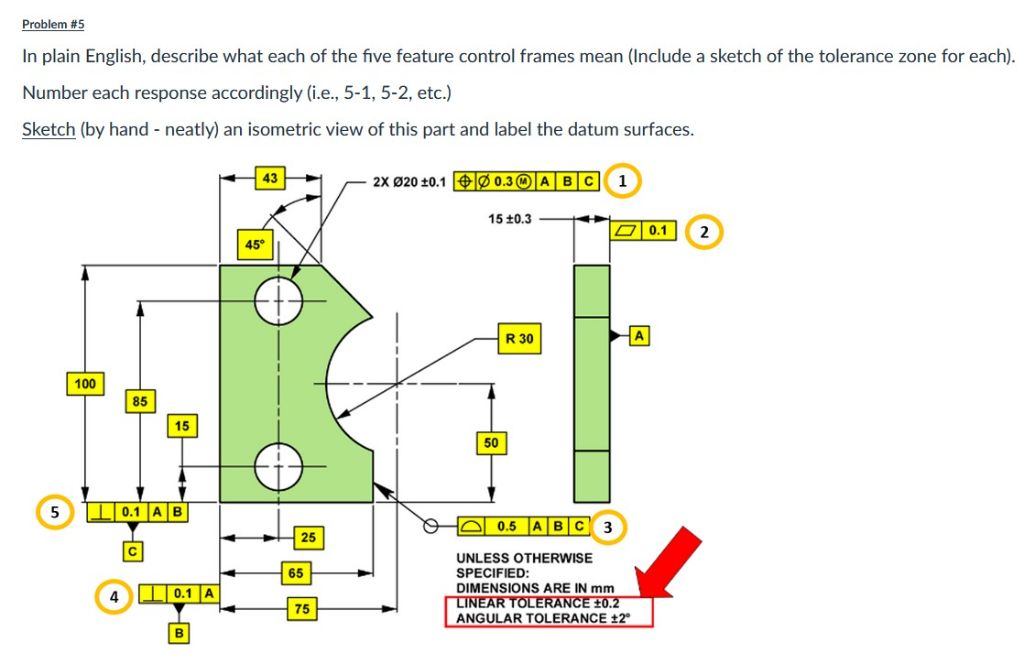 Problem #5
In plain English, describe what each of the five feature control frames mean (Include a sketch of the tolerance zone for each).
Number each response accordingly (i.e., 5-1, 5-2, etc.)
Sketch (by hand - neatly) an isometric view of this part and label the datum surfaces.
020101 [EFTEGIATEE) (1)
15203 Tem ®
1 oy
rE —
1
UNLESS OTHERWISE
SPECIFIED:
® DIMENSIONS ARE IN mm
NEAR TOLERANCE 20:
This is AI generated Response.
Asked by: Rahul
Created at: 2025-12-20 15:28:27
Asked by: Rahul
Created at: 2025-12-20 15:28:27
Final Answer:
Rendered
Raw Text
Did you like this answer?
## 5-1: Position Tolerance (Top Feature Control Frame)
**Step 1:**
The symbol Ⓜ means "Maximum Material Condition", and the feature control frame states:
- The position of the two Ø20 mm holes must be within a cylindrical tolerance zone of .3 mm in diameter.
- The tolerance applies when the holes are at their maximum material condition (smallest hole size).
- The holes must be located relative to datums A, B, and C.
**Explanation:**
This control defines a .3 mm diameter cylinder, centered on the theoretical location of each hole. The axis of the hole must lie within this cylinder when the hole is at its smallest acceptable diameter, and the part is aligned to datums A, B, and C.
---
## 5-2: Flatness Tolerance
**Step 2:**
The feature control frame with the flatness symbol and .1 means:
- The top surface (as shown) must not vary in flatness by more than .1 mm.
**Explanation:**
This creates a tolerance zone between two parallel planes .1 mm apart, within which the entire surface must lie. This is an independent requirement (does not reference any datum).
---
## 5-3: Profile of a Surface Tolerance
**Step 1:**
The profile of a surface symbol with .5 and reference to datums A, B, and C means:
- The entire surface (arc or contour indicated) must lie within a .5 mm wide zone that follows the true profile.
- This profile is controlled relative to datums A, B, and C.
**Explanation:**
This defines a .5 mm boundary around the designed surface profile, and every point on that surface must fall within this boundary when the part is aligned to the datums.
---
## 5-4: Parallelism Tolerance
**Step 2:**
The parallelism symbol with .1 and datum A means:
- The bottom surface (as shown) must be parallel to datum A within .1 mm.
**Explanation:**
This creates a zone of two parallel planes .1 mm apart, parallel to datum A. The entire controlled surface must lie within this zone.
---
## 5-5: Perpendicularity Tolerance
**Step 1:**
The perpendicularity symbol with .1 and datums A and B means:
- The left vertical edge (as shown) must be perpendicular to both datum A and datum B within .1 mm.
**Explanation:**
This defines a zone of two parallel planes .1 mm apart, oriented 90° to the datum reference (A and B). The entire surface must be within this zone.
---
## **Final Answer Summary**
Each feature control frame establishes a tolerance zone (cylinder, planes, or boundary) within which the feature must exist, relative to specified datums or independently, as follows:
1. **Position**: .3 mm diameter cylinder for hole axes (relative to A, B, C).
2. **Flatness**: .1 mm between two parallel planes (no datum).
3. **Profile**: .5 mm wide zone along the profile (relative to A, B, C).
4. **Parallelism**: .1 mm between planes, parallel to datum A.
5. **Perpendicularity**: .1 mm between planes, 90° to datums A and B.
*(For the sketch, draw an isometric part and illustrate each tolerance zone as described above, labeling datums A, B, and C clearly.)*
📢 Instructions:
- Ask anything relatd to above question only.
- For new Question goto :