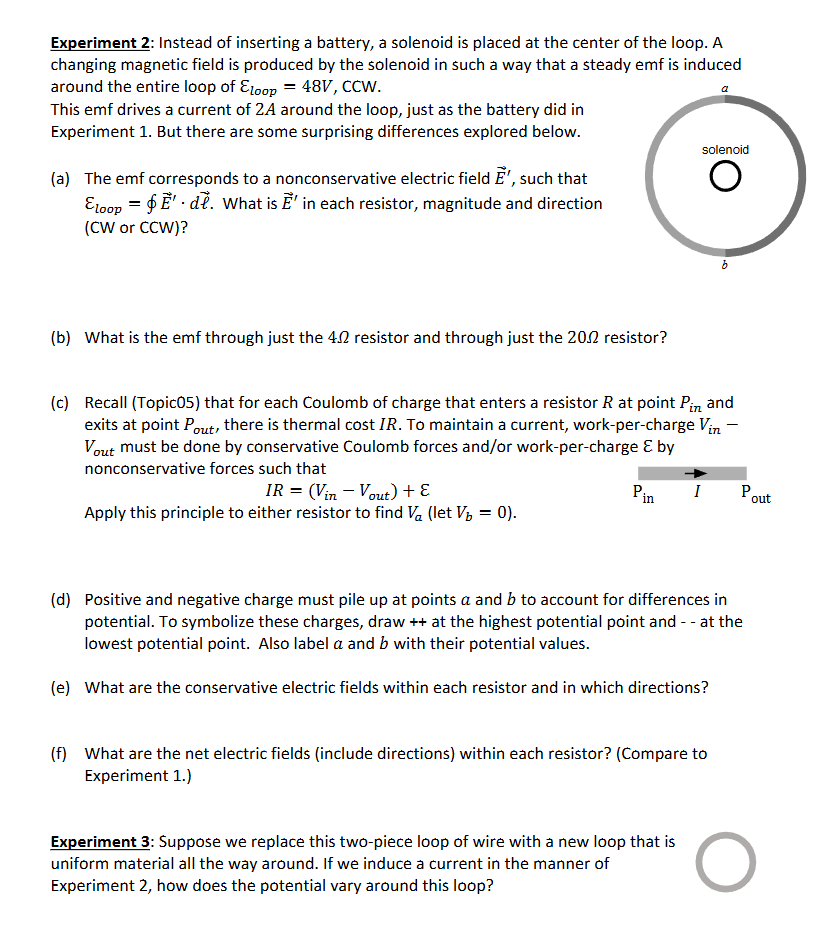
give answer in 2 step with explanation at the end of each step and final answer at the end:Experiment 2: Instead of inserting a battery, a solenoid is placed at the center of the loop. A
changing magnetic field is produced by the solenoid in such a way that a steady emf is induced
around the entire 100p of E00, = 487, CCW. 4
This emf drives a current of 24 around the loop, just as the battery did in
Experiment 1. But there are some surprising differences explored below.
solenoid
(a) The emf corresponds to a nonconservative electric field E, such that O
€100p = $ E+ dP. What is E' in each resistor, magnitude and direction
(cw or cow)?
0
(b) What is the emf through just the 42 resistor and through just the 2042 resistor?
(0) Recall (Topic05) that for each Coulomb of charge that enters a resistor R at point Py, and
exits at point Py, there is thermal cost IR. To maintain a current, work-per-charge Vi, —
Ve Must be done by conservative Coulomb forces and/or work-per-charge € by
nonconservative forces such that =
IR = (Vi — Vout) + € Py, I Py
Apply this principle to either resistor to find V; (let Vp = 0).
(d) Positive and negative charge must pile up at points a and b to account for differences in
potential. To symbolize these charges, draw ++ at the highest potential point and - - at the
lowest potential point. Also label a and b with their potential values.
(e) What are the conservative electric fields within each resistor and in which directions?
() What are the net electric fields (include directions) within each resistor? (Compare to
Experiment 1.)
Experiment 3: Suppose we replace this two-piece 100p of wire with a new loop that is
uniform material all the way around. If we induce a current in the manner of
Experiment 2, how does the potential vary around this loop?
Question:
give answer in 2 step with explanation at the end of each step and final answer at the end:Experiment 2: Instead of inserting a battery, a solenoid is placed at the center of the loop. A
changing magnetic field is produced by the solenoid in such a way that a steady emf is induced
around the entire 100p of E00, = 487, CCW. 4
This emf drives a current of 24 around the loop, just as the battery did in
Experiment 1. But there are some surprising differences explored below.
solenoid
(a) The emf corresponds to a nonconservative electric field E, such that O
€100p = $ E+ dP. What is E' in each resistor, magnitude and direction
(cw or cow)?
0
(b) What is the emf through just the 42 resistor and through just the 2042 resistor?
(0) Recall (Topic05) that for each Coulomb of charge that enters a resistor R at point Py, and
exits at point Py, there is thermal cost IR. To maintain a current, work-per-charge Vi, —
Ve Must be done by conservative Coulomb forces and/or work-per-charge € by
nonconservative forces such that =
IR = (Vi — Vout) + € Py, I Py
Apply this principle to either resistor to find V; (let Vp = 0).
(d) Positive and negative charge must pile up at points a and b to account for differences in
potential. To symbolize these charges, draw ++ at the highest potential point and - - at the
lowest potential point. Also label a and b with their potential values.
(e) What are the conservative electric fields within each resistor and in which directions?
() What are the net electric fields (include directions) within each resistor? (Compare to
Experiment 1.)
Experiment 3: Suppose we replace this two-piece 100p of wire with a new loop that is
uniform material all the way around. If we induce a current in the manner of
Experiment 2, how does the potential vary around this loop?
This is AI generated Response.
Asked by: Rahul
Created at: 2025-12-20 04:31:31
Final Answer:
RenderedRaw Text
Did you like this answer?
Let's answer part (a) step-by-step:
---
## (a) Step 1: **Relate emf to the nonconservative electric field in each resistor**
Given:
- The total emf around the loop: \(\mathcal{E}_{\text{loop}} = \oint \vec{E}' \cdot d\vec{l} = 48\,\text{V}\), counterclockwise (CCW).
- The loop has two resistors in series: \(4\,\Omega\) and \(20\,\Omega\).
- The steady current through the loop: \(I = 2\,\text{A}\).
**Explanation:**
The nonconservative electric field \(\vec{E}'\) is responsible for driving the current due to the changing magnetic flux (Faraday's Law). Since the resistors are in series, the same current flows through both.
---
### Step 2: **Find the magnitude and direction of \(\vec{E}'\) in each resistor**
**Total resistance:**
\(R_{\text{tot}} = 4\,\Omega + 20\,\Omega = 24\,\Omega\)
**Voltage (emf) drop across each resistor (Ohm's Law):**
- For \(4\,\Omega\) resistor: \(V_4 = IR = 2\,\text{A} \times 4\,\Omega = 8\,\text{V}\)
- For \(20\,\Omega\) resistor: \(V_{20} = 2\,\text{A} \times 20\,\Omega = 40\,\text{V}\)
**The emf (nonconservative work per unit charge) across each resistor is equal to the voltage drop:**
- Across \(4\,\Omega\): \(8\,\text{V}\)
- Across \(20\,\Omega\): \(40\,\text{V}\)
**Magnitude of \(\vec{E}'\):**
\(\vec{E}' = \frac{\text{emf across resistor}}{\text{length of resistor}}\)
But without lengths, just state the emf values.
**Direction:** Both fields point in the direction of current (CCW).
**Explanation:**
The nonconservative electric field \(\vec{E}'\) in each resistor is responsible for the voltage (emf) drop across it, and points in the direction of the current, which is CCW.
---
## **Final Answer (a):**
- **In the \(4\,\Omega\) resistor:** \(\vec{E}'\) produces an emf of \(8\,\text{V}\), directed CCW.
- **In the \(20\,\Omega\) resistor:** \(\vec{E}'\) produces an emf of \(40\,\text{V}\), directed CCW.
**The direction of \(\vec{E}'\) in both resistors is counterclockwise (CCW), matching the direction of the induced emf and current.**
Question:
All parts solved please
This is AI generated Response.
Asked by: Rahul
Created at: 2025-12-20 04:32:09
Final Answer:
RenderedRaw Text
Did you like this answer?
## Experiment 2 Solutions
### (a) Step 1: **Relate emf to the nonconservative electric field in each resistor**
Given:
- Total emf around the loop: \(\mathcal{E}_{\text{loop}} = 48\,\text{V}\) (CCW)
- Resistors in series: \(R_1 = 4\,\Omega\) and \(R_2 = 20\,\Omega\)
- Steady current through the loop: \(I = 2\,\text{A}\)
**Explanation:**
The nonconservative electric field \(\vec{E}'\) drives the current due to the changing magnetic flux (according to Faraday's Law). Since the resistors are in series, the same current flows through both.
---
### Step 2: **Find the magnitude and direction of \(\vec{E}'\) in each resistor**
**Total resistance:**
\[
R_{\text{tot}} = R_1 + R_2 = 4\,\Omega + 20\,\Omega = 24\,\Omega
\]
**Voltage (emf) drop across each resistor (using Ohm's Law):**
- For \(4\,\Omega\) resistor:
\[
V_1 = I \cdot R_1 = 2\,\text{A} \times 4\,\Omega = 8\,\text{V}
\]
- For \(20\,\Omega\) resistor:
\[
V_2 = I \cdot R_2 = 2\,\text{A} \times 20\,\Omega = 40\,\text{V}
\]
**Magnitude of \(\vec{E}'\):**
- Across \(4\,\Omega\): \(E'_1 = 8\,\text{V}\)
- Across \(20\,\Omega\): \(E'_2 = 40\,\text{V}\)
**Direction:**
Both fields point in the direction of current (CCW).
**Explanation:**
The nonconservative electric field \(\vec{E}'\) in each resistor is responsible for the voltage (emf) drop across it, directed CCW to match the current flow.
---
## **Final Answer (a):**
- **In the \(4\,\Omega\) resistor:** \(\vec{E}'\) produces an emf of \(8\,\text{V}\), directed CCW.
- **In the \(20\,\Omega\) resistor:** \(\vec{E}'\) produces an emf of \(40\,\text{V}\), directed CCW.
### (b) Potential across each resistor
**Using the principle of potential difference:**
\[
V_{\text{in}} - V_{\text{out}} = IR
\]
1. **For \(4\,\Omega\) resistor:**
- Let \(V_a = 0\) (point where charge enters).
- Then, \(V_b = V_a - 8\,\text{V} = -8\,\text{V}\).
2. **For \(20\,\Omega\) resistor:**
- Entering at point \(b\) where \(V_b = -8\,\text{V}\).
- Exiting at point \(c\):
\[
V_c = V_b - 40\,\text{V} = -8\,\text{V} - 40\,\text{V} = -48\,\text{V}
\]
**Explanation:**
The potential difference across each resistor corresponds to the voltage drops calculated previously, indicating how the electric potential changes as charge moves through the circuit.
---
## **Final Answer (b):**
- **Potential across \(4\,\Omega\) resistor:** \(V_a = 0\,\text{V}\) to \(V_b = -8\,\text{V}\)
- **Potential across \(20\,\Omega\) resistor:** \(V_b = -8\,\text{V}\) to \(V_c = -48\,\text{V}\)
### (c) Charge accumulation
- **At point \(a\):** Highest potential, marked with \(++\)
- **At point \(b\):** Lower potential, marked with \(--\)
**Explanation:**
Charge accumulation at points \(a\) and \(b\) indicates the potential difference where positive and negative charges build up.
---
## **Final Answer (c):**
- **Point \(a\)**: \(++\), potential \(0\,\text{V}\)
- **Point \(b\)**: \(--\), potential \(-8\,\text{V}\)
### (d) Conservative electric fields
**Within each resistor, the conservative electric field \(\vec{E}_c\) is zero.**
- **Direction:** Not applicable, as \(\vec{E}_c = 0\).
---
## **Final Answer (d):**
- **Conservative electric fields:** \(\vec{E}_c = 0\) in both resistors.
### (e) Net electric fields
**Net electric fields within each resistor:**
- Both resistors have a net electric field caused only by the nonconservative field \(\vec{E}'\), directed CCW.
**Comparison to Experiment 1:**
In Experiment 1, the electric field was conservative from the battery, whereas here it is nonconservative due to the solenoid.
---
## **Final Answer (e):**
- **Net electric fields:** Directed CCW in both resistors.
### Experiment 3
If we replace the two-piece wire with a uniform loop, the potential would vary continuously around the loop. The nonconservative electric field would cause a continuous drop in potential that corresponds to the induced current.
**Explanation:**
In a uniform material loop, the induced emf will still create a changing electric field leading to a consistent potential drop around the entire loop.
---
## **Final Answer (Experiment 3):**
- **Potential varies continuously around the loop due to the nonconservative electric field from the induced current.**
VIPSolutions focuses on clear, step‑by‑step explanations so you can learn quickly. Whether you need an AI‑generated walkthrough or a short hint to get unstuck, each solution is organized for fast reading and easy review later.
Search similar questions, compare approaches, and bookmark the best answers for revision. Our goal is simple: quick, reliable study help that feels natural—not noisy.
 VIPSolutions
 Experiment 2: Instead of inserting a battery, a solenoid is placed at the center of the loop. A
changing magnetic field is produced by the solenoid in such a way that a steady emf is induced
around the entire 100p of E00, = 487, CCW. 4
This emf drives a current of 24 around the loop, just as the battery did in
Experiment 1. But there are some surprising differences explored below.
solenoid
(a) The emf corresponds to a nonconservative electric field E, such that O
€100p = $ E+ dP. What is E' in each resistor, magnitude and direction
(cw or cow)?
0
(b) What is the emf through just the 42 resistor and through just the 2042 resistor?
(0) Recall (Topic05) that for each Coulomb of charge that enters a resistor R at point Py, and
exits at point Py, there is thermal cost IR. To maintain a current, work-per-charge Vi, —
Ve Must be done by conservative Coulomb forces and/or work-per-charge € by
nonconservative forces such that =
IR = (Vi — Vout) + € Py, I Py
Apply this principle to either resistor to find V; (let Vp = 0).
(d) Positive and negative charge must pile up at points a and b to account for differences in
potential. To symbolize these charges, draw ++ at the highest potential point and - - at the
lowest potential point. Also label a and b with their potential values.
(e) What are the conservative electric fields within each resistor and in which directions?
() What are the net electric fields (include directions) within each resistor? (Compare to
Experiment 1.)
Experiment 3: Suppose we replace this two-piece 100p of wire with a new loop that is
uniform material all the way around. If we induce a current in the manner of
Experiment 2, how does the potential vary around this loop?