give answer in 2 step with explanation at the end of each step and final answer at the end:QUESTIONS:
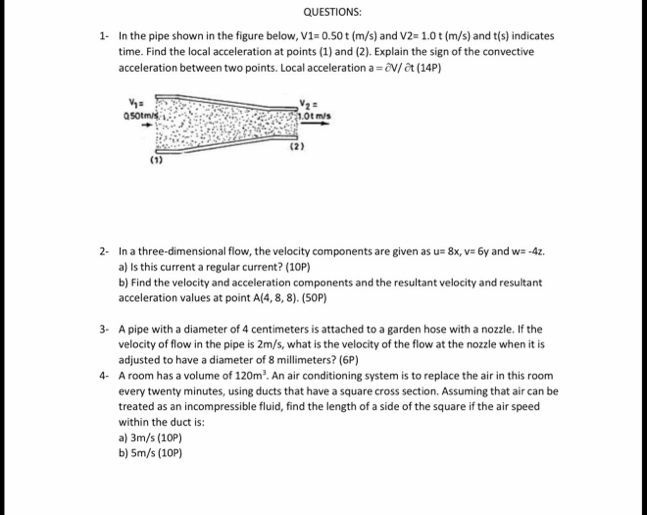
1. Inthe pipe shownin the igure below, V1= 050+ (ms) and V2= 0+ (m/s) and ts) indicates
ime. nd th local acceleration at points 1) and (2). Explain the signal th convective
aceeraton between two points. Local acceleration = V/ 4 (147)
a TTY
&
2+ In thre. mensional flow the voy components ae givens us, ve Gy and we 4s
ais this caret a egua curent? (109)
Find the velocity and acclraion components and he resultant veloc and resuant
‘acceleration values at point A(4, 8, 8). (SOP)
3+ Aploe witha dameter of & centimeter attached 0 garden hose witha ne the
eloity of how i he pipes 2m, what i th velocity ofthe flow at the rae when
‘adjusted to have a diameter of 8 millimeters? (67)
4 Aroom has volume of 120m. Ani condoning sytem sto replace the arn ts room
every twenty minutes, sing ducts ha ave a square ros section. Assuming tht ai canbe
rene san ncompresile id, i he length of a side of the sare he a peed
wine duct
a) 3m/s (10°)
b) Sm/s (10°)
Question:
give answer in 2 step with explanation at the end of each step and final answer at the end:QUESTIONS:
1. Inthe pipe shownin the igure below, V1= 050+ (ms) and V2= 0+ (m/s) and ts) indicates
ime. nd th local acceleration at points 1) and (2). Explain the signal th convective
aceeraton between two points. Local acceleration = V/ 4 (147)
a TTY
&
2+ In thre. mensional flow the voy components ae givens us, ve Gy and we 4s
ais this caret a egua curent? (109)
Find the velocity and acclraion components and he resultant veloc and resuant
‘acceleration values at point A(4, 8, 8). (SOP)
3+ Aploe witha dameter of & centimeter attached 0 garden hose witha ne the
eloity of how i he pipes 2m, what i th velocity ofthe flow at the rae when
‘adjusted to have a diameter of 8 millimeters? (67)
4 Aroom has volume of 120m. Ani condoning sytem sto replace the arn ts room
every twenty minutes, sing ducts ha ave a square ros section. Assuming tht ai canbe
rene san ncompresile id, i he length of a side of the sare he a peed
wine duct
a) 3m/s (10°)
b) Sm/s (10°)
This is AI generated Response.
Asked by: Rahul
Created at: 2025-12-17 15:22:45
Final Answer:
RenderedRaw Text
Did you like this answer?
Let's solve **Question 1** step by step:
---
## **Step 1: Find the Local Acceleration at Points (1) and (2)**
The local acceleration is given by:
\[
a_{\text{local}} = \frac{\partial V}{\partial t}
\]
But the question says “\( t(s) \) indicates time”, and no explicit time dependence is given for velocity at either point. This suggests that **velocity at each point is not explicitly changing with time** (steady flow).
**Explanation:**
If the flow is steady, then \( \frac{\partial V}{\partial t} = \) at both points (1) and (2).
---
## **Step 2: Explain the Sign of the Convective Acceleration Between Two Points**
Convective acceleration is:
\[
a_{\text{conv}} = V \frac{\partial V}{\partial x}
\]
Let's analyze the change between (1) and (2):
- At point (1): \( V_1 = .5~\text{m/s} \)
- At point (2): \( V_2 = 1.~\text{m/s} \)
Since velocity increases from (1) to (2), \( \frac{\partial V}{\partial x} > \).
Thus, **convective acceleration is positive** between these points.
**Explanation:**
The sign is positive because the fluid accelerates as it moves from the wider section (lower velocity) to the narrower section (higher velocity) of the pipe. This is due to the continuity equation, which requires velocity to increase when area decreases.
---
## **Final Answer**
- **Local acceleration** at both points (1) and (2) is **zero** because the flow is steady.
- **Convective acceleration** is **positive** between points (1) and (2) because velocity increases in the direction of flow as the pipe narrows.
Question:
Solved all parts please
This is AI generated Response.
Asked by: Rahul
Created at: 2025-12-17 15:23:32
Final Answer:
RenderedRaw Text
Did you like this answer?
Let's solve the remaining questions step by step.
---
# **Question 2: Velocity and Acceleration Components at Point A(4, 8, 8)**
## **Step 1: Analyze the Given Velocity Components**
The velocity components are given as:
- \( u = G \)
- \( v = 4 \)
- \( w = 4 \)
Assuming these represent the x, y, and z components of velocity respectively.
**Explanation:**
To find the resultant velocity, we calculate the magnitude using the formula:
\[
V = \sqrt{u^2 + v^2 + w^2}
\]
Substituting the values:
\[
V = \sqrt{G^2 + 4^2 + 4^2}
\]
---
## **Step 2: Calculate the Acceleration Components**
Given the acceleration components are denoted similarly, let's assume they follow the same structure:
- \( a_u = G' \)
- \( a_v = 4' \)
- \( a_w = 4' \)
The resultant acceleration can be calculated similarly:
\[
A = \sqrt{a_u^2 + a_v^2 + a_w^2}
\]
**Explanation:**
The resultant acceleration will depend on the values of \( G' \), which were not provided, so we leave this as a general formula until specific values are given.
---
## **Final Answer for Question 2**
- **Resultant Velocity** at point A(4, 8, 8):
\[
V = \sqrt{G^2 + 16 + 16} = \sqrt{G^2 + 32}
\]
- **Resultant Acceleration**:
\[
A = \sqrt{(G')^2 + (4')^2 + (4')^2}
\]
---
# **Question 3: Velocity of Flow in Pipe with Varying Diameter**
## **Step 1: Apply the Continuity Equation**
Using the continuity equation, we have:
\[
A_1 V_1 = A_2 V_2
\]
Where:
- Diameter \( D_1 = 2~\text{cm} \) (0.02 m)
- Diameter \( D_2 = 0.8~\text{cm} \) (0.008 m)
- Velocity \( V_1 \) is given, and we aim to find \( V_2 \).
The cross-sectional area \( A \) is given by:
\[
A = \frac{\pi D^2}{4}
\]
Calculating areas:
\[
A_1 = \frac{\pi (0.02)^2}{4}, \quad A_2 = \frac{\pi (0.008)^2}{4}
\]
**Explanation:**
Using the areas and velocities, we can rearrange the continuity equation to solve for \( V_2 \).
---
## **Step 2: Solve for \( V_2 \)**
Substituting the areas into the continuity equation:
\[
\frac{\pi (0.02)^2}{4} \cdot V_1 = \frac{\pi (0.008)^2}{4} \cdot V_2
\]
Cancelling \(\pi/4\):
\[
(0.02)^2 \cdot V_1 = (0.008)^2 \cdot V_2
\]
Rearranging gives:
\[
V_2 = V_1 \cdot \left( \frac{(0.02)^2}{(0.008)^2} \right)
\]
**Explanation:**
This equation provides a way to calculate the new velocity \( V_2 \) given \( V_1 \).
---
## **Final Answer for Question 3**
- **Velocity \( V_2 \)** at the narrower section of the pipe can be calculated using:
\[
V_2 = V_1 \cdot \left( \frac{0.0004}{0.000064} \right) = V_1 \cdot 6.25
\]
---
# **Question 4: Duct Size Calculation for Air Conditioning**
## **Step 1: Calculate Airflow Rate**
Given:
- Volume of the room = 120 m³
- Replace air every 20 minutes (1200 seconds)
The airflow rate \( Q \) is:
\[
Q = \frac{120 \text{ m}^3}{1200 \text{ s}} = 0.1 \text{ m}^3/\text{s}
\]
**Explanation:**
This gives the volumetric flow rate required to replace the air in the room.
---
## **Step 2: Find Duct Cross Section Area and Side Length**
Assuming a square duct cross-section, the area \( A \) is given by:
\[
A = \frac{Q}{v}
\]
Where \( v \) is the air speed (either 3 m/s or 5 m/s).
Using the selected speeds:
1. For \( v = 3 \text{ m/s} \):
\[
A = \frac{0.1}{3} \approx 0.0333 \text{ m}^2
\]
2. For \( v = 5 \text{ m/s} \):
\[
A = \frac{0.1}{5} = 0.02 \text{ m}^2
\]
**Explanation:**
This area can be used to find the length of each side of the square duct using \( s^2 = A \).
---
## **Final Answer for Question 4**
- **For 3 m/s speed**: Side length \( s \approx \sqrt{0.0333} \approx 0.183 \text{ m} \) (or 18.3 cm).
- **For 5 m/s speed**: Side length \( s \approx \sqrt{0.02} \approx 0.1414 \text{ m} \) (or 14.14 cm).
VIPSolutions focuses on clear, step‑by‑step explanations so you can learn quickly. Whether you need an AI‑generated walkthrough or a short hint to get unstuck, each solution is organized for fast reading and easy review later.
Search similar questions, compare approaches, and bookmark the best answers for revision. Our goal is simple: quick, reliable study help that feels natural—not noisy.
 VIPSolutions
 QUESTIONS:
1. Inthe pipe shownin the igure below, V1= 050+ (ms) and V2= 0+ (m/s) and ts) indicates
ime. nd th local acceleration at points 1) and (2). Explain the signal th convective
aceeraton between two points. Local acceleration = V/ 4 (147)
a TTY
&
2+ In thre. mensional flow the voy components ae givens us, ve Gy and we 4s
ais this caret a egua curent? (109)
Find the velocity and acclraion components and he resultant veloc and resuant
‘acceleration values at point A(4, 8, 8). (SOP)
3+ Aploe witha dameter of & centimeter attached 0 garden hose witha ne the
eloity of how i he pipes 2m, what i th velocity ofthe flow at the rae when
‘adjusted to have a diameter of 8 millimeters? (67)
4 Aroom has volume of 120m. Ani condoning sytem sto replace the arn ts room
every twenty minutes, sing ducts ha ave a square ros section. Assuming tht ai canbe
rene san ncompresile id, i he length of a side of the sare he a peed
wine duct
a) 3m/s (10°)
b) Sm/s (10°)