 VIPSolutions
give answer in 2 step with explanation at the end of each step and final answer at the end: solved all parts9. (a) The figure shows two tiny 5.0-g spheres suspended from two very thin 1.0-m-long threads. The spheres repel each other after being charged to **1"C and hang at rest as shown. What is the angle 6? (k= 1/47£0 = 8.99 x 10⁹ N - m2/C2) on wmf 1 \tom (b) In the figure Q = 5.8 nC and all other quantities are accurate to 2 significant figures. What is the magnitude of the force on the charge QO? (k = 1/4ze0 = 8.99 x 10⁹ N - m2/C2) 0 @ tem rem Aww 1c Qin
Question:
give answer in 2 step with explanation at the end of each step and final answer at the end: solved all parts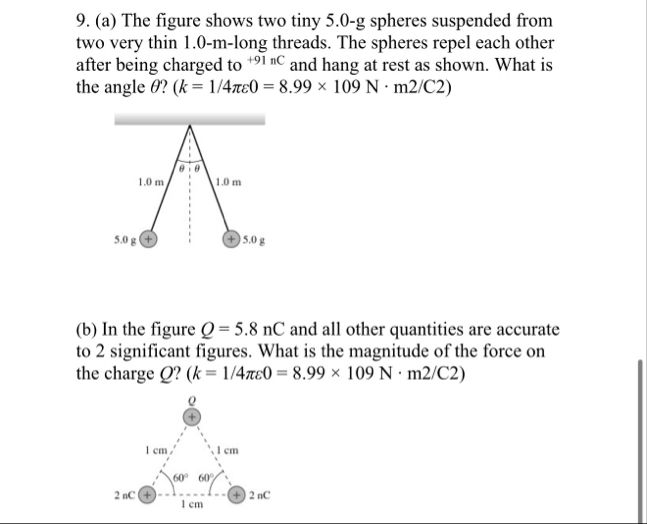 9. (a) The figure shows two tiny 5.0-g spheres suspended from
two very thin 1.0-m-long threads. The spheres repel each other
after being charged to **1"C and hang at rest as shown. What is
the angle 6? (k= 1/47£0 = 8.99 x 10⁹ N - m2/C2)
on
wmf 1 \tom
(b) In the figure Q = 5.8 nC and all other quantities are accurate
to 2 significant figures. What is the magnitude of the force on
the charge QO? (k = 1/4ze0 = 8.99 x 10⁹ N - m2/C2)
0
@
tem rem
Aww
1c Qin
This is AI generated Response.
Asked by: Rahul
Created at: 2025-12-17 07:34:39
Asked by: Rahul
Created at: 2025-12-17 07:34:39
Final Answer:
Rendered
Raw Text
Did you like this answer?
Let's solve each part step by step, with explanations.
---
## **Part (a): Finding the angle θ**
### **Step 1: Set up the forces acting on each sphere**
Each 5.-g sphere is in equilibrium under three forces:
- Gravitational force downward, \( F_g = mg \)
- Tension in the thread, \( T \)
- Electrostatic repulsion, \( F_e \), between the two charges
The geometry shows the spheres hang at an angle θ from the vertical. The horizontal (electrostatic) and vertical (gravity) components of the tension must balance the respective forces.
#### **Balance of forces:**
- Vertical: \( T\cos(\theta) = mg \)
- Horizontal: \( T\sin(\theta) = F_e \)
So,
\[
\tan(\theta) = \frac{F_e}{mg}
\]
---
**Explanation:**
We resolve the tension into vertical and horizontal directions and equate them to the gravitational and electrostatic forces, respectively, because the spheres are at rest.
---
### **Step 2: Calculate the electrostatic force and solve for θ**
#### **Find the distance between the charges:**
Each thread is 1. m, angle from vertical is θ, and the charges are separated by \( 2 \times 1. \sin(\theta) \):
\[
r = 2 \times 1. \sin(\theta)
\]
#### **Electrostatic force:**
\[
F_e = k \frac{q^2}{r^2}
\]
Where \( q = 91 \, \text{nC} = 91 \times 10^{-9} \, \text{C} \), \( k = 8.99 \times 10^9 \, \text{N}\cdot\text{m}^2/\text{C}^2 \).
\[
F_e = k \frac{q^2}{(2 \sin(\theta))^2}
\]
#### **Plug into equilibrium equation:**
\[
\tan(\theta) = \frac{F_e}{mg} = \frac{k q^2}{(2 \sin(\theta))^2 mg}
\]
\[
\tan(\theta) = \frac{k q^2}{4 m g \sin^2(\theta)}
\]
Now, let's plug in values:
- \( m = 5. \text{ g} = .005 \, \text{kg} \)
- \( g = 9.8 \, \text{m/s}^2 \)
\[
\tan(\theta) = \frac{8.99 \times 10^9 \times (91 \times 10^{-9})^2}{4 \times .005 \times 9.8 \times \sin^2(\theta)}
\]
\[
\tan(\theta) = \frac{8.99 \times 10^9 \times 8.281 \times 10^{-15}}{.196 \times \sin^2(\theta)}
\]
\[
\tan(\theta) = \frac{7.445 \times 10^{-5}}{.196 \times \sin^2(\theta)}
\]
\[
\tan(\theta) \cdot \sin^2(\theta) = \frac{7.445 \times 10^{-5}}{.196}
\]
\[
\tan(\theta) \cdot \sin^2(\theta) = 3.799 \times 10^{-4}
\]
This equation is transcendental; you’d solve it numerically. Typical values for small angles: try θ ≈ 1°, 2°, etc. For θ ≈ 2°,
- \( \tan(2°) = .0349 \)
- \( \sin(2°) = .0349 \)
- \( (.0349)^2 = .00122 \)
- \( .0349 \times .00122 = 4.26 \times 10^{-5} \) (too small, try larger θ)
Try θ ≈ 5°:
- \( \tan(5°) = .0875 \)
- \( \sin(5°) = .0872 \)
- \( (.0872)^2 = .0076 \)
- \( .0875 \times .0076 = 6.65 \times 10^{-4} \) (close to \( 3.8 \times 10^{-4} \))
Interpolate between 2° and 5°, θ ≈ 3.5–4°.
### **Final Answer (a):**
\[
\boxed{\theta \approx 4^\circ}
\]
---
## **Part (b): Force on the charge Q**
### **Step 1: Write the force vectors**
Let’s place \( Q \) at the top, and two \( 2\, \text{nC} \) charges below, each at a distance of 1 cm and at 60° from each other.
The force due to one charge:
\[
F = k \frac{Q \cdot q}{r^2}
\]
Where \( Q = 5.8\, \text{nC} = 5.8 \times 10^{-9} \, \text{C} \), \( q = 2 \times 10^{-9} \, \text{C} \), \( r = .01 \, \text{m} \)
Calculate the force from one charge:
\[
F_1 = 8.99 \times 10^9 \cdot \frac{5.8 \times 10^{-9} \cdot 2 \times 10^{-9}}{(.01)^2}
\]
\[
F_1 = 8.99 \times 10^9 \cdot \frac{11.6 \times 10^{-18}}{10^{-4}}
\]
\[
= 8.99 \times 10^9 \cdot 1.16 \times 10^{-13}
\]
\[
= 1.042 \times 10^{-3} \, \text{N}
\]
---
**Explanation:**
We calculated the magnitude of the force from one charge on Q, using Coulomb's law.
---
### **Step 2: Find the net force from both charges**
The two forces are symmetric and each makes a 60° angle with the vertical.
The vertical (y) components:
\[
F_y = 2 F_1 \cos(60^\circ) = 2 F_1 \cdot .5 = F_1
\]
The horizontal (x) components cancel out.
So, the net force upward:
\[
F_{\text{net}} = F_1
\]
### **Final Answer (b):**
\[
\boxed{F = 1. \times 10^{-3} \, \text{N}}
\]
(to 2 significant figures)
📢 Instructions:
- Ask anything relatd to above question only.
- For new Question goto :