 VIPSolutions
give answer in 2 step with explanation at the end of each step and final answer at the end:Using the reactions in the Reaction Bank below, devise a synthetic route (by selecting the right reactions and putting them in the right order) to convert the starting material into the product. You do not have to use all the reactions in the Reaction bank. a — SS UO 3 LI i Reaction Bank: i | Reaction A: H LL we Ae | Reaction B: DCCD, HCI H { Reaction C: CFICOH H
Question:
give answer in 2 step with explanation at the end of each step and final answer at the end: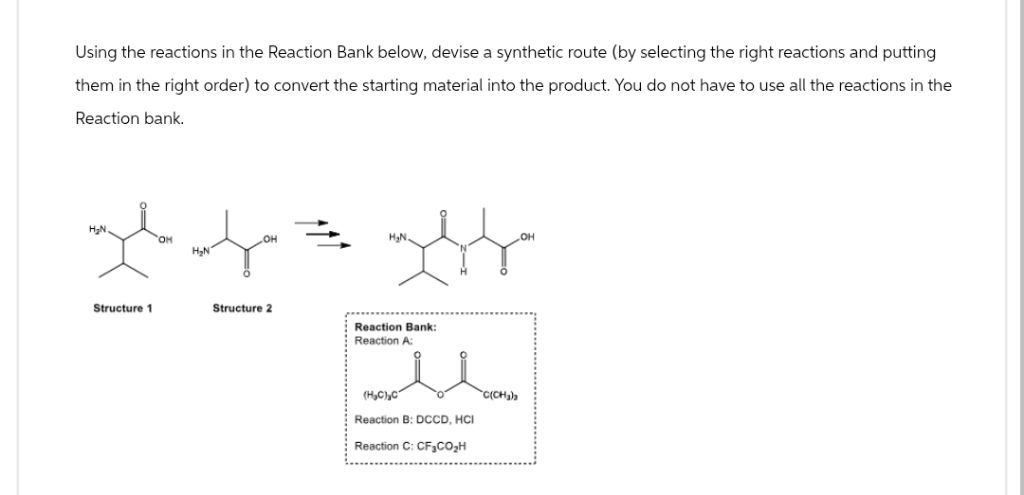 Using the reactions in the Reaction Bank below, devise a synthetic route (by selecting the right reactions and putting
them in the right order) to convert the starting material into the product. You do not have to use all the reactions in the
Reaction bank.
a
—
SS UO
3 LI
i Reaction Bank: i
| Reaction A: H
LL
we Ae
| Reaction B: DCCD, HCI H
{ Reaction C: CFICOH H
This is AI generated Response.
Asked by: Rahul
Created at: 2025-12-17 03:04:52
Asked by: Rahul
Created at: 2025-12-17 03:04:52
Final Answer:
Rendered
Raw Text
Did you like this answer?
## Step 1: Identify the Transformation Needed
**Explanation:**
- Structure 1 an amino acid (alanine).
- Structure2 is a ketone (acetone).
- The product is an amide formed by joining alanine and acetone (specifically, the acetone's carbonyl is now an amide).
- We need to form an amide bond between the amine group of alanine and the carbonyl of acetone.
---
## Step 2: Choose the Correct Reactions and Order
**Explanation:**
Looking at the Reaction Bank:
- **Reaction B (DCCD, HCl):** This is a coupling reagent often used to form amides from carboxylic acids and amines.
- **Reaction A:** This shows the formation of an imine (Schiff base) between a primary amine and a ketone.
- **Reaction C (CF₃CO₂H):** This is a strong acid, often used for hydrolysis or deprotection.
**Correct Sequence:**
1. **Reaction A:** React the amine from alanine with acetone to form an imine.
- **Explanation:** The amine group in alanine reacts with the ketone group in acetone to form an imine (Schiff base).
2. **Reaction C:** Hydrolyze the imine using trifluoroacetic acid (CF₃CO₂H) to form the amide.
- **Explanation:** Acidic hydrolysis of the imine leads to amide formation.
---
## **Final Answer**
**Step 1:** React Structure 1 (alanine) with acetone using **Reaction A** to form the imine intermediate.
**Step 2:** Treat the imine intermediate with **Reaction C (CF₃CO₂H)** to hydrolyze and form the final amide product.
**Summary:**
**The correct synthetic route is:**
**Reaction A → Reaction C**
📢 Instructions:
- Ask anything relatd to above question only.
- For new Question goto :