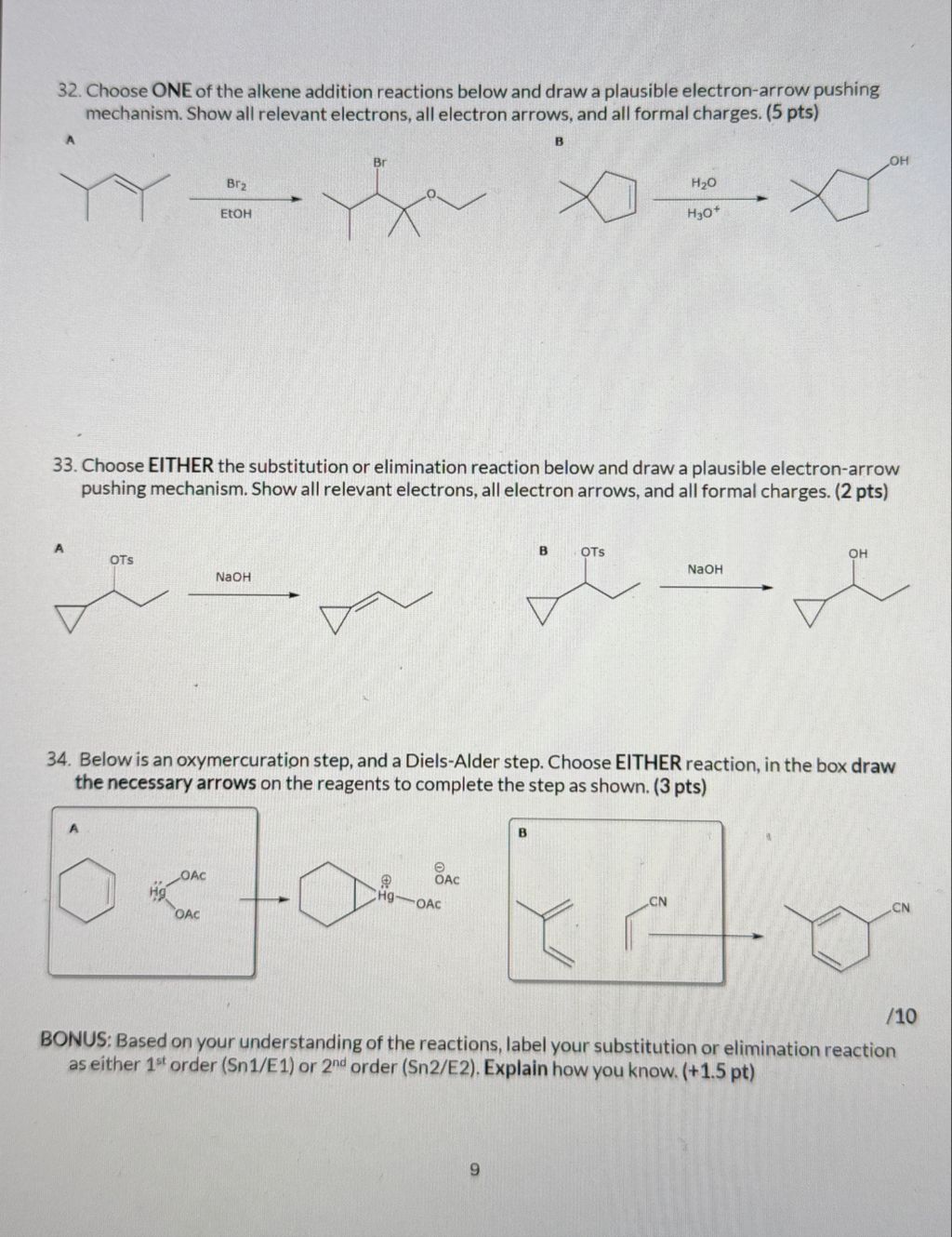
give answer in 2 step with explanation at the end of each step and final answer at the end:32. Choose ONE of the alkene addition reactions below and draw a plausible electron-arrow pushing
mechanism. Show all relevant electrons, all electron arrows, and all formal charges. (5 pts)
A L
Br H
Oh
33. Choose EITHER the substitution or elimination reaction below and draw a plausible electron-arrow
pushing mechanism. Show all relevant electrons, all electron arrows, and all formal charges. (2 pts)
A ors B OTs ill OH
NaOH
ng FE wiiliel
34. Below is an oxymercuration step, and a Diels-Alder step. Choose EITHER reaction, in the box draw
the necessary arrows on the reagents to complete the step as shown. (3 pts)
A 8 \
p OAc ] Onc
| Hg, Hg:
IN ~oaAc (i CN
ll |
10
BONUS: Based on your understanding of the reactions, label your substitution or elimination reaction
as either 1% order (Sn1/E1) or 2° order (Sn2/E2). Explain how you know. (+15 pt)
9
Question:
give answer in 2 step with explanation at the end of each step and final answer at the end:32. Choose ONE of the alkene addition reactions below and draw a plausible electron-arrow pushing
mechanism. Show all relevant electrons, all electron arrows, and all formal charges. (5 pts)
A L
Br H
Oh
33. Choose EITHER the substitution or elimination reaction below and draw a plausible electron-arrow
pushing mechanism. Show all relevant electrons, all electron arrows, and all formal charges. (2 pts)
A ors B OTs ill OH
NaOH
ng FE wiiliel
34. Below is an oxymercuration step, and a Diels-Alder step. Choose EITHER reaction, in the box draw
the necessary arrows on the reagents to complete the step as shown. (3 pts)
A 8 \
p OAc ] Onc
| Hg, Hg:
IN ~oaAc (i CN
ll |
10
BONUS: Based on your understanding of the reactions, label your substitution or elimination reaction
as either 1% order (Sn1/E1) or 2° order (Sn2/E2). Explain how you know. (+15 pt)
9
This is AI generated Response.
Asked by: Rahul
Created at: 2025-12-16 03:04:09
Final Answer:
RenderedRaw Text
Did you like this answer?
Let's choose and answer **Question 32, Reaction A** (alkene addition with Br₂/EtOH):
---
## Step 1: **Bromonium Ion Formation**
- **Mechanism:**
The alkene reacts with Br₂. The π electrons from the double bond attack one Br atom, while the Br-Br bond breaks, a bromonium (a threeed ring with Br as the bridge) and a Br⁻ ion.
-Arrow Pushing:**
- Curved arrow from the double bond to one Br atom.
- Curved arrow from Br-Br bond to the other Br atom (now Br⁻).
**Explanation:**
The alkene acts as a nucleophile and attacks Br₂, which acts as an electrophile. This forms a cyclic bromonium ion intermediate and a bromide ion.
---
## Step 2: **Nucleophilic Attack by EtO⁻**
- **Mechanism:**
The ethoxide ion (EtO⁻, from EtOH) attacks the more substituted carbon of the bromonium ion, opening the ring. The Br is left attached to the other carbon.
- **Arrow Pushing:**
- Curved arrow from the lone pair on EtO⁻ to the more substituted carbon (anti-addition).
- The Br leaves as a leaving group from that carbon (the bond to Br breaks heterolytically).
**Explanation:**
The nucleophile (EtO⁻) attacks the more substituted carbon due to its partial positive charge (Markovnikov-like addition), opening the bromonium ring and leading to anti stereochemistry.
---
## Final Answer:
- **Product:**
The product is the anti-addition of Br and OEt across the double bond. Br is on one carbon, and OEt is on the more substituted carbon.
**Summary:**
1. Formation of bromonium ion by attack of alkene on Br₂.
2. Ring opening by nucleophilic attack of EtO⁻, leading to anti-addition product.
---
**If you'd like the stepwise electron-pushing diagrams for the other questions, let me know!**
Question:
All parts solved please
This is AI generated Response.
Asked by: Rahul
Created at: 2025-12-16 03:04:47
Final Answer:
RenderedRaw Text
Did you like this answer?
Sure! Let's go through each of the three questions step by step with explanations.
---
## Question 32: Alkene Addition Mechanism
### Step 1: **Bromonium Ion Formation**
- **Mechanism:**
The alkene reacts with Br₂. The π electrons from the double bond attack one Br atom, while the Br-Br bond breaks, forming a bromonium ion and a Br⁻ ion.
- **Arrow Pushing:**
- **Curved arrow:** from the double bond to one Br atom.
- **Curved arrow:** from the Br-Br bond to the other Br atom (resulting in Br⁻).
**Explanation:**
The alkene acts as a nucleophile and attacks Br₂, creating a cyclic bromonium ion and a bromide ion as a leaving group. This step is crucial for the subsequent nucleophilic attack.
---
### Step 2: **Nucleophilic Attack by EtO⁻**
- **Mechanism:**
The ethoxide ion (EtO⁻) attacks the more substituted carbon of the bromonium ion, resulting in the opening of the ring. The Br remains attached to the other carbon.
- **Arrow Pushing:**
- **Curved arrow:** from the lone pair on EtO⁻ to the more substituted carbon (indicating nucleophilic attack).
- **Curved arrow:** breaking the bond between the carbon and Br, allowing Br to leave as a leaving group.
**Explanation:**
The nucleophile (EtO⁻) selectively attacks the more substituted carbon due to its partial positive charge formed in the bromonium ion. This leads to an anti-addition product, which is significant in stereochemistry.
---
## Final Answer for Question 32:
- **Product:**
The resulting product is the anti-addition of Br and OEt across the double bond, with Br on one carbon and OEt on the more substituted carbon.
---
## Question 33: Substitution or Elimination Reaction
### Step 1: **Nucleophilic Attack by NaOH**
- **Mechanism:**
The hydroxide ion (OH⁻) acts as a nucleophile and attacks the carbon attached to the leaving group (OTs) in a substitution reaction.
- **Arrow Pushing:**
- **Curved arrow:** from the lone pair of OH⁻ to the carbon attached to OTs.
- **Curved arrow:** from the bond between carbon and OTs to indicate the leaving group (OTs) departing.
**Explanation:**
NaOH provides a strong nucleophile (OH⁻), which replaces the leaving group (OTs) through an \( S_N2 \) mechanism. The concerted nature of this mechanism results in inversion of configuration at the carbon center.
---
### Step 2: **Formation of Alcohol**
- **Mechanism:**
After the nucleophilic attack, the leaving group is expelled, resulting in the formation of an alcohol.
- **Arrow Pushing:**
- No additional arrow pushing required; the product is formed after the bond to OTs breaks.
**Explanation:**
The substitution reaction concludes with the formation of the alcohol as the final product, confirming that a nucleophilic substitution has successfully occurred.
---
## Final Answer for Question 33:
- **Product:**
The product is an alcohol formed by the substitution of the OTs group with OH⁻.
---
## Question 34: Oxymercuration Step
### Step 1: **Nucleophilic Attack by Water (H₂O)**
- **Mechanism:**
In the oxymercuration reaction, water acts as a nucleophile and attacks the electrophilic carbon of the mercurinium ion generated in the previous step.
- **Arrow Pushing:**
- **Curved arrow:** from the lone pair of H₂O to the more substituted carbon of the mercurinium ion.
- **Curved arrow:** from the bond between carbon and Hg to indicate the formation of a new bond with H₂O.
**Explanation:**
Water acts as a nucleophile and attacks the positively charged carbon, resulting in the opening of the mercurinium ion and forming an alcohol.
---
### Step 2: **Deprotonation to Form the Final Product**
- **Mechanism:**
The newly formed oxonium ion (alcohol) is then deprotonated, typically by another water molecule or base.
- **Arrow Pushing:**
- **Curved arrow:** from the lone pair on water or base to the hydrogen on the oxonium ion, resulting in the formation of the neutral alcohol.
**Explanation:**
The final deprotonation step yields the neutral alcohol product, completing the oxymercuration process.
---
## Final Answer for Question 34:
- **Product:**
The product is an alcohol formed after the nucleophilic attack of water on the mercurinium ion and subsequent deprotonation.
---
## BONUS: Identifying the Reaction Order
### **Reaction Order Identification**
- **Mechanism Type:**
The substitution reaction (from Question 33) is classified as \( S_N2 \).
- **Explanation:**
The \( S_N2 \) mechanism is characterized by a single concerted step where the nucleophile attacks the substrate as the leaving group departs. This results in a bimolecular reaction, identifiable by the rate depending on both the substrate and nucleophile concentrations, thus confirming it as second-order.
---
**Overall Summary:**
1. **Question 32:** Alkene addition leads to anti-addition of Br and OEt.
2. **Question 33:** Nucleophilic substitution results in alcohol formation via \( S_N2 \).
3. **Question 34:** Oxymercuration yields an alcohol through nucleophilic attack and deprotonation.
4. **Bonus:** The substitution reaction is \( S_N2 \) (second-order) due to its mechanism.
If you have further questions or need additional details, feel free to ask!
VIPSolutions focuses on clear, step‑by‑step explanations so you can learn quickly. Whether you need an AI‑generated walkthrough or a short hint to get unstuck, each solution is organized for fast reading and easy review later.
Search similar questions, compare approaches, and bookmark the best answers for revision. Our goal is simple: quick, reliable study help that feels natural—not noisy.
 VIPSolutions
 32. Choose ONE of the alkene addition reactions below and draw a plausible electron-arrow pushing
mechanism. Show all relevant electrons, all electron arrows, and all formal charges. (5 pts)
A L
Br H
Oh
33. Choose EITHER the substitution or elimination reaction below and draw a plausible electron-arrow
pushing mechanism. Show all relevant electrons, all electron arrows, and all formal charges. (2 pts)
A ors B OTs ill OH
NaOH
ng FE wiiliel
34. Below is an oxymercuration step, and a Diels-Alder step. Choose EITHER reaction, in the box draw
the necessary arrows on the reagents to complete the step as shown. (3 pts)
A 8 \
p OAc ] Onc
| Hg, Hg:
IN ~oaAc (i CN
ll |
10
BONUS: Based on your understanding of the reactions, label your substitution or elimination reaction
as either 1% order (Sn1/E1) or 2° order (Sn2/E2). Explain how you know. (+15 pt)
9