VIPSolutions logo ✨ VIPSolutions

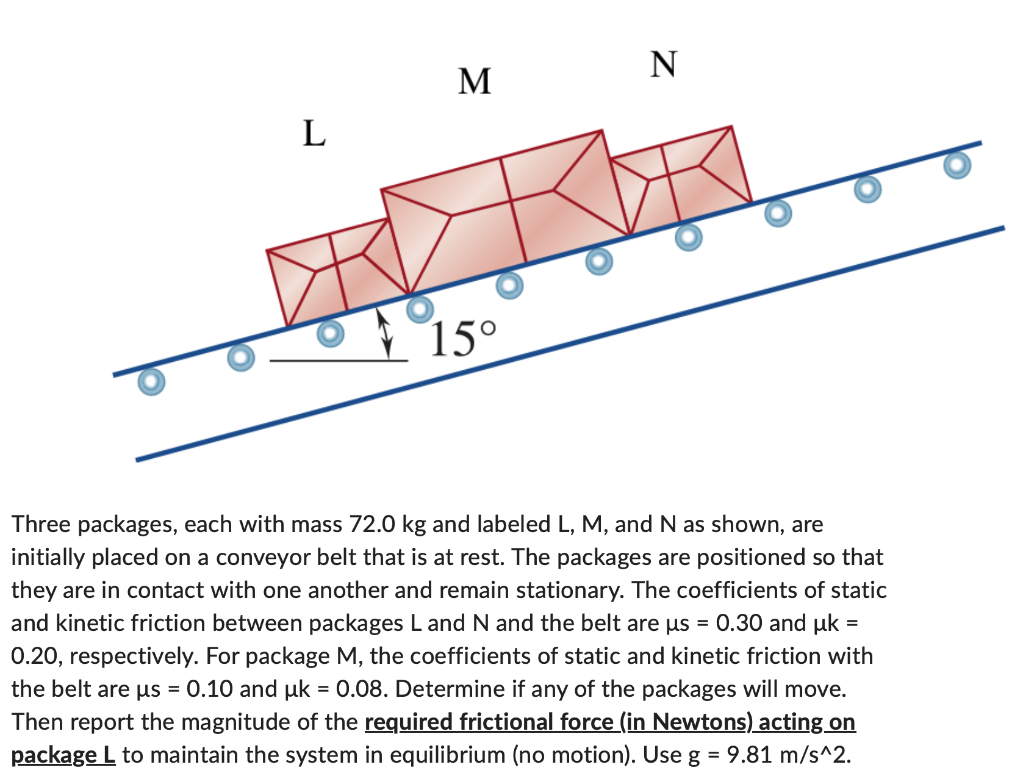
give answer in 2 step with explanation at the end of each step and final answer at the end:N M L ET Three packages, each with mass 72.0 kg and labeled L, M, and N as shown, are initially placed on a conveyor belt that is at rest. The packages are positioned so that they are in contact with one another and remain stationary. The coefficients of static and kinetic friction between packages L and N and the belt are ps = 0.30 and pk = 0.20, respectively. For package M, the coefficients of static and kinetic friction with the belt are ps = 0.10 and pk = 0.08. Determine if any of the packages will move. Then report the magnitude of the required frictional force (in Newtons) acting on package L to maintain the system in equilibrium (no motion). Use g = 9.81 m/s"2.

Question:

give answer in 2 step with explanation at the end of each step and final answer at the end:Uploaded ImageN M L ET Three packages, each with mass 72.0 kg and labeled L, M, and N as shown, are initially placed on a conveyor belt that is at rest. The packages are positioned so that they are in contact with one another and remain stationary. The coefficients of static and kinetic friction between packages L and N and the belt are ps = 0.30 and pk = 0.20, respectively. For package M, the coefficients of static and kinetic friction with the belt are ps = 0.10 and pk = 0.08. Determine if any of the packages will move. Then report the magnitude of the required frictional force (in Newtons) acting on package L to maintain the system in equilibrium (no motion). Use g = 9.81 m/s"2.
This is AI generated Response.
Asked by: Rahul
Created at: 2025-12-15 03:00:10

Final Answer:

Rendered Raw Text
Did you like this answer?
## Step 1: Analyze Forces and Friction for Each Package ### Forces on Each Package Each package has: - Weight \( mg \) acting downward. - Normal force \( N \) perpendicular to the belt. - Friction force \( f \) acting up the incline (resisting motion down the incline). #### Calculate Weight Components for Each Package (L, M, N) - Mass, \( m = 72.\, \text{kg} \) - Gravity, \( g = 9.81\, \text{m/s}^2 \) - Incline angle, \( \theta = 15^\circ \) Weight component **down the incline**: \[ F_{\text{down}} = mg \sin \theta = 72. \times 9.81 \times \sin(15^\circ) \approx 183.2\, \text{N} \] Weight component **perpendicular to incline**: \[ N = mg \cos \theta = 72. \times 9.81 \times \cos(15^\circ) \approx 682.6\, \text{N} \] **Explanation:** Each package tries to slide down due to the component of its weight parallel to the incline; friction resists this. --- ## Step 2: Find Maximum Static Friction and Compare ### Calculate Maximum Static Friction for Each Package - For **L and N**: \( \mu_s = .30 \) - For **M**: \( \mu_s = .10 \) **Maximum static friction for L/N:** \[ f_{s,\text{max,L/N}} = \mu_s N = .30 \times 682.6 \approx 204.8\, \text{N} \] **Maximum static friction for M:** \[ f_{s,\text{max,M}} = .10 \times 682.6 \approx 68.3\, \text{N} \] **Explanation:** The friction force must be at least as large as the downhill force to prevent motion. If not, the package will move. --- ### **Check If Any Package Moves** - **Force down the incline for each package:** \( 183.2\, \text{N} \) - **L/N max friction:** \( 204.8\, \text{N} \) (enough) - **M max friction:** \( 68.3\, \text{N} \) (**NOT enough**) **Package M will move** because the required force (183.2 N) exceeds the max static friction (68.3 N). --- ## **Final Answer** **The required frictional force acting on package L to maintain equilibrium:** \[ f_{s,\text{L,required}} = F_{\text{down}} = 183.2\, \text{N} \] However, **package M will move** since its friction is insufficient, so the system cannot remain in equilibrium as specified. **If only considering L's frictional force (before slipping):** \[ \boxed{183\, \text{N}} \] But, the system will not stay at rest because package M will slip.

📢 Instructions:

  • Ask anything relatd to above question only.
  • For new Question goto :

Study Help, Fast Answers

VIPSolutions focuses on clear, step‑by‑step explanations so you can learn quickly. Whether you need an AI‑generated walkthrough or a short hint to get unstuck, each solution is organized for fast reading and easy review later.

Search similar questions, compare approaches, and bookmark the best answers for revision. Our goal is simple: quick, reliable study help that feels natural—not noisy.