 VIPSolutions
give answer in 2 step with explanation at the end of each step and final answer at the end:As shown in the figure, an object of mass m is placed on a cart that moves smoothly across the floor. The left end of the object is connected to a damper (viscous damping coefficient: 3c), and the right end is connected to a spring (spring constant: 2k). The right end of the spring is fixed to a wall. When the position of the left end of the damper varies according toy = Ycoswt, determine the amplitude x of the forced oscillation from the equation of motion for the displacement x of the object. BB y=Ycoswr X 3¢ 2k
Question:
give answer in 2 step with explanation at the end of each step and final answer at the end: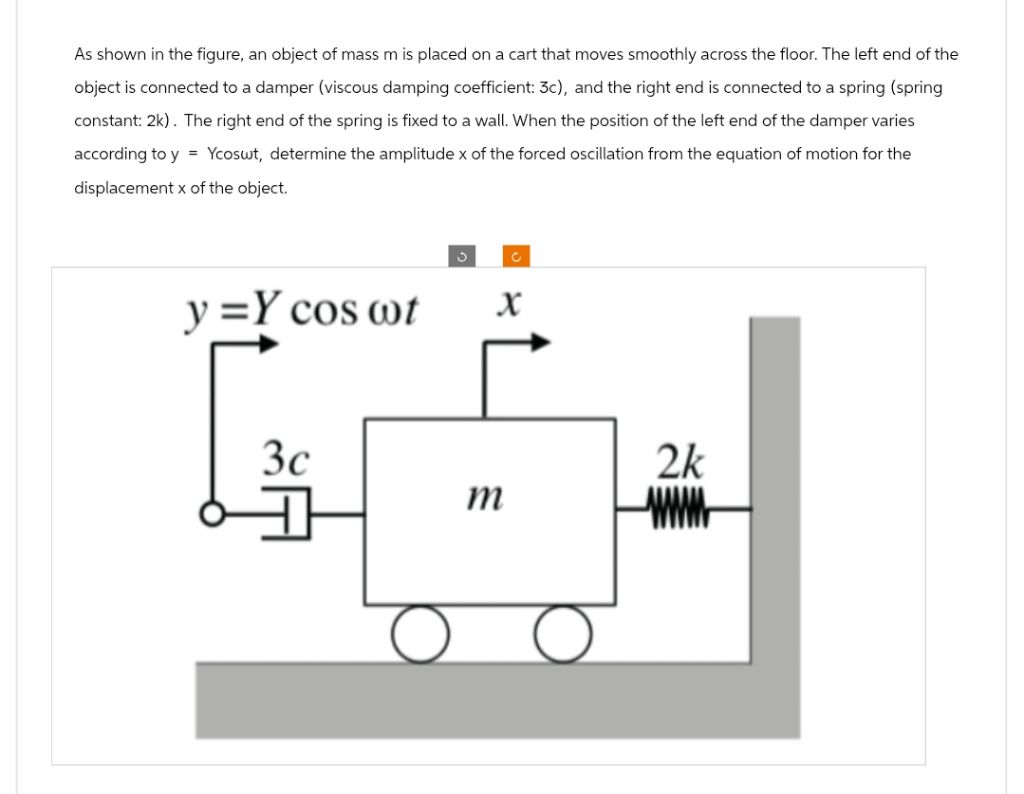 As shown in the figure, an object of mass m is placed on a cart that moves smoothly across the floor. The left end of the
object is connected to a damper (viscous damping coefficient: 3c), and the right end is connected to a spring (spring
constant: 2k). The right end of the spring is fixed to a wall. When the position of the left end of the damper varies
according toy = Ycoswt, determine the amplitude x of the forced oscillation from the equation of motion for the
displacement x of the object.
BB
y=Ycoswr X
3¢ 2k
This is AI generated Response.
Asked by: Rahul
Created at: 2025-12-14 17:48:00
Asked by: Rahul
Created at: 2025-12-14 17:48:00
Final Answer:
Rendered
Raw Text
Did you like this answer?
## Step 1: Write the Equation of Motion
Let \( x \) be the displacement of the mass \( m \), and \( y = Y \cos(\omega t) \) be the position of the left end of the damper.
- The force by the damper: \( F_{damping} = 3c(\dot{y} - \dot{x}) \)
- The force by the spring: \( F_{spring} = -2k x \)
The equation of motion using Newton's second law:
\[
m\ddot{x} = F_{damping} + F_{spring}
\]
Substitute the expressions:
\[
m\ddot{x} = 3c(\dot{y} - \dot{x}) - 2k x
\]
\[
m\ddot{x} + 3c\dot{x} + 2k x = 3c\dot{y}
\]
Since \( \dot{y} = -Y \omega \sin(\omega t) \):
\[
m\ddot{x} + 3c\dot{x} + 2k x = -3c Y \omega \sin(\omega t)
\]
**Explanation:**
We have derived the equation of motion by considering the forces due to the damper and spring and including the driving motion \( y \).
---
## Step 2: Find the Steady-State Amplitude
Assume a steady-state solution of the form:
\[
x_p = X \cos(\omega t - \phi)
\]
The right side is a sine, so let's rewrite as \( -3c Y \omega \sin(\omega t) = 3c Y \omega \cos(\omega t - \frac{\pi}{2}) \).
For a driving force \( F_ \cos(\omega t - \delta) \), the amplitude is:
\[
X = \frac{F_}{\sqrt{(2k - m\omega^2)^2 + (3c\omega)^2}}
\]
Here, \( F_ = 3c Y \omega \) and \( \delta = \frac{\pi}{2} \).
So,
\[
X = \frac{3c Y \omega}{\sqrt{(2k - m\omega^2)^2 + (3c\omega)^2}}
\]
**Explanation:**
By matching the form of the forced oscillation equation, we identify the amplitude \( X \) of forced oscillation.
---
## Final Answer
\[
\boxed{
X = \frac{3c Y \omega}{\sqrt{(2k - m\omega^2)^2 + (3c\omega)^2}}
}
\]
This is the amplitude of the forced oscillation for the displacement \( x \) of the object.
Question:
Then solved
This is AI generated Response.
Asked by: Rahul
Created at: 2025-12-14 17:48:28
Asked by: Rahul
Created at: 2025-12-14 17:48:28
Final Answer:
Rendered
Raw Text
Did you like this answer?
# Solution to Forced Oscillation Problem
## Step 1: Write the Equation of Motion
Let \( x \) be the displacement of the mass \( m \), and \( y = Y \cos(\omega t) \) be the position of the left end of the damper.
- **Damping Force:**
The force exerted by the damper is given by:
\[
F_{\text{damping}} = 3c(\dot{y} - \dot{x})
\]
- **Spring Force:**
The force exerted by the spring is:
\[
F_{\text{spring}} = -2k x
\]
Using Newton's second law, the equation of motion can be expressed as:
\[
m\ddot{x} = F_{\text{damping}} + F_{\text{spring}}
\]
Substituting the expressions for forces:
\[
m\ddot{x} = 3c(\dot{y} - \dot{x}) - 2k x
\]
Rearranging gives:
\[
m\ddot{x} + 3c\dot{x} + 2k x = 3c\dot{y}
\]
Now substituting \( \dot{y} = -Y \omega \sin(\omega t) \):
\[
m\ddot{x} + 3c\dot{x} + 2k x = -3c Y \omega \sin(\omega t)
\]
**Explanation:**
We have derived the equation of motion by considering the forces acting on the mass due to the damper and spring, with the displacement of the left end of the damper described as a harmonic function.
---
## Step 2: Find the Steady-State Amplitude
Assuming a steady-state solution of the form:
\[
x_p = X \cos(\omega t - \phi)
\]
The right side can be rewritten to match the cosine form:
\[
-3c Y \omega \sin(\omega t) = 3c Y \omega \cos(\omega t - \frac{\pi}{2})
\]
For a driving force \( F = 3c Y \omega \) acting as a cosine function, the amplitude \( X \) of the forced oscillation is given by:
\[
X = \frac{F}{\sqrt{(2k - m\omega^2)^2 + (3c\omega)^2}}
\]
Substituting \( F = 3c Y \omega \):
\[
X = \frac{3c Y \omega}{\sqrt{(2k - m\omega^2)^2 + (3c\omega)^2}}
\]
**Explanation:**
By matching the form of the forced oscillation equation with the input driving force, we have derived the expression for the amplitude \( X \) of the oscillation.
---
## Final Answer
\[
\boxed{
X = \frac{3c Y \omega}{\sqrt{(2k - m\omega^2)^2 + (3c\omega)^2}}
}
\]
This represents the amplitude of the forced oscillation for the displacement \( x \) of the object.
📢 Instructions:
- Ask anything relatd to above question only.
- For new Question goto :