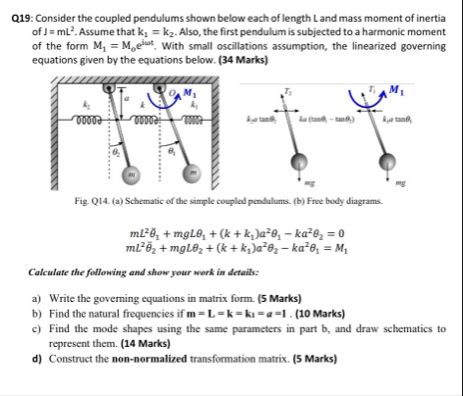
give answer in 2 step with explanation at the end of each step and final answer at the end:QS: Consider the coupled pendulums shown below each of ength Land mass moment of inertia
of =m. Assume that k, =k. Also, the first pends subjected toa harmanic moment
of the form M, = Me™, With small osclations assumption, the lincarized governing
equations given by the equations below. (38 Marks)
7, pM,
iw Ra, Pe Thy
m\ fe
© -
Fi QI. (0) Schcmaic ofthe sie coupe pedebens. 5 Fe body digas.
mIZ6, + mole, + (k + k)e%0, ~ ka®6, = 0
mL, + mol, + (k + ky)a8, ~ ka®6, = My
Cateutt the follwing and shew your werk in dts:
3) Write the governing cquatons in matrix form. (5 Marks)
b) Find the natural ioquencies ifm = L = k= ky =a =1 10 Marks)
©) Find the mode shapes using the same parameter in part b, and draw schematics to
represent them. (14 Marks)
4) Construct the non-nermalized ransformation mari. (5 Marks)
Question:
give answer in 2 step with explanation at the end of each step and final answer at the end:
This is AI generated Response. Asked by: Rahul Created at: 2025-12-14 03:20:49
Did you like this answer?
👍 0
👎 0
Let's solve **question (a)** and **(b)** in **2 steps**. Explanations are given at each step.
---
## (a) Write the governing equations in matrix form
### **Step 1: Arrange the equations**
Given:
\[
\begin{align*}
mL^2\ddot{\theta}_1 + mgL\theta_1 + (k_1 + k_2)L^2\theta_1 - k_2L^2\theta_2 &= M_1 \\
mL^2\ddot{\theta}_2 + mgL\theta_2 + (k_1 + k_2)L^2\theta_2 - k_2L^2\theta_1 &=
\end{align*}
\]
**Explanation:**
We write both equations as given, keeping all terms with \(\theta_1\) and \(\theta_2\) grouped.
---
### **Step 2: Express in matrix form**
Combine coefficients and write in matrix form:
\[
\begin{bmatrix}
mL^2 & \\
& mL^2
\end{bmatrix}
\begin{bmatrix}
\ddot{\theta}_1 \\
\ddot{\theta}_2
\end{bmatrix}
+
\begin{bmatrix}
mgL + (k_1 + k_2)L^2 & -k_2L^2 \\
-k_2L^2 & mgL + (k_1 + k_2)L^2
\end{bmatrix}
\begin{bmatrix}
\theta_1 \\
\theta_2
\end{bmatrix}
=
\begin{bmatrix}
M_1 \\
\end{bmatrix}
\]
**Explanation:**
- The mass matrix is diagonal as both pendulums have the same mass moment of inertia.
- The stiffness matrix includes the gravitational and spring terms, with coupling via \(-k_2L^2\).
- The right side is the forcing vector.
---
### **Final matrix equation:**
\[
\boxed{
\mathbf{M}\ddot{\Theta} + \mathbf{K}\Theta = \mathbf{F}
}
\]
where
\[
\mathbf{M} =
\begin{bmatrix}
mL^2 & \\
& mL^2
\end{bmatrix}
,\quad
\mathbf{K} =
\begin{bmatrix}
mgL + (k_1 + k_2)L^2 & -k_2L^2 \\
-k_2L^2 & mgL + (k_1 + k_2)L^2
\end{bmatrix}
,\quad
\mathbf{F} =
\begin{bmatrix}
M_1 \\
\end{bmatrix}
\]
---
## (b) Find the natural frequencies if \(m = L = k_1 = k_2 = 1, g = 1\)
### **Step 1: Substitute values**
Substitute \(m = L = k_1 = k_2 = g = 1\):
\[
\mathbf{M} = \begin{bmatrix} 1 & \\ & 1 \end{bmatrix}
\]
\[
\mathbf{K} =
\begin{bmatrix}
1 + (1+1) & -1 \\
-1 & 1 + (1+1)
\end{bmatrix}
=
\begin{bmatrix}
3 & -1 \\
-1 & 3
\end{bmatrix}
\]
**Explanation:**
All parameters are set to 1, simplifying the mass and stiffness matrices.
---
### **Step 2: Solve the eigenvalue problem**
The natural frequencies are found from:
\[
\det(\mathbf{K} - \omega^2 \mathbf{M}) =
\]
So,
\[
\begin{vmatrix}
3 - \omega^2 & -1 \\
-1 & 3 - \omega^2
\end{vmatrix} =
\]
\[
(3 - \omega^2)^2 - 1 = \implies (3 - \omega^2)^2 = 1
\]
\[
3 - \omega^2 = \pm1
\]
So,
- When \(3 - \omega^2 = 1 \implies \omega^2 = 2\)
- When \(3 - \omega^2 = -1 \implies \omega^2 = 4\)
So,
\(\omega_1 = \sqrt{2}\)
\(\omega_2 = 2\)
**Explanation:**
Solving the determinant gives two eigenvalues, which are the squares of the natural frequencies.
---
## **Final Answers**
### **(a) Matrix form:**
\[
\boxed{
\mathbf{M}\ddot{\Theta} + \mathbf{K}\Theta = \mathbf{F}
}
\]
with \(\mathbf{M}\), \(\mathbf{K}\), and \(\mathbf{F}\) as above.
### **(b) Natural frequencies:**
\[
\boxed{
\omega_1 = \sqrt{2}, \quad \omega_2 = 2
}
\]
📢 Instructions:
Ask anything relatd to above question only.
For new Question goto :
🚀 Submit (-0.25 Credits🪙)
Study Help, Fast Answers
VIPSolutions focuses on clear, step‑by‑step explanations so you can learn quickly. Whether you need an AI‑generated walkthrough or a short hint to get unstuck, each solution is organized for fast reading and easy review later.
Search similar questions, compare approaches, and bookmark the best answers for revision. Our goal is simple: quick, reliable study help that feels natural—not noisy.
 VIPSolutions
 QS: Consider the coupled pendulums shown below each of ength Land mass moment of inertia
of =m. Assume that k, =k. Also, the first pends subjected toa harmanic moment
of the form M, = Me™, With small osclations assumption, the lincarized governing
equations given by the equations below. (38 Marks)
7, pM,
iw Ra, Pe Thy
m\ fe
© -
Fi QI. (0) Schcmaic ofthe sie coupe pedebens. 5 Fe body digas.
mIZ6, + mole, + (k + k)e%0, ~ ka®6, = 0
mL, + mol, + (k + ky)a8, ~ ka®6, = My
Cateutt the follwing and shew your werk in dts:
3) Write the governing cquatons in matrix form. (5 Marks)
b) Find the natural ioquencies ifm = L = k= ky =a =1 10 Marks)
©) Find the mode shapes using the same parameter in part b, and draw schematics to
represent them. (14 Marks)
4) Construct the non-nermalized ransformation mari. (5 Marks)