 VIPSolutions
give answer in 2 step with explanation at the end of each step and final answer at the end:1 Dew al gram youre No rei for ames without spree sche. 3 ordain ot es BE Sve Enis oem sig ho ee. 500m co br dn wine tee wl. peso, vy rl os Se; es rm orto of et SS ee mt fe td mei = a i a
Question:
give answer in 2 step with explanation at the end of each step and final answer at the end: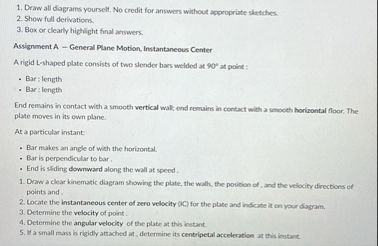 1 Dew al gram youre No rei for ames without spree sche.
3 ordain ot es
BE
Sve
Enis oem sig ho ee.
500m co br dn wine tee wl. peso, vy rl
os
Se; es
rm orto of et
SS ee mt fe td mei = a i a
This is AI generated Response.
Asked by: Rahul
Created at: 2025-12-14 03:16:57
Asked by: Rahul
Created at: 2025-12-14 03:16:57
Final Answer:
Rendered
Raw Text
Did you like this answer?
Certainly! Let's break down the problem into **two major steps**, with explanations after each, as requested:
---
## **Step 1: Diagram and Velocity Directions**
**Task:**
Draw a clear kinematic diagram showing:
- The L-shaped plate (with bars welded at 90°),
- The vertical wall, the horizontal floor,
- The position of the plate,
- **Velocity directions** of the ends in contact with the wall and the floor.
### **Explanation:**
The L-shaped plate has two bars:
- Let’s call them **Bar 1** (horizontal, in contact with the wall) and **Bar 2** (vertical, in contact with the floor).
- The plate moves such that:
- **End A** (in contact with vertical wall) slides **down** at speed \( v \).
- **End B** (in contact with horizontal floor) moves **to the right** at some speed.
**Diagram:**
```
(Wall)
|
| A
|___ (Bar 1, length l)
|
|
|
B____________ (Floor)
(Bar 2, length l)
```
- **A** slides DOWN (\(\vec{v}_A\) is vertically downward).
- **B** slides RIGHT (\(\vec{v}_B\) is horizontally right).
---
## **Step 2: Instantaneous Center of Zero Velocity (ICZV)**
**Task:**
Locate the **instantaneous center of zero velocity (ICZV)** and indicate it on your diagram.
### **Explanation:**
- The ICZV is the point about which the whole plate is **instantaneously rotating**.
- For rigid body motion, **velocity at any point** = \(\vec{\omega} \times \vec{r}\), where \(\vec{\omega}\) is angular velocity and \(\vec{r}\) is the position vector from ICZV.
For this L-shape:
- Draw perpendiculars to the velocity vectors at A and B:
- At **A**, velocity is vertical (\(\downarrow\)), so draw a horizontal line through A.
- At **B**, velocity is horizontal (\(\rightarrow\)), so draw a vertical line through B.
- The intersection of these two lines is the **ICZV**.
**Mark this point on your diagram.**
---
## **Final Answer (Summary):**
- **Step 1:**
- Draw the L-shaped plate with ends A (down) and B (right), indicating velocity directions.
- **Step 2:**
- The ICZV is found by drawing perpendiculars to the velocity vectors at A and B; their intersection gives the instantaneous center.
**The ICZV is located at the intersection of a horizontal line through A and a vertical line through B.**
---
Would you like to proceed with the angular velocity and acceleration analysis in a similar stepwise manner?
Question:
Solved full answer
This is AI generated Response.
Asked by: Rahul
Created at: 2025-12-14 03:17:37
Asked by: Rahul
Created at: 2025-12-14 03:17:37
Final Answer:
Rendered
Raw Text
Did you like this answer?
# Kinematic Analysis of an L-Shaped Plate
We will analyze the motion of an L-shaped plate in two structured steps. Each step includes explanations to clarify the concepts.
---
## Step 1: Diagram and Velocity Directions
### Task
Draw a kinematic diagram that shows:
- The L-shaped plate consisting of two bars.
- The vertical wall and horizontal floor.
- The position of the plate.
- Velocity directions for the ends in contact with the wall and the floor.
### Explanation
The L-shaped plate consists of two bars:
- **Bar 1** is horizontal and in contact with the wall.
- **Bar 2** is vertical and in contact with the floor.
The motion of the plate can be described as follows:
- **End A** (at the wall) moves **downward** with velocity \( v_A \).
- **End B** (on the floor) moves **to the right** with velocity \( v_B \).
**Diagram:**
```
(Wall)
|
| A (v_A down)
|___ (Bar 1, length l)
|
|
|
B (v_B right) ____________ (Floor)
(Bar 2, length l)
```
- **A** has a downward velocity (\(\vec{v}_A\)).
- **B** has a rightward velocity (\(\vec{v}_B\)).
---
## Step 2: Instantaneous Center of Zero Velocity (ICZV)
### Task
Locate the **instantaneous center of zero velocity (ICZV)** on your diagram.
### Explanation
The ICZV is the point about which the L-shaped plate is **instantaneously rotating**. The relationship between angular velocity and linear velocity can be expressed as:
\[
\vec{v} = \vec{\omega} \times \vec{r}
\]
where:
- \(\vec{v}\) is the linear velocity,
- \(\vec{\omega}\) is the angular velocity,
- \(\vec{r}\) is the position vector from the ICZV.
To find the ICZV:
- Draw perpendicular lines to the velocity vectors at points A and B:
- From **A**, where the velocity is downward, draw a horizontal line.
- From **B**, where the velocity is to the right, draw a vertical line.
- The intersection of these two lines indicates the **ICZV**.
**Mark this point on your diagram.**
---
## Final Answer (Summary)
- **Step 1:**
- The L-shaped plate is drawn with ends A (moving down) and B (moving right), showing their respective velocity directions.
- **Step 2:**
- The ICZV is determined by the intersection of the horizontal line through A and the vertical line through B.
**The ICZV is located at the intersection point of the two perpendicular lines drawn from points A and B.**
📢 Instructions:
- Ask anything relatd to above question only.
- For new Question goto :