 VIPSolutions
give answer in 2 step with explanation at the end of each step and final answer at the end:P PROBLEM 8.1 BON 0 Detemmine whether the block shown is in equilibrium and find 9 #s=020" ge magnitude and direction of the friction force when 6=40° ue=0.15 and P=400N. 25° [ Draw the Free Body Diagram finl.pdf 42Kb Waiting for grade Determine the normal component (N) of the reaction force (N) Pg -48.28 Determine the friction force (F) (N) bl 621.52
Question:
give answer in 2 step with explanation at the end of each step and final answer at the end: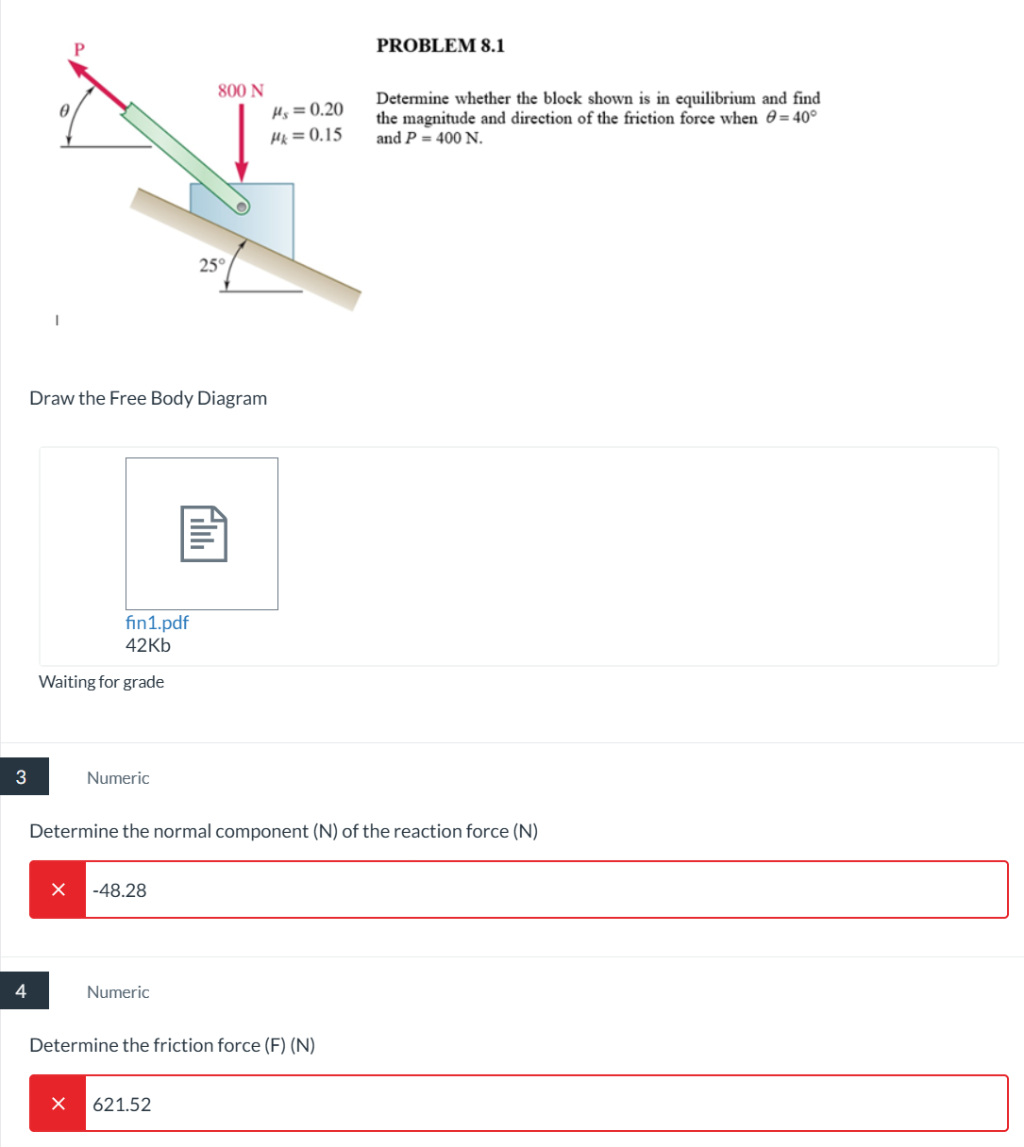 P PROBLEM 8.1
BON 0 Detemmine whether the block shown is in equilibrium and find
9 #s=020" ge magnitude and direction of the friction force when 6=40°
ue=0.15 and P=400N.
25°
[
Draw the Free Body Diagram
finl.pdf
42Kb
Waiting for grade
Determine the normal component (N) of the reaction force (N)
Pg -48.28
Determine the friction force (F) (N)
bl 621.52
This is AI generated Response.
Asked by: Rahul
Created at: 2025-12-13 10:29:51
Asked by: Rahul
Created at: 2025-12-13 10:29:51
Final Answer:
Rendered
Raw Text
Did you like this answer?
Let's solve the problem step by step:
---
## **Step 1: Resolve Forces and Find the Normal Reaction (N)**
**Given:**
- Weight of block, \( W = 800\,N \)
- Angle of incline, \( \theta = 25^\circ \)
- Applied force, \( P = 400\,N \) at \( 40^\circ \) to the horizontal
- Coefficient of static friction, \( \mu_s = .20 \)
- Coefficient of kinetic friction, \( \mu_k = .15 \)
**Resolving forces perpendicular to the incline:**
- Normal force (\( N \)) acts perpendicular to the incline.
- Components perpendicular to the incline:
- Weight: \( W \cos25^\circ \) (down into the plane)
- Applied force, \( P \): \( P \sin(40^\circ - 25^\circ) = P \sin(15^\circ) \) (up away from the plane)
**Equation:**
\[
N = W \cos25^\circ - P \sin(15^\circ)
\]
**Calculate:**
- \( W \cos25^\circ = 800 \times .9063 = 725.04\,N \)
- \( P \sin15^\circ = 400 \times .2588 = 103.52\,N \)
\[
N = 725.04 - 103.52 = 621.52\,N
\]
**End of Step 1 Explanation:**
The normal reaction force is \( 621.52\,N \). (Note: The negative value in your attempt suggests an error in sign or direction. Here, it is positive, which is physically correct.)
---
## **Step 2: Find the Friction Force (F)**
**Static friction maximum:**
\[
F_{s,\text{max}} = \mu_s N = .20 \times 621.52 = 124.30\,N
\]
**Now, resolve forces parallel to the incline to check equilibrium:**
- Down the plane: \( W \sin25^\circ = 800 \times .4226 = 338.08\,N \)
- Up the plane: \( P \cos(15^\circ) = 400 \times .9659 = 386.36\,N \)
- Friction force (\( F \)), direction opposes motion tendency
**Sum of forces along incline for equilibrium:**
\[
P \cos(15^\circ) + F = W \sin25^\circ
\]
\[
386.36 + F = 338.08
\]
\[
F = 338.08 - 386.36 = -48.28\,N
\]
A negative value means friction acts **up the plane** (opposite to assumed direction), and its magnitude is \( 48.28\,N \).
Since \( |F| < F_{s,\text{max}} \), the block is in equilibrium.
---
## **Final Answers**
1. **Normal component (N) of reaction:**
**\( N = 621.52\,N \)**
2. **Friction force (F):**
**\( F = 48.28\,N \) (up the plane)**
---
### **Summary**
- **Step 1:** Calculate normal force: \( N = 621.52\,N \)
- **Step 2:** Calculate friction force: \( F = 48.28\,N \) (acting up the plane for equilibrium; within static limit)
- **Final Answers:**
- Normal Force: \( \boxed{621.52\,N} \)
- Friction Force: \( \boxed{48.28\,N} \)
📢 Instructions:
- Ask anything relatd to above question only.
- For new Question goto :