 VIPSolutions
give answer in 2 step with explanation at the end of each step and final answer at the end:b), Change in te He see a 3. (7 marks) A motor spins a mass whereby at t= 0, the mass has an angular yelogity of 30.0 rad/s. The mass then experiences & constant angular acceleration from the motor of 40.0 rad/s? for another 2.50 seconds when the motor becomes. disconnected from the mass. ‘Decelerting at a constant rate until it comes 10 it Stop: the mass continues to rotate another 500 rad. Determine: a) Angular displacement fromt=0 10 when the motor was disconnected b) Time required for the mass. 10 come 10 @ stop after the motor was. disconnected eke a nented inside by Wo
Question:
give answer in 2 step with explanation at the end of each step and final answer at the end: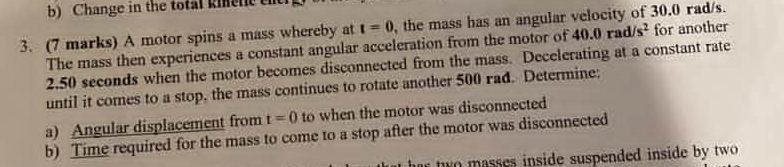 b), Change in te He see a
3. (7 marks) A motor spins a mass whereby at t= 0, the mass has an angular yelogity of 30.0 rad/s.
The mass then experiences & constant angular acceleration from the motor of 40.0 rad/s? for another
2.50 seconds when the motor becomes. disconnected from the mass. ‘Decelerting at a constant rate
until it comes 10 it Stop: the mass continues to rotate another 500 rad. Determine:
a) Angular displacement fromt=0 10 when the motor was disconnected
b) Time required for the mass. 10 come 10 @ stop after the motor was. disconnected
eke a nented inside by Wo
This is AI generated Response.
Asked by: Rahul
Created at: 2025-12-13 09:58:37
Asked by: Rahul
Created at: 2025-12-13 09:58:37
Final Answer:
Rendered
Raw Text
Did you like this answer?
Let's break down the problem step by step.
---
### Given Data
- Initial angular velocity, \( \omega_ = 30. \) rad/s
- Angular acceleration, \( \alpha = 40. \) rad/s\(^2\) (while the motor is connected)
- Time interval, \( t_1 = 2.50 \) s (motor connected)
- Additional angular displacement after disconnect, \( \theta_2 = 500 \) rad (while decelerating to stop)
We will solve:
#### a) **Angular displacement from \( t = \) to when motor was disconnected**
**Step 1: Find final angular velocity at disconnect (\( \omega_1 \))**
\[
\omega_1 = \omega_ + \alpha t_1
\]
\[
\omega_1 = 30. + (40. \times 2.50) = 30. + 100. = 130. \ \text{rad/s}
\]
**Explanation:**
This gives the angular velocity at the moment the motor is disconnected.
---
**Step 2: Find angular displacement during this interval (\( \theta_1 \))**
\[
\theta_1 = \omega_ t_1 + \frac{1}{2} \alpha t_1^2
\]
\[
\theta_1 = (30. \times 2.50) + \frac{1}{2}(40.)(2.50^2)
\]
\[
\theta_1 = 75. + .5 \times 40. \times 6.25
\]
\[
\theta_1 = 75. + 20. \times 6.25
\]
\[
\theta_1 = 75. + 125. = 200. \ \text{rad}
\]
**Explanation:**
This is the total angular displacement from \( t = \) to when the motor is disconnected.
---
**Final Answer (a):**
**Angular displacement from \( t = \) to disconnect:**
\[
\boxed{200 \ \text{rad}}
\]
---
#### b) **Time required for the mass to come to a stop after disconnect**
**Step 1: Use displacement and initial velocity after disconnect**
We know:
- Initial angular velocity after disconnect = \( \omega_1 = 130. \) rad/s
- Angular displacement to stop = \( \theta_2 = 500 \) rad
- Final angular velocity = (stopped)
- Let angular acceleration after disconnect = \( \alpha_2 \) (unknown, negative)
First, use kinematic equation:
\[
\omega_f^2 = \omega_1^2 + 2\alpha_2 \theta_2
\]
\[
= (130.)^2 + 2\alpha_2 \times 500
\]
\[
= 16900 + 100\alpha_2
\]
\[
100\alpha_2 = -16900
\]
\[
\alpha_2 = -16.9 \ \text{rad/s}^2
\]
**Explanation:**
This is the angular deceleration as the mass comes to a stop.
---
**Step 2: Find time to stop (\( t_2 \)) after disconnect**
\[
\omega_f = \omega_1 + \alpha_2 t_2
\]
\[
= 130. + (-16.9)t_2
\]
\[
16.9t_2 = 130.
\]
\[
t_2 = \frac{130.}{16.9} \approx 7.69 \ \text{s}
\]
**Explanation:**
This is the time needed for the mass to come to a stop after disconnect.
---
**Final Answer (b):**
**Time to stop after disconnect:**
\[
\boxed{7.69 \ \text{s}}
\]
---
### **Summary of Answers:**
a) Angular displacement before disconnect: **200 rad**
b) Time to stop after disconnect: **7.69 s**
📢 Instructions:
- Ask anything relatd to above question only.
- For new Question goto :