 VIPSolutions
give answer in 2 step with explanation at the end of each step and final answer at the end:A weight w = 200 N hangs from joint A as shown. The apparatus is held in equilibrium by the spring at B. At equilibrium, 6Uypta1 = 6Uw + 0Uspring = 0, where §Uy, is the virtual work done by the weight, and Uspring is the virtual work done by the spring. For § = 7/6 = 30°, determine the virtual work that would be done by the weight w if § were to change to 0 + 46. [5 pts] The virtual work done by the weight ye N w is (see below for units): ®) =~ | i'm 1. 6U, = —10066 units. A NY 2. 6U,, = —11246 units. : 3. 0U,, = —11960 units. IC ba 4. 6Uy = —157 66 units. k = 900 N/m 5. 6U,, = —17340 units.
Question:
give answer in 2 step with explanation at the end of each step and final answer at the end: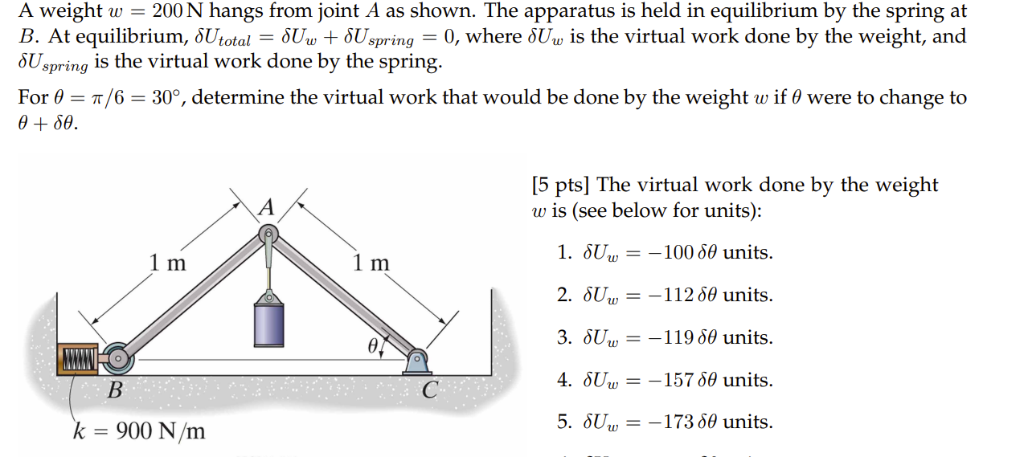 A weight w = 200 N hangs from joint A as shown. The apparatus is held in equilibrium by the spring at
B. At equilibrium, 6Uypta1 = 6Uw + 0Uspring = 0, where §Uy, is the virtual work done by the weight, and
Uspring is the virtual work done by the spring.
For § = 7/6 = 30°, determine the virtual work that would be done by the weight w if § were to change to
0 + 46.
[5 pts] The virtual work done by the weight
ye N w is (see below for units):
®)
=~ | i'm 1. 6U, = —10066 units.
A NY 2. 6U,, = —11246 units.
: 3. 0U,, = —11960 units.
IC ba
4. 6Uy = —157 66 units.
k = 900 N/m 5. 6U,, = —17340 units.
This is AI generated Response.
Asked by: Rahul
Created at: 2025-12-13 07:45:15
Asked by: Rahul
Created at: 2025-12-13 07:45:15
Final Answer:
Rendered
Raw Text
Did you like this answer?
Let's solve the problem step by step:
---
### **Step 1: Find the Vertical Displacement ($\delta y_A$) of Point A due to Small Change $\delta\theta$**
When the angle $\theta$ increases by $\delta\theta$, the vertical position of point A changes.
- The length of each rod is 1 m.
- The vertical height of A from the base is:
\( y_A = 1 \cdot \sin\theta \)
A small change in $\theta$ gives a change in $y_A$:
\[
\delta y_A = \frac{d}{d\theta} (1 \cdot \sin\theta)\, \delta\theta = \cos\theta \, \delta\theta
\]
**For $\theta = 30^\circ = \pi/6$:**
\[
\cos(30^\circ) = \frac{\sqrt{3}}{2}
\]
\[
\delta y_A = \frac{\sqrt{3}}{2} \, \delta\theta
\]
**Explanation:**
This step finds how much the vertical position of point A changes for a small change in angle, which is needed because the weight does work as point moves vertically.
---
### **Step 2: Calculate the Virtual Work Done by the Weight ($\delta U_w$)**
The virtual work done by the weight \( w \) is:
\[
\delta U_w = w \cdot (\text{vertical displacement of A}) = w \, \delta y_A
\]
Given \( w = 200\, \text{N} \):
\[
\delta U_w = 200 \cdot \frac{\sqrt{3}}{2} \, \delta\theta \approx 200 \cdot .866 \, \delta\theta = 173.2\, \delta\theta
\]
Since the weight acts downward and $\delta y_A$ is upward for positive $\delta\theta$, the work **done by the weight is negative**:
\[
\delta U_w = -173\, \delta\theta
\]
**Explanation:**
The weight does negative work as point A moves upward (since the force is downward and the displacement is upward).
---
## **Final Answer**
**The virtual work done by the weight $w$ is:**
\[
\boxed{\delta U_w = -173\, \delta\theta}
\]
**(Units: N·rad, option 5)**
📢 Instructions:
- Ask anything relatd to above question only.
- For new Question goto :