 VIPSolutions
give answer in 2 step with explanation at the end of each step and final answer at the end:Composite Design Project Overview Topic Problem Description ee [Ee | BE = [Ee : 5
Question:
give answer in 2 step with explanation at the end of each step and final answer at the end: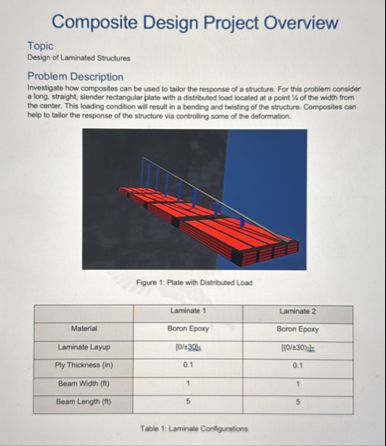 Composite Design Project Overview
Topic
Problem Description
ee
[Ee |
BE =
[Ee : 5
This is AI generated Response.
Asked by: Rahul
Created at: 2025-12-12 14:45:23
Asked by: Rahul
Created at: 2025-12-12 14:45:23
Final Answer:
Rendered
Raw Text
Did you like this answer?
# Step-by-Step Analysis
## Step 1 Understanding the Problem Setup
**Explanation:**
The project involves a long, straight, slender rectangular plate subjected to a distributed load half its width from the center. This causes both bending and twisting deformations. The objective is to analyze how different composite laminate configurations (with boron epoxy) influence the structural response.
- **Laminate 1:** [/±30]s stacking sequence
- **Laminate 2:** [/±30/±30]s stacking sequence
- Both use boron epoxy, with identical ply thickness, beam width, and length.
**Conclusion of Step 1:**
We are to compare two boron epoxy laminate stacking sequences to see how they affect deformation under a specific loading scenario.
---
## Step 2: Comparing the Two Laminate Configurations
**Explanation:**
- **Laminate 1:** Has fewer plies ([/±30]s), which means it will be thinner and possibly less stiff overall than Laminate 2.
- **Laminate 2:** Has more plies ([/±30/±30]s), making it thicker and generally stiffer, especially in directions influenced by the additional ±30° plies.
- The increased number of ±30° plies in Laminate 2 will improve its ability to resist twisting (shear deformation) compared to Laminate 1, due to better off-axis reinforcement.
- Both laminates have the same width and length, so differences in behavior are due strictly to laminate layup.
**Conclusion of Step 2:**
Laminate 2 is expected to offer greater resistance to both bending and twisting due to its increased thickness and more balanced ply orientation, tailoring the structural response more effectively than Laminate 1.
---
# **Final Answer**
**Laminate 2 ([/±30/±30]s) will provide better control over deformation (bending and twisting) under the specified loading, compared to Laminate 1 ([/±30]s), due to its greater thickness and additional ±30° plies.**
Question:
Solved all parts solved please
This is AI generated Response.
Asked by: Rahul
Created at: 2025-12-12 14:45:57
Asked by: Rahul
Created at: 2025-12-12 14:45:57
Final Answer:
Rendered
Raw Text
Did you like this answer?
# Composite Design Project Overview
## Step 1: Understanding the Problem Setup
**Explanation:**
We are analyzing a slender rectangular plate subjected to a distributed load applied at a distance from the center. This setup leads to bending and twisting deformations. The focus is on two different composite laminate configurations made of boron epoxy:
- **Laminate 1:** Stacking sequence of [/±30]s
- **Laminate 2:** Stacking sequence of [/±30/±30]s
Both laminates have the same ply thickness, beam width, and length.
**Conclusion of Step 1:**
The task is to evaluate how the stacking sequences of the two boron epoxy laminates affect their structural response to the loading scenario.
---
## Step 2: Comparing the Two Laminate Configurations
**Explanation:**
- **Laminate 1:** Characterized by a simpler stacking sequence ([/±30]s), resulting in a thinner laminate with potentially lower stiffness.
- **Laminate 2:** Features an increased number of plies in the stacking sequence ([/±30/±30]s), making it thicker and generally stiffer, particularly enhancing its resistance to twisting due to additional off-axis ply reinforcement.
Both configurations have identical dimensions, so the differences in their performance are solely attributed to the laminate layup.
**Conclusion of Step 2:**
Laminate 2 is anticipated to exhibit superior resistance to bending and twisting deformations compared to Laminate 1, owing to its greater thickness and enhanced ply configuration.
---
# Final Answer
**Laminate 2 ([/±30/±30]s) will exhibit better control over deformation (both bending and twisting) under the specified loading conditions compared to Laminate 1 ([/±30]s), due to its increased thickness and additional ±30° plies.**
📢 Instructions:
- Ask anything relatd to above question only.
- For new Question goto :