 VIPSolutions
give answer in 2 step with explanation at the end of each step and final answer at the end:Siesmesge | om Ann coun a by St 1 rs
Question:
give answer in 2 step with explanation at the end of each step and final answer at the end: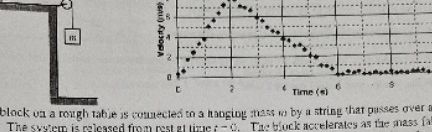 Siesmesge
| om
Ann coun a by St 1 rs
This is AI generated Response.
Asked by: Rahul
Created at: 2025-12-12 08:28:35
Asked by: Rahul
Created at: 2025-12-12 08:28:35
Final Answer:
Rendered
Raw Text
Did you like this answer?
## Step 1: Describe the Physical Setup
The diagram shows a block on a rough connected by a over a pulley a hanging massm\). The string is taut, and the system is released from rest at \(t = \).
**Explanation:**
The setup is a classic Atwood-type machine, but one block is on a rough surface (implying friction), and one mass is hanging. The motion will depend on gravity, tension, and friction.
---
## Step 2: Interpret the Graph
The graph next to the setup shows velocity (m/s) versus time (s) for the system. The velocity starts at zero, increases, reaches a peak, and then decreases, eventually returning to zero and staying there.
**Explanation:**
This means the system starts moving, speeds up (accelerates), slows down (decelerates), and then stops. This is consistent with the hanging mass causing initial acceleration, but friction eventually balancing the forces, bringing motion to a stop.
---
## Final Answer
**The block initially accelerates due to the hanging mass, reaches a maximum velocity, then friction overcomes the force from the hanging mass, causing the system to decelerate and finally come to rest.**
Question:
Then solved
This is AI generated Response.
Asked by: Rahul
Created at: 2025-12-12 08:28:55
Asked by: Rahul
Created at: 2025-12-12 08:28:55
Final Answer:
Rendered
Raw Text
Did you like this answer?
## Step 1: Analyze the Forces Acting on the System
In the given setup, consider the forces acting on both the block on the rough surface and the hanging mass.
1. **For the Block on the Surface:**
- Weight: \( mg \) (downward)
- Normal Force: \( N \) (upward)
- Frictional Force: \( f \) (opposing motion, proportional to \( N \))
- Tension in the string: \( T \) (toward the pulley)
2. **For the Hanging Mass:**
- Weight: \( W = mg \) (downward)
- Tension in the string: \( T \) (upward)
**Explanation:**
The block on the rough surface experiences friction, which will affect its motion as it tries to accelerate due to the tension from the hanging mass. The net force on the system will determine the acceleration.
---
## Step 2: Apply Newton's Second Law
Using Newton's Second Law (\( F = ma \)), set up the equations for both masses.
1. **For the Block on the Surface:**
\[
T - f = m_1 a
\]
where \( f = \mu N = \mu m_1 g \) (frictional force).
2. **For the Hanging Mass:**
\[
m_2 g - T = m_2 a
\]
**Explanation:**
These equations can be solved simultaneously to find the acceleration \( a \) of the system and the tension \( T \). The frictional force reduces the net force acting on the block, impacting its acceleration.
---
## Final Answer
**By solving the equations, you can find the acceleration of the system and the tension in the string. The block accelerates initially, but friction eventually brings it to a stop.**
📢 Instructions:
- Ask anything relatd to above question only.
- For new Question goto :