 VIPSolutions
give answer in 2 step with explanation at the end of each step and final answer at the end:In Figure (a), a uniform magnetic field B increases in magnitude with time t as given by Figure (b), where the vertical axis scale is set by B; = 10 mT and the horizontal scale is set by t; = 6.15. A circular conducting loop of area 11 x 104 m2 lies in the field, in the plane of the page. The amount of charge q passing point A on the loop is given in Figure (c) as a function of t, with the vertical axis scale set by gs = 6.7 mC and the horizontal axis scale again set by t; = 6.15. What is the loop's resistance? _B a hie A B =o Ll 0 ry [1 ty (es) ts) (a) (b) (ey
Question:
give answer in 2 step with explanation at the end of each step and final answer at the end: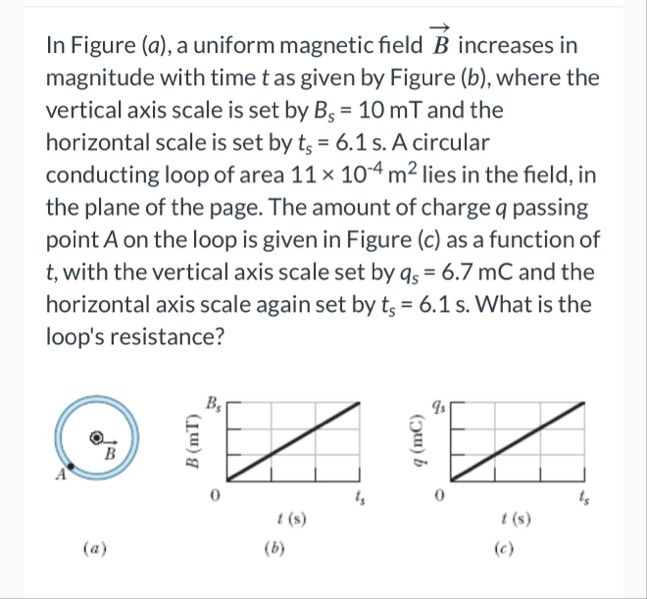 In Figure (a), a uniform magnetic field B increases in
magnitude with time t as given by Figure (b), where the
vertical axis scale is set by B; = 10 mT and the
horizontal scale is set by t; = 6.15. A circular
conducting loop of area 11 x 104 m2 lies in the field, in
the plane of the page. The amount of charge q passing
point A on the loop is given in Figure (c) as a function of
t, with the vertical axis scale set by gs = 6.7 mC and the
horizontal axis scale again set by t; = 6.15. What is the
loop's resistance?
_B a
hie
A B =o Ll
0 ry [1 ty
(es) ts)
(a) (b) (ey
This is AI generated Response.
Asked by: Rahul
Created at: 2025-12-12 04:29:05
Asked by: Rahul
Created at: 2025-12-12 04:29:05
Final Answer:
Rendered
Raw Text
Did you like this answer?
Let's solve the problem in **2 steps** as requested.
---
## **Step 1: Find the Induced EMF (\(\mathcal{E}\))**
**Explanation:**
The change in magnetic field induces an emf in the loop, given by Faraday’s law:
\[
\mathcal{E} = -\frac{d\Phi_B}{dt} = -A\frac{dB}{dt}
\]
where:
- \(A = 11 \times 10^{-4}\) m² (area of the loop)
- \(\frac{dB}{dt}\) is the rate of change of the magnetic field.
From the given graph (b):
- \(B\) increases linearly from to \(B_s = 10\) mT in \(t_s = 6.1\) s.
- Thus, \(\frac{dB}{dt} = \frac{10 \times 10^{-3}}{6.1}\) T/s.
Now, plug in the values:
\[
\mathcal{E} = A \left(\frac{dB}{dt}\right) = 11 \times 10^{-4} \cdot \frac{10 \times 10^{-3}}{6.1}
\]
\[
\mathcal{E} = 11 \times 10^{-4} \cdot \frac{10}{6.1} \times 10^{-3}
\]
\[
\mathcal{E} = 11 \times 10^{-4} \cdot 1.639 \times 10^{-3}
\]
\[
\mathcal{E} \approx 1.8 \times 10^{-6} \text{ V}
\]
---
## **Step 2: Find the Resistance Using the Total Charge Passed**
**Explanation:**
The total charge \(q\) passing through the loop in time \(t_s\) is given in the graph (c) as \(q_s = 6.7\) mC \(= 6.7 \times 10^{-3}\) C.
We use the relation:
\[
q = \frac{\mathcal{E} t_s}{R}
\]
So,
\[
R = \frac{\mathcal{E} t_s}{q}
\]
Plug in the values:
- \(\mathcal{E} \approx 1.8 \times 10^{-6}\) V (from Step 1)
- \(t_s = 6.1\) s
- \(q = 6.7 \times 10^{-3}\) C
\[
R = \frac{1.8 \times 10^{-6} \times 6.1}{6.7 \times 10^{-3}}
\]
\[
R = \frac{1.098 \times 10^{-5}}{6.7 \times 10^{-3}}
\]
\[
R \approx 1.64 \times 10^{-3} \, \Omega
\]
---
## **Final Answer**
**The loop's resistance is:**
\[
\boxed{1.6 \times 10^{-3}~\Omega}
\]
📢 Instructions:
- Ask anything relatd to above question only.
- For new Question goto :