 VIPSolutions
give answer in 2 step with explanation at the end of each step and final answer at the end:te —— ee § As an illustration of laminar motion, we shall study the motion of round object (cylinder, ball, and so on) rolling down an inclined plane. shown in Figure 8.11, there are three forces acting on the body. g v : i“ x EN Rall S59 VE. Bs fy FIGURE 8.11 Body rolling an inclined plane. Motion with No Slipping 1f the contact is perfectly rough so that no sipping can 0oSuty we have the following relations: : | Ton = 09 ’ bon = 0 = 09 rg : where ¢ is the angle of rotation. 1 ¥ Flip otc and leg =v Be 4 mgsing __ __gER® __ . ~ Syow TMT: to = La TTF (eet/0) [ where ken is the radius of gyration about the center of mass.
Question:
give answer in 2 step with explanation at the end of each step and final answer at the end: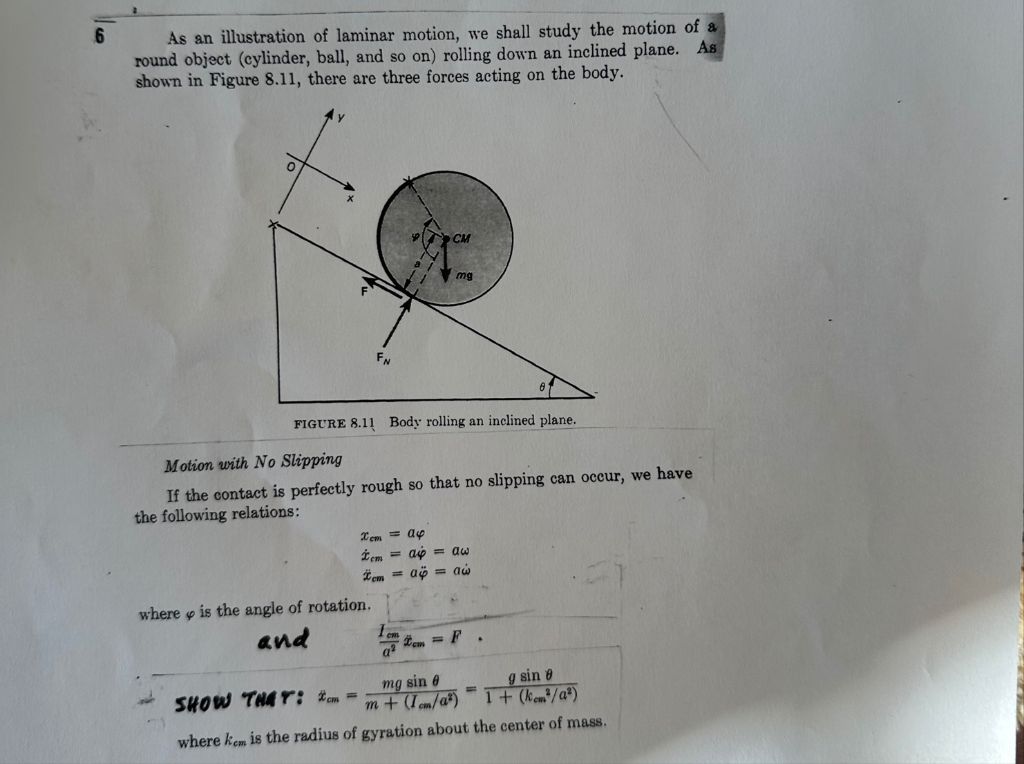 te —— ee
§ As an illustration of laminar motion, we shall study the motion of
round object (cylinder, ball, and so on) rolling down an inclined plane.
shown in Figure 8.11, there are three forces acting on the body.
g v :
i“
x EN
Rall
S59 VE. Bs
fy
FIGURE 8.11 Body rolling an inclined plane.
Motion with No Slipping
1f the contact is perfectly rough so that no sipping can 0oSuty we have
the following relations: : |
Ton = 09
’ bon = 0 = 09
rg :
where ¢ is the angle of rotation. 1 ¥
Flip otc
and leg =v
Be 4 mgsing __ __gER® __ .
~ Syow TMT: to = La TTF (eet/0) [
where ken is the radius of gyration about the center of mass.
This is AI generated Response.
Asked by: Rahul
Created at: 2025-12-12 03:51:57
Asked by: Rahul
Created at: 2025-12-12 03:51:57
Final Answer:
Rendered
Raw Text
Did you like this answer?
Sure! Let's follow a **two-step process** to derive the given result for the **acceleration of the center of mass (\(\ddot{x}_{cm}\))** for a body rolling down an incline **without slipping**:
---
## **Step 1: Force and Motion Equations**
### **Translational Motion (Newton's Second Law)**
For a body of mass \( m \) rolling down an incline of angle \( \theta \):
- The component of gravity down the plane: \( mg \sin\theta \)
- Friction force up the plane: \( F \)
So, Newton's second law along the incline:
\[
m\ddot{x}_{cm} = mg \sin\theta - F
\]
**Explanation:**
The net force down the plane equals mass times acceleration of the center of mass.
---
## **Step 2: Rotational Motion and No-Slip Constraint**
### **Rotational Motion (Moment About Center of Mass)**
- Torque due to friction: \( F \cdot a \), where \( a \) is the radius.
- Moment of inertia about the center of mass: \( I_{cm} \).
So,
\[
I_{cm} \ddot{\varphi} = F a
\]
But from the no-slip condition, \( \ddot{x}_{cm} = a\ddot{\varphi} \), so \( \ddot{\varphi} = \frac{\ddot{x}_{cm}}{a} \):
\[
I_{cm} \frac{\ddot{x}_{cm}}{a} = F a \implies F = \frac{I_{cm}}{a^2} \ddot{x}_{cm}
\]
**Explanation:**
The friction force provides the torque responsible for rotation, and the no-slip condition relates angular and linear accelerations.
---
### **Combine Both Equations**
Substitute \( F \) into the translational equation:
\[
m\ddot{x}_{cm} = mg \sin\theta - \frac{I_{cm}}{a^2} \ddot{x}_{cm}
\]
\[
\left( m + \frac{I_{cm}}{a^2} \right)\ddot{x}_{cm} = mg \sin\theta
\]
\[
\ddot{x}_{cm} = \frac{mg \sin\theta}{m + \frac{I_{cm}}{a^2}}
\]
Given \( I_{cm} = m k_{cm}^2 \) (where \( k_{cm} \) is the radius of gyration):
\[
\ddot{x}_{cm} = \frac{mg \sin\theta}{m + m \left(\frac{k_{cm}^2}{a^2}\right)}
= \frac{g \sin\theta}{1 + \left(\frac{k_{cm}^2}{a^2}\right)}
\]
---
## **Final Answer**
\[
\boxed{
\ddot{x}_{cm} = \frac{mg \sin\theta}{m + \left(\frac{I_{cm}}{a^2}\right)} = \frac{mg \sin\theta}{m + m \left(\frac{k_{cm}^2}{a^2}\right)} = \frac{g \sin\theta}{1 + \left(\frac{k_{cm}^2}{a^2}\right)}
}
\]
**This matches the required result.**
📢 Instructions:
- Ask anything relatd to above question only.
- For new Question goto :