 VIPSolutions
give answer in 2 step with explanation at the end of each step and final answer at the end:a. = % - = er OSA _ 5 Figure 13.1
Question:
give answer in 2 step with explanation at the end of each step and final answer at the end: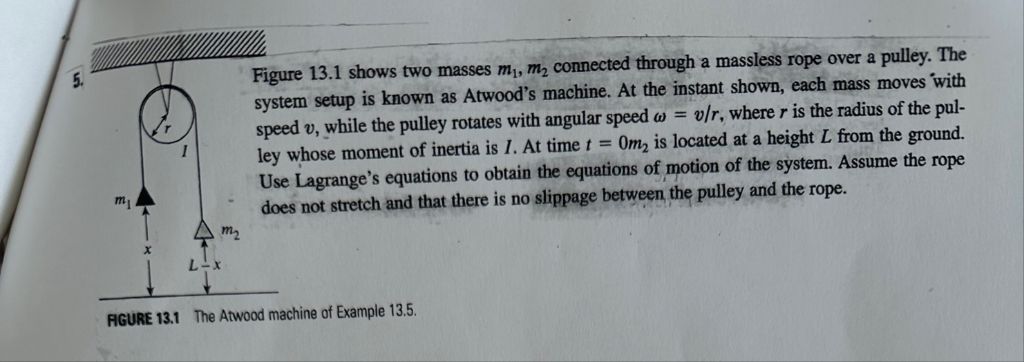 a. =
% - = er OSA _
5 Figure 13.1
This is AI generated Response.
Asked by: Rahul
Created at: 2025-12-12 03:44:49
Asked by: Rahul
Created at: 2025-12-12 03:44:49
Final Answer:
Rendered
Raw Text
Did you like this answer?
## Step 1: **Define the System and Write the Energies**
Let \( x \) be the distance fallen by mass \( m_1 \) (so mass \( m_2 \) rises by the same amount, since the rope is inextensible).
- **Kinetic Energy (T):**
- \( m_1 \) moves down with speed \( v \)
- \( m_2 \) moves up with speed \( v \)
- Pulley rotates with angular speed \( \omega = v/r \), moment of inertia \( I \)
So,
\[
T = \frac{1}{2} m_1 v^2 + \frac{1}{2} m_2 v^2 + \frac{1}{2} I \omega^2
\]
Substitute \( v = \dot{x} \) and \( \omega = \dot{x}/r \):
\[
T = \frac{1}{2} m_1 \dot{x}^2 + \frac{1}{2} m_2 \dot{x}^2 + \frac{1}{2} I \left(\frac{\dot{x}}{r}\right)^2
= \frac{1}{2} (m_1 + m_2) \dot{x}^2 + \frac{1}{2} \frac{I}{r^2} \dot{x}^2
= \frac{1}{2} \left(m_1 + m_2 + \frac{I}{r^2}\right) \dot{x}^2
\]
**Explanation:**
All kinetic energies are written in terms of \( \dot{x} \) (the velocity of the masses), using the relation between linear and angular speed at the rim of the pulley.
---
## Step 2: **Write the Potential Energy and Lagrangian, then Apply Lagrange's Equation**
- **Potential Energy (U):**
Let the zero level be at the ground. At time \( t \), \( m_1 \) is at height \( L-x \), \( m_2 \) is at height \( x \).
\[
U = m_1 g (L - x) + m_2 g x
\]
\[
U = m_1 g L - m_1 g x + m_2 g x = m_1 g L + (m_2 - m_1) g x
\]
(The constant \( m_1 g L \) can be ignored in the equations of motion.)
- **Lagrangian \( \mathcal{L} = T - U \):**
\[
\mathcal{L} = \frac{1}{2} \left(m_1 + m_2 + \frac{I}{r^2}\right) \dot{x}^2 - (m_2 - m_1) g x
\]
- **Apply Euler-Lagrange Equation:**
\[
\frac{d}{dt} \left( \frac{\partial \mathcal{L}}{\partial \dot{x}} \right) - \frac{\partial \mathcal{L}}{\partial x} =
\]
Compute derivatives:
\[
\frac{\partial \mathcal{L}}{\partial \dot{x}} = \left(m_1 + m_2 + \frac{I}{r^2}\right) \dot{x}
\]
\[
\frac{d}{dt} \left( \frac{\partial \mathcal{L}}{\partial \dot{x}} \right) = \left(m_1 + m_2 + \frac{I}{r^2}\right) \ddot{x}
\]
\[
\frac{\partial \mathcal{L}}{\partial x} = - (m_2 - m_1) g
\]
Plug into Euler-Lagrange:
\[
\left(m_1 + m_2 + \frac{I}{r^2}\right) \ddot{x} + (m_2 - m_1) g =
\]
\[
\boxed{
\ddot{x} = \frac{(m_1 - m_2) g}{m_1 + m_2 + \frac{I}{r^2}}
}
\]
**Explanation:**
The Lagrangian is constructed using the energies, and Lagrange’s equation gives the acceleration of the masses. The additional term \(\frac{I}{r^2}\) in the denominator accounts for the rotational inertia of the pulley.
---
## **Final Answer**
**Equation of motion:**
\[
\boxed{
\ddot{x} = \frac{(m_1 - m_2) g}{m_1 + m_2 + \frac{I}{r^2}}
}
\]
where \(x\) is the downward displacement of mass \(m_1\).
📢 Instructions:
- Ask anything relatd to above question only.
- For new Question goto :