give answer in 2 step with explanation at the end of each step and final answer at the end:Part B — Pure-Exchange Economy
B.1 (30 points) Pure-Exchange Economy
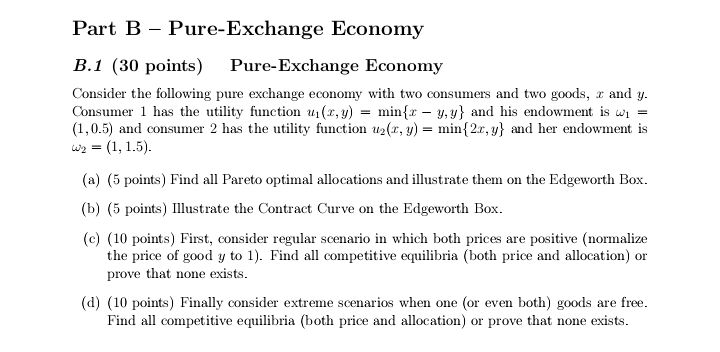
Consider the following pure exchange economy with two consumers and two goods, = and
Consumer 1 has the utility function w;(z,) = min{z — 3,y} and his endowment is w, =
(1,0.5) and consumer 2 has the utility function u(r, y) = min{2r,y} and her endowment is
w= (1,15).
(8) (5 points) Find all Pareto optimal allocations and illustrate them on the Edgeworth Box.
(b) (5 points) Tustrate the Contract Curve on the Edgeworth Box.
(¢) (10 points) First, consider regular scenario in which both prices are positive (normalize
the price of good y to 1). Find all competitive equilibria (both price and allocation) or
prove that none exists.
(d) (10 points) Finally consider extreme scenarios when one (or even both) goods are free.
Find all competitive equilibria (both price and allocation) or prove that none exists.
Question:
give answer in 2 step with explanation at the end of each step and final answer at the end:Part B — Pure-Exchange Economy
B.1 (30 points) Pure-Exchange Economy
Consider the following pure exchange economy with two consumers and two goods, = and
Consumer 1 has the utility function w;(z,) = min{z — 3,y} and his endowment is w, =
(1,0.5) and consumer 2 has the utility function u(r, y) = min{2r,y} and her endowment is
w= (1,15).
(8) (5 points) Find all Pareto optimal allocations and illustrate them on the Edgeworth Box.
(b) (5 points) Tustrate the Contract Curve on the Edgeworth Box.
(¢) (10 points) First, consider regular scenario in which both prices are positive (normalize
the price of good y to 1). Find all competitive equilibria (both price and allocation) or
prove that none exists.
(d) (10 points) Finally consider extreme scenarios when one (or even both) goods are free.
Find all competitive equilibria (both price and allocation) or prove that none exists.
This is AI generated Response.
Asked by: Rahul
Created at: 2025-12-11 20:08:22
Final Answer:
RenderedRaw Text
Did you like this answer?
Let's address **Part (a): all Pareto optimal allocations** in **2 steps**, with explanations.
---
### **Step1: Understand the Utility Functions and Pareto Optimality**
- **Consumer 1:** \( u_1(x_1, y_1) = \min\{x_1 - y_1, y_1\} \)
- **Consumer 2:** \( u_2(x_2, y_2) = \min\{2x_2, y_2\} \)
**Endowments:**
- Consumer 1: \( \omega_1 = (1, .5) \)
- Consumer 2: \( \omega_2 = (1, 1.5) \)
**Total resources:** \( (2, 2) \)
**Pareto optimality** requires that you cannot make one consumer better off without making the other worse off.
#### **Key:**
- For **Consumer 1**, utility is maximized when \( x_1 - y_1 = y_1 \implies x_1 = 2y_1 \)
- For **Consumer 2**, utility is maximized when \( 2x_2 = y_2 \)
**Explanation:**
Set each consumer at the point where their utility function argument is balanced for max utility. These are the lines \( x_1 = 2y_1 \) for Consumer 1 and \( 2x_2 = y_2 \) for Consumer 2.
---
### **Step 2: Find All Pareto Optimal Allocations**
Let \( (x_1, y_1) \) be the allocation to Consumer 1, so Consumer 2 gets \( (x_2, y_2) = (2-x_1, 2-y_1) \).
- **Consumer 1’s optimal:** \( x_1 = 2y_1 \)
- **Consumer 2’s optimal:** \( 2x_2 = y_2 \implies 2(2-x_1) = 2-y_1 \implies 4 - 2x_1 = 2 - y_1 \implies y_1 = 2x_1 - 2 \)
**Combine:**
- From above, \( x_1 = 2y_1 \implies y_1 = \frac{x_1}{2} \)
- But also, \( y_1 = 2x_1 - 2 \)
Set equal:
\[
\frac{x_1}{2} = 2x_1 - 2 \implies x_1 = 4x_1 - 4 \implies 3x_1 = 4 \implies x_1 = \frac{4}{3}
\]
\[
y_1 = \frac{4}{6} = \frac{2}{3}
\]
So, only the allocation \( (x_1, y_1) = \left(\frac{4}{3}, \frac{2}{3}\right) \) for Consumer 1 and \( (x_2, y_2) = \left(\frac{2}{3}, \frac{4}{3}\right) \) for Consumer 2 is feasible **if both are at their optimal mix**.
But **Pareto optimality** means _either_ consumer is at their max, not necessarily both. So, allow for corner solutions:
- **Consumer 1 at optimum:** \( x_1 = 2y_1 \), \( x_2 = 2 - x_1 \), \( y_2 = 2 - y_1 \)
- **Consumer 2 at optimum:** \( y_2 = 2x_2 \), \( x_1 = 2 - x_2 \), \( y_1 = 2 - y_2 \)
We must also have \( x_1 \ge , y_1 \ge , x_2 \ge , y_2 \ge \).
**Set 1:** \( x_1 = 2y_1 \), \( y_1 \in [,1] \) (since \( x_1 \le 2 \implies 2y_1 \le 2 \implies y_1 \le 1 \))
- So, allocations: \( (x_1, y_1) = (2y_1, y_1) \), \( (x_2, y_2) = (2-2y_1, 2-y_1) \), \( y_1 \in [,1] \)
**Set 2:** \( y_2 = 2x_2 \), \( x_2 \in [,1] \) (since \( y_2 \le 2 \implies 2x_2 \le 2 \implies x_2 \le 1 \))
- \( (x_2, y_2) = (x_2, 2x_2) \), \( (x_1, y_1) = (2-x_2, 2-2x_2) \), \( x_2 \in [,1] \)
**Final Answer:**
All **Pareto optimal allocations** are those where **at least one consumer's allocation lies on their respective "kink line"**:
- For **Consumer 1**: All allocations where \( x_1 = 2y_1 \), \( y_1 \in [,1] \)
- For **Consumer 2**: All allocations where \( y_2 = 2x_2 \), \( x_2 \in [,1] \)
---
## **Summary Table**
| Consumer 1 | Consumer 2 | Condition | Range |
|-----------------|------------------|------------------------|-----------------------|
| \( x_1 = 2y_1 \) | \( x_2 = 2-2y_1 \), \( y_2 = 2-y_1 \) | \( y_1 \in [,1] \) |
| \( x_1 = 2-x_2 \), \( y_1 = 2-2x_2 \) | \( y_2 = 2x_2 \) | \( x_2 \in [,1] \) |
---
## **Final Answer:**
**All Pareto optimal allocations are those where the allocation of at least one consumer lies on their utility kink line:**
- \( (x_1, y_1) = (2y_1, y_1) \), \( (x_2, y_2) = (2-2y_1, 2-y_1) \), for \( y_1 \in [,1] \)
- \( (x_2, y_2) = (x_2, 2x_2) \), \( (x_1, y_1) = (2-x_2, 2-2x_2) \), for \( x_2 \in [,1] \)
All such allocations are Pareto optimal and can be illustrated as the contract curve in the Edgeworth Box.
VIPSolutions focuses on clear, step‑by‑step explanations so you can learn quickly. Whether you need an AI‑generated walkthrough or a short hint to get unstuck, each solution is organized for fast reading and easy review later.
Search similar questions, compare approaches, and bookmark the best answers for revision. Our goal is simple: quick, reliable study help that feels natural—not noisy.
 VIPSolutions
 Part B — Pure-Exchange Economy
B.1 (30 points) Pure-Exchange Economy
Consider the following pure exchange economy with two consumers and two goods, = and
Consumer 1 has the utility function w;(z,) = min{z — 3,y} and his endowment is w, =
(1,0.5) and consumer 2 has the utility function u(r, y) = min{2r,y} and her endowment is
w= (1,15).
(8) (5 points) Find all Pareto optimal allocations and illustrate them on the Edgeworth Box.
(b) (5 points) Tustrate the Contract Curve on the Edgeworth Box.
(¢) (10 points) First, consider regular scenario in which both prices are positive (normalize
the price of good y to 1). Find all competitive equilibria (both price and allocation) or
prove that none exists.
(d) (10 points) Finally consider extreme scenarios when one (or even both) goods are free.
Find all competitive equilibria (both price and allocation) or prove that none exists.