 VIPSolutions
give answer in 2 step with explanation at the end of each step and final answer at the end:EE — lms lp lke eye Sr £101 bn en " 83, —— 32 . PEI FE a § 5 . is sou Ts Aa mmm oA om ts goa Sie . aur, soe Cnn mmol e— ima ce
Question:
give answer in 2 step with explanation at the end of each step and final answer at the end: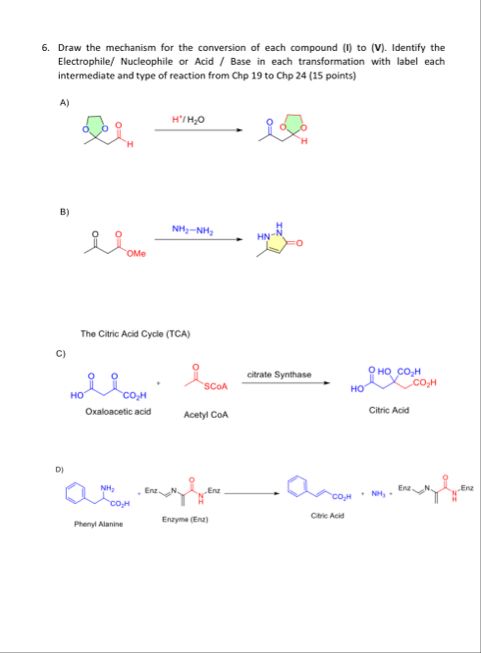 EE —
lms lp lke eye
Sr £101 bn en
"
83, —— 32
.
PEI
FE
a
§ 5
. is sou
Ts Aa mmm oA om
ts goa Sie
.
aur, soe Cnn mmol
e— ima ce
This is AI generated Response.
Asked by: Rahul
Created at: 2025-12-11 16:09:20
Asked by: Rahul
Created at: 2025-12-11 16:09:20
Final Answer:
Rendered
Raw Text
Did you like this answer?
Let's break down each transformation step-by-step, identifying electrophiles/nucleophiles/acids/bases and the reaction type.
---
## **A)**
### **Step 1: Acid-Catalyzed Hydrolysis of Ester**
- **Reactants:** Gamma-butyrolactone (cyclic ester) + acid + water.
- **Type of Reaction:** Nucleophilic acyl substitution (hydrolysis of ester).
- **Mechanism:**
1. **Protonation of Carbonyl:** The carbonyl oxygen of the lactone is protonated by acid, making the carbonyl carbon more electrophilic.
- **Electrophile:** Carbonyl carbon.
- **Nucleophile:** Water.
2. **Nucleophilic Attack by Water:** Water attacks the carbonyl carbon, leading to ring opening and formation of a hydroxy acid.
**Explanation:** Acid catalyzes the ring opening of lactone via nucleophilic attack by water, forming gamma-hydroxybutyric acid.
---
## **B)**
### **Step 1: Wolff–Kishner Reduction**
- **Reactants:** Methyl ketone + hydrazine (NH₂NH₂).
- **Type of Reaction:** Reduction of carbonyl group to methylene.
- **Mechanism:**
1. **Formation of Hydrazone:** Ketone reacts with hydrazine. The carbonyl carbon (electrophile) is attacked by hydrazine (nucleophile), forming a hydrazone intermediate and water.
- **Electrophile:** Carbonyl carbon.
- **Nucleophile:** Hydrazine.
2. **Reduction Under Basic Conditions:** The hydrazone is heated with base, leading to loss of N₂ and formation of a methylene (CH₂) group.
**Explanation:** Hydrazine replaces the carbonyl oxygen, and under basic conditions, the hydrazone is reduced to a CH₂ group.
---
## **C)**
### **Step 1: Claisen Condensation (Aldol-like enzyme-catalyzed reaction)**
- **Reactants:** Oxaloacetate + Acetyl-CoA (TCA cycle).
- **Type of Reaction:** Nucleophilic addition (carbon–carbon bond formation).
- **Mechanism:**
1. **Enolate Formation:** Acetyl-CoA forms an enolate (nucleophile) under enzyme catalysis.
2. **Attack on Oxaloacetate:** The enolate attacks the carbonyl carbon on oxaloacetate (electrophile), forming citrate.
**Explanation:** Enzyme-catalyzed enolate addition forms a new C–C bond, creating citric acid.
---
## **D)**
### **Step 1: Transamination**
- **Reactants:** Phenylalanine + Enzyme (transaminase).
- **Type of Reaction:** Transamination (amino group transfer).
- **Mechanism:**
1. **Amino Transfer:** The amino group of phenylalanine (nucleophile) is transferred to an acceptor, forming phenylpyruvate and glutamate.
2. **Conversion to Citrate:** Through further reactions (not detailed here), this structure can enter the TCA cycle.
**Explanation:** Enzymatic transfer of the amino group allows phenylalanine to be converted and funneled into central metabolism.
---
## **Final Answers (Summary):**
- **A)** Acid-catalyzed hydrolysis of lactone to hydroxy acid (Nucleophilic acyl substitution).
- **B)** Wolff–Kishner reduction (Nucleophilic addition, reduction of C=O to CH₂).
- **C)** Claisen condensation (Enolate nucleophilic addition to carbonyl in TCA cycle).
- **D)** Enzymatic transamination (Amino group transfer by nucleophilic substitution).
Let me know if you want the arrow-pushing mechanisms or more details for any specific step!
📢 Instructions:
- Ask anything relatd to above question only.
- For new Question goto :