 VIPSolutions
give answer in 2 step with explanation at the end of each step and final answer at the end:h a CAM-follower mechanism, the follower has 60 mm of stroke length, _ First Outstroke (30 mm): 60°, Dwell: 30°, First Return stroke (15 mm): 60°, Dwell: 30°, | ~ Second Outstroke (45 mm): 60°, Dwell: 30°, Second Return stroke (60 mm): 60°, Dwell: Rest ofthe travel. 3 a) [2] Draw the follower displacement profile. 5 ht b) [4] Draw the CAM profile if the base the circle radius is 50 mm, and the follower is % in-line with the CAM axis, (Use ruler, compass and protractor to draw the follower and CAM profile) | it.
Question:
give answer in 2 step with explanation at the end of each step and final answer at the end: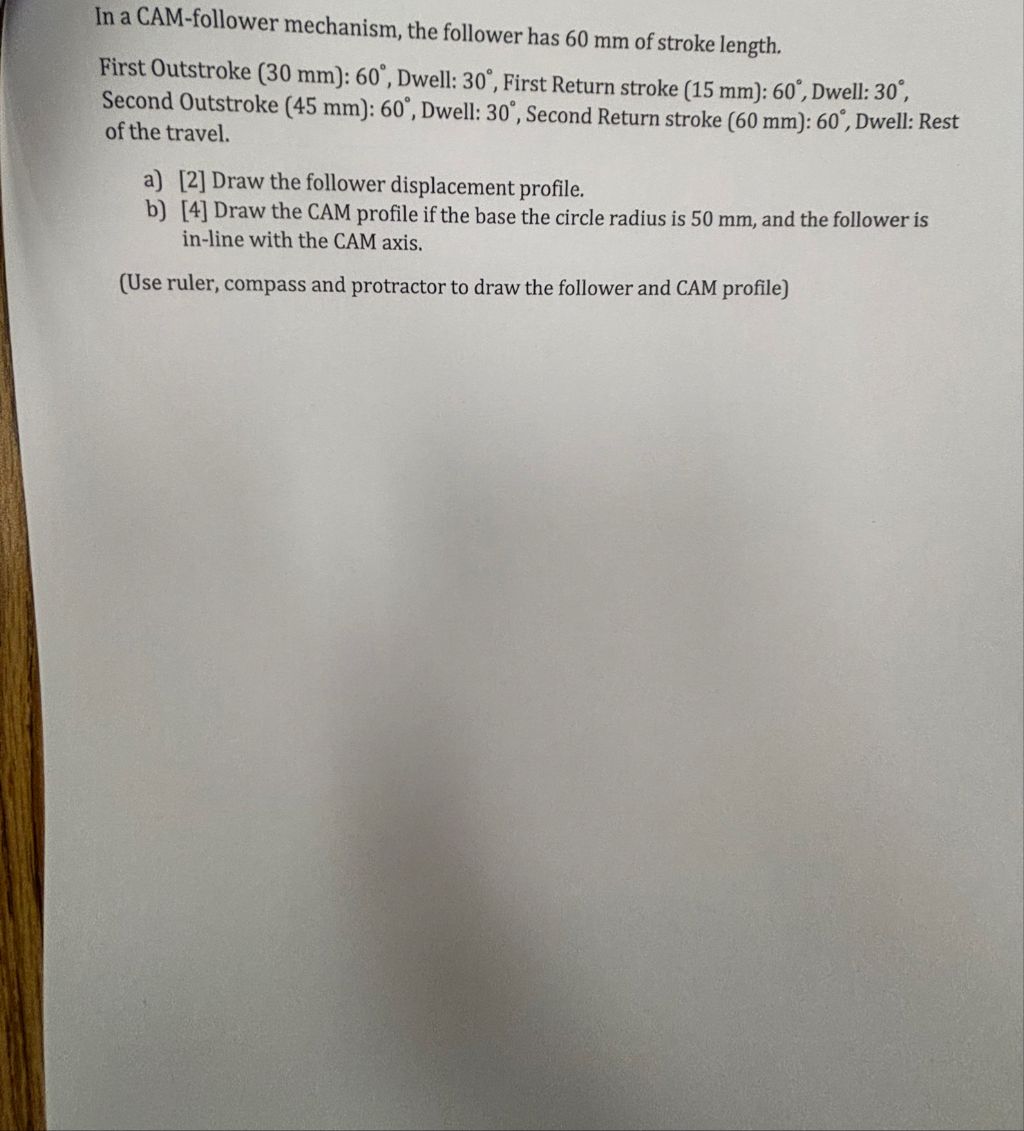 h a CAM-follower mechanism, the follower has 60 mm of stroke length,
_ First Outstroke (30 mm): 60°, Dwell: 30°, First Return stroke (15 mm): 60°, Dwell: 30°,
| ~ Second Outstroke (45 mm): 60°, Dwell: 30°, Second Return stroke (60 mm): 60°, Dwell: Rest
ofthe travel.
3 a) [2] Draw the follower displacement profile. 5
ht b) [4] Draw the CAM profile if the base the circle radius is 50 mm, and the follower is
% in-line with the CAM axis,
(Use ruler, compass and protractor to draw the follower and CAM profile)
|
it.
This is AI generated Response.
Asked by: Rahul
Created at: 2025-12-11 15:57:26
Asked by: Rahul
Created at: 2025-12-11 15:57:26
Final Answer:
Rendered
Raw Text
Did you like this answer?
Let's solve the problem step by step:
---
## Step 1: Draw the Follower Displacement Profile
### Breakdown of Motion
Given data:
- **Total stroke length:** 60 mm
- **First Outstroke30 mm):** 60°
- **Dwell:** 30°
- **First Return stroke (15 mm):** 60°
- **Dwell:** 30°
- **Second Outstroke (45 mm):** 60°
- **Dwell:** 30°
- **Second Return stroke (60 mm):** 60°
- **Dwell:** Rest of the travel
Let's organize the follower displacement for each cam rotation segment:
| Segment | Angle (°) | Displacement (mm) | Type |
|-------------------------|-----------|-------------------|--------------|
| First Outstroke | 60 | → 30 | Rise |
| Dwell | 30 | 30 | Dwell |
| First Return stroke | 60 | 30 → 15 | Fall |
| Dwell | 30 | 15 | Dwell |
| Second Outstroke | 60 | 15 → 60 | Rise |
| Dwell | 30 | 60 | Dwell |
| Second Return stroke | 60 | 60 → | Fall |
| Dwell | Rest | | Dwell |
### Displacement Profile Construction
1. Draw a horizontal line and divide it into angular segments as above (60, 30, 60, 30, 60, 30, 60, 30).
2. On the vertical axis, mark displacement from mm to 60 mm.
3. Plot the rise, dwell, fall, and dwell segments accordingly.
**Explanation:**
This profile shows how the follower rises, dwells, falls, and dwells again as the cam rotates. Each segment corresponds to a cam rotation angle and the follower displacement.
---
## Step 2: Draw the CAM Profile (Base Circle Radius = 50 mm)
### Construction Steps
1. **Draw the base circle:** Draw a circle with a 50 mm radius.
2. **Mark angular segments:** From a reference line, use a protractor to mark off the angles for each segment (60°, 30°, etc.) around the base circle.
3. **Radial Lines:** From the circle center, draw radial lines at those angles.
4. **Transfer Displacements:** From each radial line, measure outward from the base circle by the displacement amount from the displacement diagram (e.g., at 60°, mark 30 mm from the base circle, at 120°, mark 30 mm, etc.).
5. **Join points with a smooth curve:** Connect these offset points smoothly to form the cam profile.
**Explanation:**
This gives the actual cam shape that will produce the specified follower motion when rotated. The displacement values are measured radially outward from the base circle along each segment.
---
## Final Answer
**Step 1:**
Draw the follower displacement profile as per the angular segments and corresponding follower movements.
**Step 2:**
Draw the cam profile by plotting the displacement for each segment radially from the base circle (50 mm radius), using the displacement profile as reference.
---
**Note:**
Use a ruler, compass, and protractor for accuracy as instructed.
If you need a hand-drawn example or a more visual diagram, let me know!
📢 Instructions:
- Ask anything relatd to above question only.
- For new Question goto :