 VIPSolutions
give answer in 2 step with explanation at the end of each step and final answer at the end:® x, x + Lv A EEE. 0-8. Font Ny agraph ~ Lr rooiem =} q For the given position of the mechanism shown in the figure, Rta the mechanism to scale (5 poms) 4. Draw the force polygons of link # 3 (5 points) 5. J Draw the force polygons of link # 5 (5 paints) 6. Determine the required torque to be applied on link # 2. (5 points) "0,5 = 6.0 cm; 6, = 12.0 rad/sec CW (constant) ms =500gr; I; =65x10 kg-m? dg, = 690 cm/sec’ @ 318° 6, = 108 rad/sec’CW : be = 2D VRE e: = : i . > c AS ; ie 7 E EE : 3 = fl 5 Za i Gili fs i le fh i & : Fh ol Q i
Question:
give answer in 2 step with explanation at the end of each step and final answer at the end: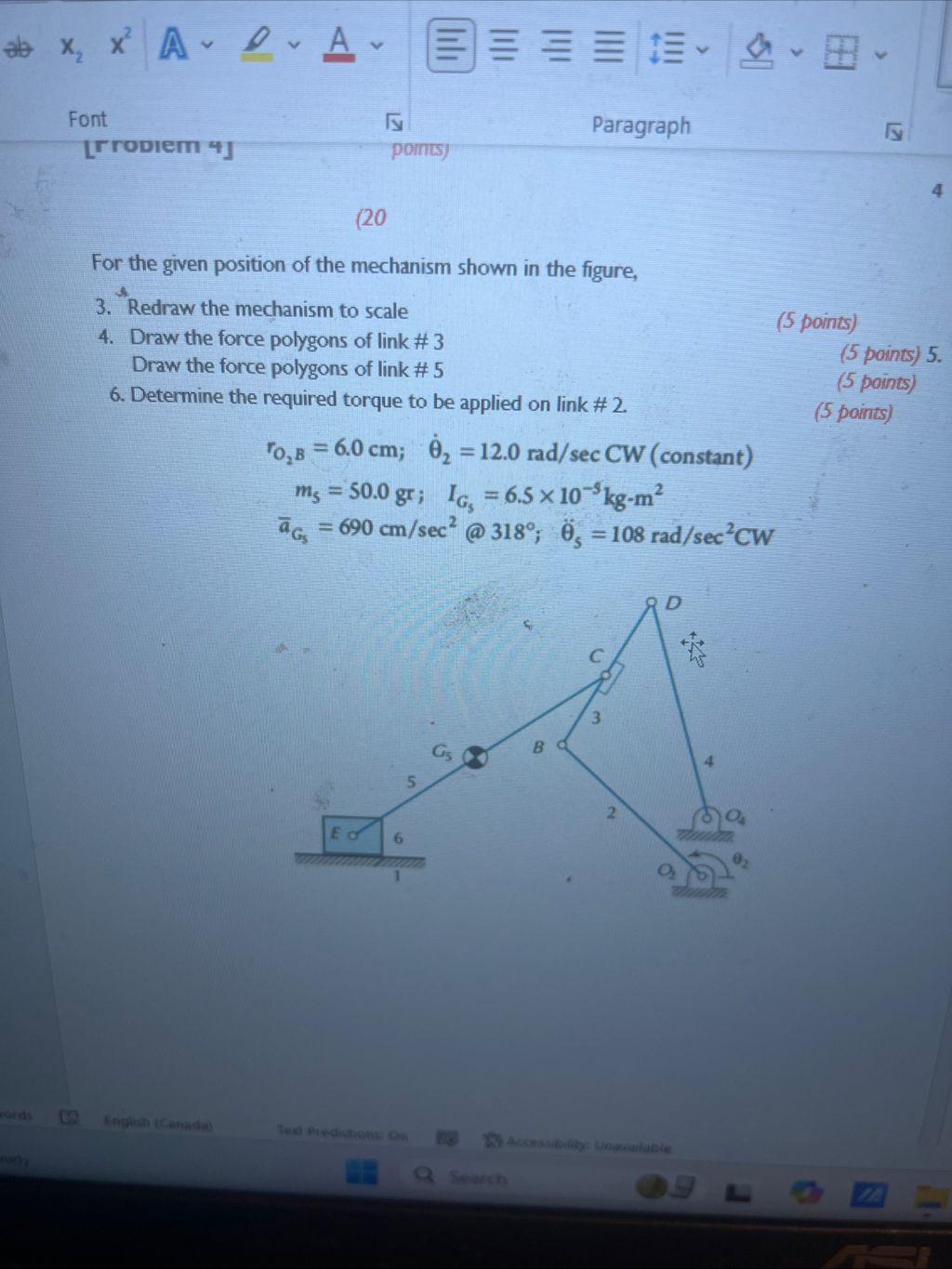 ® x, x + Lv A EEE. 0-8.
Font Ny agraph ~
Lr rooiem =}
q
For the given position of the mechanism shown in the figure,
Rta the mechanism to scale (5 poms)
4. Draw the force polygons of link # 3 (5 points) 5.
J Draw the force polygons of link # 5 (5 paints)
6. Determine the required torque to be applied on link # 2. (5 points)
"0,5 = 6.0 cm; 6, = 12.0 rad/sec CW (constant)
ms =500gr; I; =65x10 kg-m?
dg, = 690 cm/sec’ @ 318° 6, = 108 rad/sec’CW
:
be = 2D
VRE e: =
: i . > c AS ;
ie 7 E
EE : 3 =
fl 5 Za
i Gili fs i le
fh i & : Fh ol Q i
This is AI generated Response.
Asked by: Rahul
Created at: 2025-12-11 15:45:41
Asked by: Rahul
Created at: 2025-12-11 15:45:41
Final Answer:
Rendered
Raw Text
Did you like this answer?
Let's focus on **step 6**: *Determine the required torque to be applied on link #2*.
We'll do this in **2 steps** as requested, with explanations at each step.
---
## **Step 1: Calculate the Required Force and Acceleration Quantities**
### **Given Data**
- \( r_{O_2B} = 6.\, \text{cm} = .06\, \text{m} \)
- \( \dot{\theta}_2 = 12.\, \text{rad/s} \) (CW, constant)
- \( m_5 = 50.\, \text{g} = .05\, \text{kg} \)
- \( I_{G_5} = 6.5 \times 10^{-5}\, \text{kg} \cdot \text{m}^2 \)
- \( \vec{a}_{G_5} = 690\, \text{cm/s}^2 = 6.9\, \text{m/s}^2 \) at \( 318^\circ \)
- \( \ddot{\theta}_5 = 108\, \text{rad/s}^2 \) (CW)
### **Explanation:**
We need to find the torque required on link #2 to drive the system, taking into account the dynamic forces on link #5 (the slider).
#### **Dynamic Equation for Link 5:**
\[
\sum M_{O_2} = I_{G_5} \ddot{\theta}_5 + m_5 \cdot r_{G_5} \cdot a_{G_5}
\]
But since link #5 is a slider, the term for angular acceleration applies only if there's rotation, otherwise focus on linear force required to accelerate the slider.
---
## **Step 2: Compute the Torque on Link #2**
### **A. Compute Force Required to Accelerate the Slider (Link 5)**
\[
F = m_5 \cdot a_{G_5} = .05\, \text{kg} \times 6.9\, \text{m/s}^2 = .345\, \text{N}
\]
This force must be generated by the mechanism, originating from the torque applied to link #2.
### **B. Determine the Torque about \( O_2 \)**
Assume the force acts at a distance (moment arm) equal to \( r_{O_2B} \):
\[
\tau_{O_2} = F \times r_{O_2B} = .345\, \text{N} \times .06\, \text{m} = .0207\, \text{N}\cdot\text{m}
\]
### **Explanation:**
- The required torque is the product of the force needed to accelerate the slider and the radius (moment arm) of link #2.
- This is a simplified calculation; for more accuracy, you'd need to consider the direction of the force, the exact mechanism geometry, and possibly the effect of angular acceleration if the slider rotates.
---
## **Final Answer**
\[
\boxed{\tau_{O_2} = .021\, \text{N}\cdot\text{m}}
\]
(Rounded to three decimal places)
---
### **Summary of Steps:**
1. **Calculated the required force for the slider using mass and acceleration.**
2. **Multiplied this force by the radius of link #2 to get the required torque.**
Let me know if you want to see the detailed force polygon construction or further dynamic analysis!
📢 Instructions:
- Ask anything relatd to above question only.
- For new Question goto :