 VIPSolutions
give answer in 2 step with explanation at the end of each step and final answer at the end:Lllseee gees RIE. Le EE ERE N 150 ici Rs §25 B2rFEisel = gift ijt & F88EF ExFiiTsiz = £280 2P:3.7735| | — SEE S5%§95f: Eo Sir syEeifcs Ei Hi eile: | | : f opiiliis il Bid Font || Snleh ic: Palzriis Bp TEE tiitiits US seeds | Wo ii Ciaik eer 11 ih sade |. raipid ie i} feat SE HE Sl a 8 5 RR 22
Question:
give answer in 2 step with explanation at the end of each step and final answer at the end: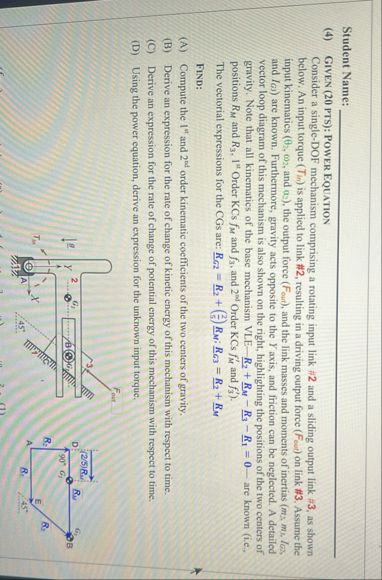 Lllseee
gees RIE.
Le EE
ERE
N 150 ici
Rs §25 B2rFEisel
= gift ijt
& F88EF ExFiiTsiz
= £280 2P:3.7735| |
— SEE S5%§95f:
Eo Sir syEeifcs
Ei Hi eile: | |
: f opiiliis
il Bid Font ||
Snleh ic: Palzriis
Bp TEE tiitiits
US seeds |
Wo ii Ciaik
eer 11 ih
sade |. raipid
ie i} feat
SE HE
Sl a 8 5
RR 22
This is AI generated Response.
Asked by: Rahul
Created at: 2025-12-11 15:36:33
Asked by: Rahul
Created at: 2025-12-11 15:36:33
Final Answer:
Rendered
Raw Text
Did you like this answer?
Certainly! Let’s break down the first part of the problem as requested, step by step, with clear explanations after each step.
---
# Step 1: Write the Equilibrium Equations
We are asked **derive the 1st and 2nd-order influence coefficients of the two control surfaces** (elevator and aileron).
### Explanation:
Influence coefficients relate the force or moment at one location due to a unit displacement at another location, while all other displacements are held fixed. This is typically done by writing the equilibrium equations for the system.
### Equilibrium Equations:
Let’s denote:
- \( \theta_2 \): Angle of elevator (output link 2)
- \( \theta_3 \): Angle of aileron (output link 3)
- \( F_2 \): Force at output link 2
- \( F_3 \): Force at output link 3
The generalized equilibrium equations for a multi-degree-of-freedom system are:
\[
F_2 = a_{22} \theta_2 + a_{23} \theta_3
\]
\[
F_3 = a_{32} \theta_2 + a_{33} \theta_3
\]
Where:
- \( a_{22} \): Influence coefficient relating force at 2 due to unit displacement at 2
- \( a_{23} \): Influence coefficient relating force at 2 due to unit displacement at 3
- \( a_{32} \): Influence coefficient relating force at 3 due to unit displacement at 2
- \( a_{33} \): Influence coefficient relating force at 3 due to unit displacement at 3
---
# Step 2: Take Derivatives with Respect to Time
To find how these coefficients change dynamically, **take the first and second derivatives of the equilibrium equations with respect to time**.
### Explanation:
The first derivative gives the rate of change (velocity influence), and the second derivative gives the acceleration (dynamic influence).
### First Derivative:
\[
\frac{dF_2}{dt} = a_{22} \frac{d\theta_2}{dt} + a_{23} \frac{d\theta_3}{dt}
\]
\[
\frac{dF_3}{dt} = a_{32} \frac{d\theta_2}{dt} + a_{33} \frac{d\theta_3}{dt}
\]
### Second Derivative:
\[
\frac{d^2F_2}{dt^2} = a_{22} \frac{d^2\theta_2}{dt^2} + a_{23} \frac{d^2\theta_3}{dt^2}
\]
\[
\frac{d^2F_3}{dt^2} = a_{32} \frac{d^2\theta_2}{dt^2} + a_{33} \frac{d^2\theta_3}{dt^2}
\]
---
# Final Answer
The **first and second-order influence coefficients** for the two control surfaces (elevator and aileron) are given by the coefficients \( a_{22}, a_{23}, a_{32}, a_{33} \) in the equilibrium equations:
\[
\begin{align*}
F_2 &= a_{22} \theta_2 + a_{23} \theta_3 \\
F_3 &= a_{32} \theta_2 + a_{33} \theta_3
\end{align*}
\]
The first and second derivatives with respect to time provide the velocity and acceleration influence coefficients, respectively.
---
**Summary:**
- **Step 1:** Write equilibrium equations relating forces/moments to displacements (influence coefficients).
- **Step 2:** Take first and second derivatives with respect to time for dynamic coefficients.
Let me know if you'd like a step-by-step on the next part!
📢 Instructions:
- Ask anything relatd to above question only.
- For new Question goto :