 VIPSolutions
give answer in 2 step with explanation at the end of each step and final answer at the end:Consider a robotic system whose position vector is denoted by x = [xy, x,]7. The robot is instrumented with a sensing system whose feedback features y satisfy the following relation: _ _ [sin(xy) + xy x; + X2%1 + 2 y=f= vais — sin(x; + x,) — 34 (a) Derive the interaction matrix L = df /x for this system (12 marks) (b) Explain (with equations and schematic control loop) how you would design a sensorimotor controller X to drive y into a desired constant reference yg. (8 marks)
Question:
give answer in 2 step with explanation at the end of each step and final answer at the end: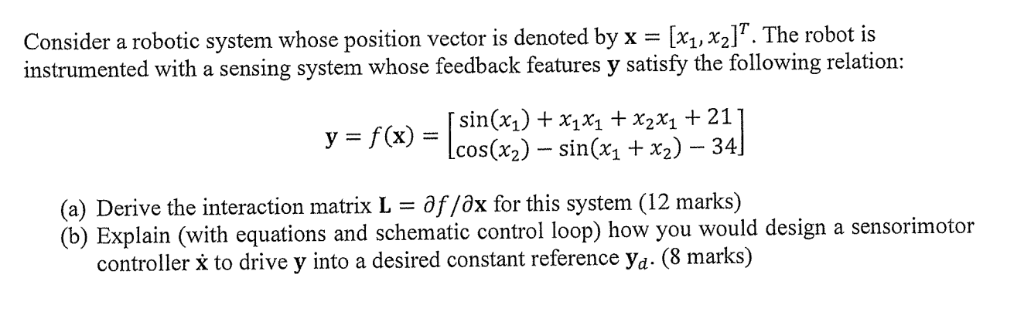 Consider a robotic system whose position vector is denoted by x = [xy, x,]7. The robot is
instrumented with a sensing system whose feedback features y satisfy the following relation:
_ _ [sin(xy) + xy x; + X2%1 + 2
y=f= vais — sin(x; + x,) — 34
(a) Derive the interaction matrix L = df /x for this system (12 marks)
(b) Explain (with equations and schematic control loop) how you would design a sensorimotor
controller X to drive y into a desired constant reference yg. (8 marks)
This is AI generated Response.
Asked by: Rahul
Created at: 2025-12-11 04:40:34
Asked by: Rahul
Created at: 2025-12-11 04:40:34
Final Answer:
Rendered
Raw Text
Did you like this answer?
Let's break down the solution step by step:
---
## Step 1: Derive the Interaction Matrix \( \mathbf{L} = \frac{\partial \mathbf{f}}{\partial \mathbf{x}} \)
Given:
\[
\mathbf{x} = \begin{bmatrix} x_1 \\ x_2 \end{bmatrix}, \quad
\mathbf{y} = \mathbf{f}(\mathbf{x}) =
\begin{bmatrix}
\sin(x_1) + x_1 x_1 + x_2 x_1 + 21 \\
\cos(x_2) - \sin(x_1 + x_2) - 34
\end{bmatrix}
\]
### Compute the Jacobian (Interaction Matrix)
The interaction matrix \( \mathbf{L} \) is the Jacobian of \( \mathbf{f}(\mathbf{x}) \):
\[
\mathbf{L} = \frac{\partial \mathbf{f}}{\partial \mathbf{x}} =
\begin{bmatrix}
\frac{\partial f_1}{\partial x_1} & \frac{\partial f_1}{\partial x_2} \\
\frac{\partial f_2}{\partial x_1} & \frac{\partial f_2}{\partial x_2}
\end{bmatrix}
\]
#### For \( f_1(x_1, x_2) = \sin(x_1) + x_1^2 + x_2 x_1 + 21 \):
- \( \frac{\partial f_1}{\partial x_1} = \cos(x_1) + 2x_1 + x_2 \)
- \( \frac{\partial f_1}{\partial x_2} = x_1 \)
#### For \( f_2(x_1, x_2) = \cos(x_2) - \sin(x_1 + x_2) - 34 \):
- \( \frac{\partial f_2}{\partial x_1} = -\cos(x_1 + x_2) \)
- \( \frac{\partial f_2}{\partial x_2} = -\sin(x_2) - \cos(x_1 + x_2) \)
**So, the interaction matrix is:**
\[
\boxed{
\mathbf{L} =
\begin{bmatrix}
\cos(x_1) + 2x_1 + x_2 & x_1 \\
-\cos(x_1 + x_2) & -\sin(x_2) - \cos(x_1 + x_2)
\end{bmatrix}
}
\]
**Explanation:**
This matrix relates small changes in the robot's position vector \( \mathbf{x} \) to small changes in sensory feedback \( \mathbf{y} \).
---
## Step 2: Design a Sensorimotor Controller to Drive \( \mathbf{y} \) to \( \mathbf{y}_d \)
We want to design a control law for \( \dot{\mathbf{x}} \) so that \( \mathbf{y} \to \mathbf{y}_d \) (desired feature vector).
### Error Definition
\[
\mathbf{e} = \mathbf{y} - \mathbf{y}_d
\]
### Control Law (Visual Servoing)
The time derivative of \( \mathbf{y} \):
\[
\dot{\mathbf{y}} = \mathbf{L} \dot{\mathbf{x}}
\]
To drive the error to zero, set a desired dynamics (e.g., exponential decay):
\[
\dot{\mathbf{e}} = -\lambda \mathbf{e}
\]
Since \( \dot{\mathbf{e}} = \dot{\mathbf{y}} = \mathbf{L} \dot{\mathbf{x}} \), we have:
\[
\mathbf{L} \dot{\mathbf{x}} = -\lambda (\mathbf{y} - \mathbf{y}_d)
\]
Assuming \( \mathbf{L} \) is invertible (or using pseudo-inverse if not):
\[
\dot{\mathbf{x}} = -\lambda \mathbf{L}^+ (\mathbf{y} - \mathbf{y}_d)
\]
Where \( \lambda > \) is a gain, and \( \mathbf{L}^+ \) is the (pseudo-)inverse of \( \mathbf{L} \).
**Schematic Control Loop:**
1. Measure \( \mathbf{x} \), compute \( \mathbf{y} = \mathbf{f}(\mathbf{x}) \).
2. Compute error: \( \mathbf{e} = \mathbf{y} - \mathbf{y}_d \).
3. Compute interaction matrix \( \mathbf{L} \).
4. Compute control law: \( \dot{\mathbf{x}} = -\lambda \mathbf{L}^+ \mathbf{e} \).
5. Apply \( \dot{\mathbf{x}} \) to the robot.
6. Repeat.
**Explanation:**
This control strategy ensures that the sensory feedback \( \mathbf{y} \) converges exponentially to the desired value \( \mathbf{y}_d \) by using the interaction matrix to map sensory errors to corrective motions.
---
## **Final Answers**
### **(a) Interaction Matrix**
\[
\boxed{
\mathbf{L} =
\begin{bmatrix}
\cos(x_1) + 2x_1 + x_2 & x_1 \\
-\cos(x_1 + x_2) & -\sin(x_2) - \cos(x_1 + x_2)
\end{bmatrix}
}
\]
### **(b) Sensorimotor Controller**
\[
\boxed{
\dot{\mathbf{x}} = -\lambda \mathbf{L}^+ (\mathbf{y} - \mathbf{y}_d)
}
\]
Where \( \lambda > \) and \( \mathbf{L}^+ \) is the pseudo-inverse of \( \mathbf{L} \). This drives \( \mathbf{y} \) to \( \mathbf{y}_d \).
📢 Instructions:
- Ask anything relatd to above question only.
- For new Question goto :