 VIPSolutions
give answer in 2 step with explanation at the end of each step and final answer at the end:Consider a function f whose derivative y= f (x) is sketched below. We know that f(2)=1. 7 = 6 5 4 3 2 1 ur TEE \af p) N_/ 5 -4 -5 From this graph, we know that (select one correct answer). ® 13) is positive. f(3) is negative © r6)=0 ® Since we only have the graph of y= f' (x) , we have no way of knowing anything about f(3) .
Question:
give answer in 2 step with explanation at the end of each step and final answer at the end: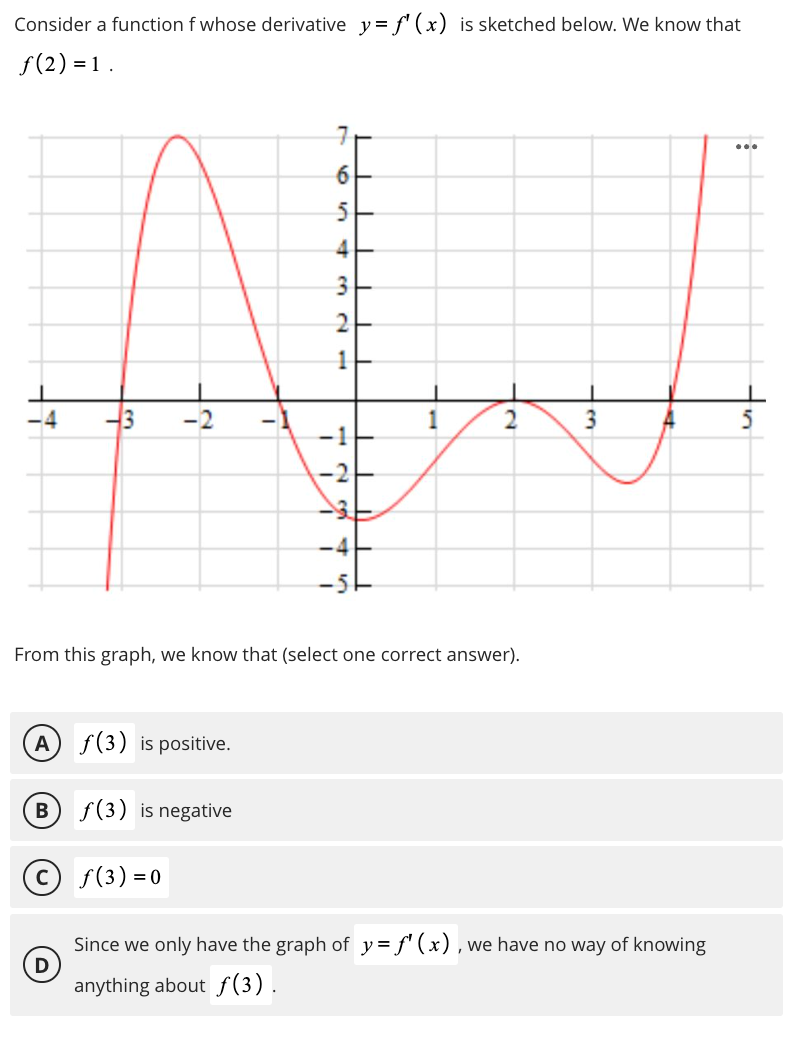 Consider a function f whose derivative y= f (x) is sketched below. We know that
f(2)=1.
7 =
6
5
4
3
2
1
ur TEE \af p) N_/ 5
-4
-5
From this graph, we know that (select one correct answer).
® 13) is positive.
f(3) is negative
© r6)=0
® Since we only have the graph of y= f' (x) , we have no way of knowing
anything about f(3) .
This is AI generated Response.
Asked by: Rahul
Created at: 2025-12-11 04:09:56
Asked by: Rahul
Created at: 2025-12-11 04:09:56
Final Answer:
Rendered
Raw Text
Did you like this answer?
### Step 1: Analyze the Graph of \( f'(x) \)
The given graph is of \( f'(x) \), which tells us about the **slope** of \( f(x) \), not the value of \( f(x) \) itself. We are also told that \( f(2) = 1 \). To find \( f(3) \), we need to consider how \( f(x) \) changes from \( x = 2 \) to \( x = 3 \). This change is given by the **area under the curve** of \( f'(x) \) between 2 and 3.
**Explanation:**
The derivative \( f'(x) \) gives the rate of change of \( f(x) \). The value of \( f(x) \) at a new point can be found by adding the net area under \( f'(x) \) from the starting point to the new point.
---
### Step 2: Estimate the Area Under \( f'(x) \) from 2 to 3
Look at the graph between \( x = 2 \) and \( x = 3 \):
- In this interval, \( f'(x) \) is below the x-axis (negative values), which means \( f(x) \) is **decreasing**.
- Since \( f(2) = 1 \) and the area under \( f'(x) \) from 2 to 3 is negative, \( f(3) \) will be **less than 1**.
- But is \( f(3) \) negative? The area does not appear to be large enough to bring \( f(3) \) below zero (it looks much less than -1), so \( f(3) \) is likely still positive.
**Explanation:**
Since \( f'(x) \) is negative from 2 to 3, \( f(x) \) decreases but does not drop below zero if the area (magnitude) is less than 1.
---
### **Final Answer**
**A. \( f(3) \) is positive.**
We know \( f(3) \) is positive because \( f(2) = 1 \) and the negative area under \( f'(x) \) from 2 to 3 is not enough to make \( f(3) \) negative.
📢 Instructions:
- Ask anything relatd to above question only.
- For new Question goto :