 VIPSolutions
give answer in 2 step with explanation at the end of each step and final answer at the end:AD) Lek He pnp ok nocenal Line of the curve C lec Lhe Some as +e inomnak Line af he nr ve er. Show Hno® 2D = TS) + A, where dan on — A) 'd (63 = —- > rT n==b C,e,t,n b - - EE x >% T n a C,et, tt, nk NN, ~C NS yd FL RS) ADA 2 / - aw oy « a df _pean+nl--2) Eg ds 0 ¢ Sance Pirie bid oa t° ds qt J de Hi ds ” = ra o Is n=ztb d EE — — -— sdk ds 5 dd? T° ds = dZ°. 7 dd _,.n=0 ds
Question:
give answer in 2 step with explanation at the end of each step and final answer at the end: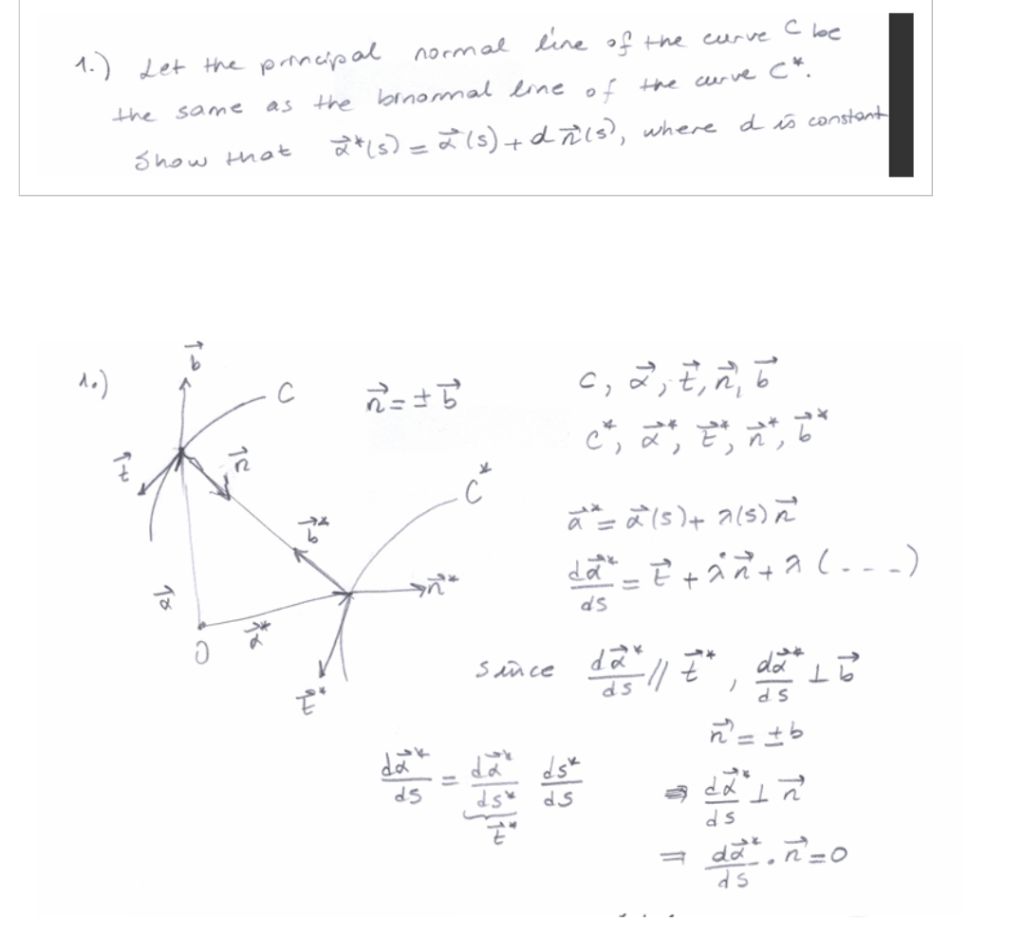 AD) Lek He pnp ok nocenal Line of the curve C lec
Lhe Some as +e inomnak Line af he nr ve er.
Show Hno® 2D = TS) + A, where dan on
—
A) 'd
(63 = —- > rT
n==b C,e,t,n b
- - EE x >%
T n a C,et, tt, nk
NN, ~C
NS yd FL RS) ADA
2 / - aw oy
« a df _pean+nl--2)
Eg ds
0 ¢
Sance Pirie bid oa
t° ds qt J de Hi
ds
” =
ra o Is n=ztb
d EE — — -—
sdk ds 5 dd?
T° ds
= dZ°. 7
dd _,.n=0
ds
This is AI generated Response.
Asked by: Rahul
Created at: 2025-12-11 03:30:34
Asked by: Rahul
Created at: 2025-12-11 03:30:34
Final Answer:
Rendered
Raw Text
Did you like this answer?
# Step-by-Step Solution
## Step 1: Problem Setup & Geometric Relationship
**Explanation:**
Let the principal normal line of curve \( C \) be the same as the binormal line of curve \( C^* \).
We want to show that \( \vec{\alpha}^*(s) = \vec{\alpha}(s) + d\vec{n}(s) \), where \( d \) is a constant.
From the diagram and notes:
- For curve \( C \): tangent \( \vec{t} \), normal \( \vec{n} \), binormal \( \vec{b} \)
- For curve \( C^* \): tangent \( \vec{t}^* \), normal \( \vec{n}^* \), binormal \( \vec{b}^* \)
We assume \( \vec{n} = \pm \vec{b}^* \).
Let \( \vec{\alpha}^*(s) = \vec{\alpha}(s) + \lambda(s) \vec{n}(s) \), where \( \lambda(s) \) is a function to be determined.
**End of Step 1 Explanation**
We have set up the relationship between the two curves and expressed the position vector of \( C^* \) in terms of \( C \) and its principal normal.
---
## Step 2: Differentiate and Apply the Given Condition
**Explanation:**
Differentiate \( \vec{\alpha}^*(s) \) with respect to \( s \):
\[
\frac{d\vec{\alpha}^*}{ds} = \frac{d\vec{\alpha}}{ds} + \frac{d}{ds}[\lambda(s)\vec{n}(s)]
\]
\[
= \vec{t} + \lambda'(s)\vec{n} + \lambda(s)\frac{d\vec{n}}{ds}
\]
Recall that \( \frac{d\vec{\alpha}^*}{ds} \) is tangent to \( C^* \) and, from the notes, it should be perpendicular to \( \vec{n} \) (since the binormal of \( C^* \) is the normal of \( C \)), i.e.,
\[
\frac{d\vec{\alpha}^*}{ds} \cdot \vec{n} =
\]
Plug in the previous expression:
\[
[\vec{t} + \lambda'(s)\vec{n} + \lambda(s)\frac{d\vec{n}}{ds}] \cdot \vec{n} =
\]
But \( \vec{t} \cdot \vec{n} = \), \( \frac{d\vec{n}}{ds} \cdot \vec{n} = \) (since \( \vec{n} \) is a unit vector), so:
\[
\lambda'(s)\vec{n} \cdot \vec{n} = \implies \lambda'(s) =
\]
So, \( \lambda(s) = d \), a constant.
**End of Step 2 Explanation**
We have shown that the only way the tangent to \( C^* \) is perpendicular to \( \vec{n} \) is if \( \lambda(s) \) is constant.
---
## **Final Answer**
\[
\boxed{
\vec{\alpha}^*(s) = \vec{\alpha}(s) + d\vec{n}(s)
}
\]
where \( d \) is a constant.
**Summary:**
By setting up the problem and using the geometric condition, we differentiated and applied the orthogonality condition to show that \( \vec{\alpha}^*(s) \) must be a constant normal offset from \( \vec{\alpha}(s) \).
📢 Instructions:
- Ask anything relatd to above question only.
- For new Question goto :