This is AI generated Response.
Asked by: Rahul
Created at: 2025-12-11 03:22:30
Final Answer:
RenderedRaw Text
Did you like this answer?
Let's solve each question step by step, **with explanations after each step**.
---
## a) Find the capacitance of the air-filled capacitor
### **Step 1: Write the formula for the capacitance of a parallel-plate capacitor**
\[
C = \epsilon_ \frac{A}{d}
\]
Where:
- \(\epsilon_ = 8.85 \times 10^{-12}~\text{F/m}\) (permittivity of free space)
- \(A = .020~\text{m}^2\)
- \(d = 3.~\text{mm} = 3. \times 10^{-3}~\text{m}\)
---
### **Step 2: Substitute values and calculate**
\[
C = (8.85 \times 10^{-12}) \frac{.020}{3. \times 10^{-3}}
\]
\[
C = (8.85 \times 10^{-12}) \times \frac{.020}{.003}
\]
\[
C = (8.85 \times 10^{-12}) \times 6.67
\]
\[
C \approx 5.9 \times 10^{-11}~\text{F}
\]
\[
C \approx 59~\text{pF}
\]
**Final Answer (a):**
\[
\boxed{C = 59~\text{pF}}
\]
---
Let me know if you'd like to proceed with part (b)!
Question:
All parts solved please
This is AI generated Response.
Asked by: Rahul
Created at: 2025-12-11 03:23:09
Final Answer:
RenderedRaw Text
Did you like this answer?
Let's solve all parts step by step, providing explanations after each step.
---
## a) Find the capacitance of the air-filled capacitor
### **Step 1: Write the formula for the capacitance of a parallel-plate capacitor**
\[
C = \epsilon_0 \frac{A}{d}
\]
Where:
- \(\epsilon_0 = 8.85 \times 10^{-12}~\text{F/m}\) (permittivity of free space)
- \(A = 0.020~\text{m}^2\)
- \(d = 3.0~\text{mm} = 3.0 \times 10^{-3}~\text{m}\)
### **Step 2: Substitute values and calculate**
\[
C = (8.85 \times 10^{-12}) \frac{0.020}{3.0 \times 10^{-3}}
\]
\[
C = (8.85 \times 10^{-12}) \times \frac{0.020}{0.003}
\]
\[
C = (8.85 \times 10^{-12}) \times 6.67
\]
\[
C \approx 5.9 \times 10^{-11}~\text{F}
\]
\[
C \approx 59~\text{pF}
\]
**Final Answer (a):**
\[
\boxed{C = 59~\text{pF}}
\]
---
## b) Determine the time constant of the circuit
### **Step 1: Write the formula for the time constant**
The time constant \(\tau\) for an RC circuit is given by:
\[
\tau = R \cdot C
\]
Where:
- \(R = 150~\Omega\)
- \(C = 5.9 \times 10^{-11}~\text{F}\)
### **Step 2: Substitute values and calculate**
\[
\tau = 150 \cdot (5.9 \times 10^{-11})
\]
\[
\tau \approx 8.85 \times 10^{-9}~\text{s}
\]
**Final Answer (b):**
\[
\boxed{\tau \approx 8.85~\text{ns}}
\]
---
## c) Determine how long it will take the capacitor to fully charge
### **Step 1: Understand the charging process**
A capacitor charges to approximately 63.2% of the full voltage after one time constant \(\tau\). It takes about \(5\tau\) to effectively reach full charge.
### **Step 2: Calculate the time for effective charge**
\[
t \approx 5 \cdot \tau = 5 \cdot (8.85 \times 10^{-9}) \approx 4.43 \times 10^{-8}~\text{s}
\]
**Final Answer (c):**
\[
\boxed{t \approx 44.3~\text{ns}}
\]
---
## d) What is the charge on the capacitor once fully charged?
### **Step 1: Write the formula for charge**
The charge \(Q\) on a capacitor is given by:
\[
Q = C \cdot V
\]
Where:
- \(V = 12.0~\text{V}\) (voltage from the power supply)
- \(C = 5.9 \times 10^{-11}~\text{F}\)
### **Step 2: Substitute values and calculate**
\[
Q = (5.9 \times 10^{-11}) \cdot 12.0
\]
\[
Q \approx 7.08 \times 10^{-10}~\text{C}
\]
**Final Answer (d):**
\[
\boxed{Q \approx 708~\text{pC}}
\]
---
## e) A dielectric is now inserted into the capacitor (k=3), what happens to the voltage of the capacitor?
### **Step 1: Understand the effect of a dielectric**
When a dielectric material is inserted, the capacitance increases by a factor of \(k\):
\[
C' = k \cdot C
\]
The voltage across the capacitor is given by:
\[
V' = \frac{Q}{C'}
\]
### **Step 2: Calculate the new capacitance and voltage**
New capacitance:
\[
C' = 3 \cdot (5.9 \times 10^{-11}) = 1.77 \times 10^{-10}~\text{F}
\]
Using the previously calculated charge:
\[
V' = \frac{Q}{C'} = \frac{7.08 \times 10^{-10}}{1.77 \times 10^{-10}} \approx 4.0~\text{V}
\]
**Final Answer (e):**
The voltage decreases to approximately 4.0 V.
\[
\boxed{V' \approx 4.0~\text{V}}
\]
VIPSolutions focuses on clear, step‑by‑step explanations so you can learn quickly. Whether you need an AI‑generated walkthrough or a short hint to get unstuck, each solution is organized for fast reading and easy review later.
Search similar questions, compare approaches, and bookmark the best answers for revision. Our goal is simple: quick, reliable study help that feels natural—not noisy.
 VIPSolutions
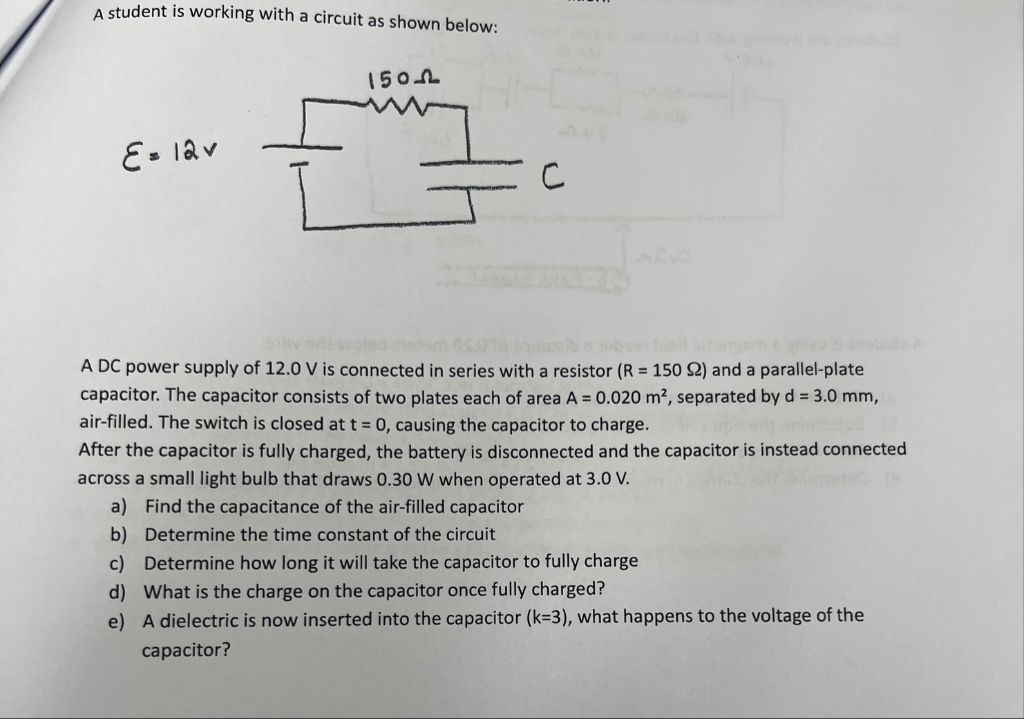 / Astudent is working with a circuit as shown below:
\500.
A DC power supply of 12.0 V is connected in series with a resistor (R = 150 ©) and a parallel-plate
capacitor. The capacitor consists of two plates each of area A = 0.020 m?, separated by d =3.0 mm,
air-filled. The switch is closed at t = 0, causing the capacitor to charge.
After the capacitor is fully charged, the battery is disconnected and the capacitor is instead connected
across a small light bulb that draws 0.30 W when operated at 3.0 V.
a) Find the capacitance of the air-filled capacitor
b) Determine the time constant of the circuit
c) Determine how long it will take the capacitor to fully charge
d) What is the charge on the capacitor once fully charged?
e) A dielectric is now inserted into the capacitor (k=3), what happens to the voltage of the
capacitor?