 VIPSolutions
give answer in 2 step with explanation at the end of each step and final answer at the end:4 Given the shown cross-section, determine . i . oo the principal moments of inertia about the aliie oo centroid, and the angle at which they | { C IE mm — 10 mm | | 60 nim 10 1 — SRS S| f= 10 mm
Question:
give answer in 2 step with explanation at the end of each step and final answer at the end: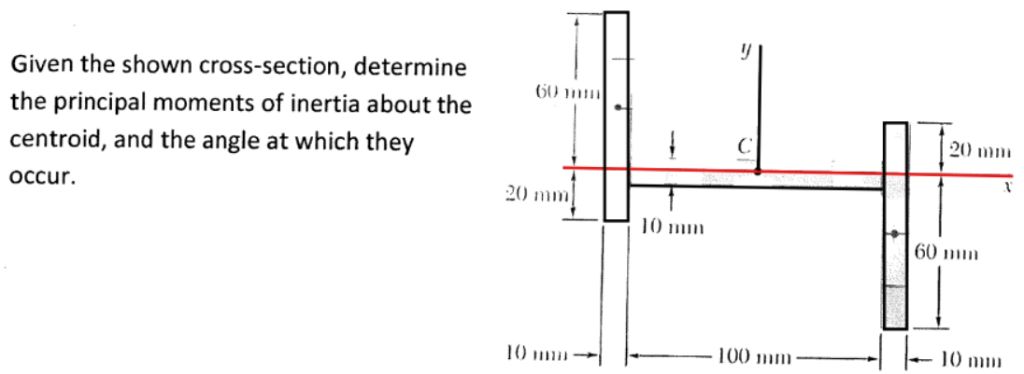 4
Given the shown cross-section, determine
. i . oo
the principal moments of inertia about the aliie oo
centroid, and the angle at which they | { C IE mm
— 10 mm
| | 60 nim
10 1 — SRS S| f= 10 mm
This is AI generated Response.
Asked by: Rahul
Created at: 2025-12-11 02:25:11
Asked by: Rahul
Created at: 2025-12-11 02:25:11
Final Answer:
Rendered
Raw Text
Did you like this answer?
## Step 1: Calculate the Centroid Location
**Explanation:**
First, we find the centroid (\( \bar{x}, \bar{y} \)) of the composite section, using the method of composite areas.
Let’s break the section into three rectangles:
- **A1:** Left vertical rectangle (10 mm × 60 mm)
- **A2:** Middle horizontal rectangle (100 mm × 20 mm)
- **A3:** Right vertical rectangle (10 mm × 60 mm)
### Areas and Centroid Positions
| Area | Dimensions | \(A_i\) (mm²) | \(x_i\) (mm) | \(y_i\) (mm) |
|------|---------------------|---------------|--------------|--------------|
| A1 | 10 × 60 | 600 | + 5 | 60/2 + 20 |
| A2 | 100 × 20 | 200 | 10 + 100/2 | 20/2 |
| A3 | 10 × 60 | 600 | 110 + 5 | 60/2 + 20 |
**x-coordinates:**
- A1: \(x_1 = 5\) mm
- A2: \(x_2 = 10 + 50 = 60\) mm
- A3: \(x_3 = 110 + 5 = 115\) mm
**y-coordinates:**
- A1: \(y_1 = 60/2 + 20 = 30 + 20 = 50\) mm
- A2: \(y_2 = 20/2 = 10\) mm
- A3: \(y_3 = 30 + 20 = 50\) mm
**Calculate centroid:**
\[
\bar{x} = \frac{\sum A_i x_i}{\sum A_i}
\]
\[
\bar{x} = \frac{600 \times 5 + 200 \times 60 + 600 \times 115}{600 + 200 + 600}
= \frac{300 + 120000 + 69000}{320} = \frac{192000}{320} = 60 \text{ mm}
\]
\[
\bar{y} = \frac{\sum A_i y_i}{\sum A_i}
\]
\[
\bar{y} = \frac{600 \times 50 + 200 \times 10 + 600 \times 50}{320}
= \frac{30000 + 20000 + 30000}{320} = \frac{80000}{320} = 25 \text{ mm}
\]
**End of Step 1:**
The centroid of the cross-section is at \((\bar{x}, \bar{y}) = (60, 25)\) mm.
---
## Step 2: Calculate Moments of Inertia and Principal Axes
**Explanation:**
Now, find the moments of inertia about the centroidal axes (\(I_{xx}, I_{yy}, I_{xy}\)), then find the principal moments and angle.
### Moments of Inertia for Each Rectangle
For each rectangle, use the parallel axis theorem:
\[
I_{xx} = I_{xx,centroid} + A d_y^2
\]
\[
I_{yy} = I_{yy,centroid} + A d_x^2
\]
\[
I_{xy} = A d_x d_y
\]
where \(d_x = x_i - \bar{x}\), \(d_y = y_i - \bar{y}\).
#### Rectangle A1:
- \(A_1 = 600\) mm², \(x_1 = 5\), \(y_1 = 50\), \(d_x = -55\), \(d_y = 25\)
- \(I_{xx,1,centroid} = \frac{1}{12} b h^3 = \frac{1}{12} \times 10 \times 60^3 = 180,000\) mm⁴
- \(I_{yy,1,centroid} = \frac{1}{12} h b^3 = \frac{1}{12} \times 60 \times 10^3 = 5,000\) mm⁴
\[
I_{xx,1} = 180,000 + 600 \times (25)^2 = 180,000 + 375,000 = 555,000
\]
\[
I_{yy,1} = 5,000 + 600 \times (-55)^2 = 5,000 + 1,815,000 = 1,820,000
\]
\[
I_{xy,1} = 600 \times (-55) \times 25 = -825,000
\]
#### Rectangle A2:
- \(A_2 = 200\) mm², \(x_2 = 60\), \(y_2 = 10\), \(d_x = \), \(d_y = -15\)
- \(I_{xx,2,centroid} = \frac{1}{12} \times 100 \times 20^3 = 66,667\) mm⁴
- \(I_{yy,2,centroid} = \frac{1}{12} \times 20 \times 100^3 = 1,666,667\) mm⁴
\[
I_{xx,2} = 66,667 + 200 \times (-15)^2 = 66,667 + 450,000 = 516,667
\]
\[
I_{yy,2} = 1,666,667 + 200 \times ()^2 = 1,666,667
\]
\[
I_{xy,2} = 200 \times \times (-15) =
\]
#### Rectangle A3:
- \(A_3 = 600\) mm², \(x_3 = 115\), \(y_3 = 50\), \(d_x = 55\), \(d_y = 25\)
- \(I_{xx,3,centroid} = 180,000\) mm⁴
- \(I_{yy,3,centroid} = 5,000\) mm⁴
\[
I_{xx,3} = 180,000 + 600 \times (25)^2 = 555,000
\]
\[
I_{yy,3} = 5,000 + 600 \times (55)^2 = 1,820,000
\]
\[
I_{xy,3} = 600 \times 55 \times 25 = 825,000
\]
### Sum for Total Inertia
\[
I_{xx} = 555,000 + 516,667 + 555,000 = 1,626,667 \text{ mm}^4
\]
\[
I_{yy} = 1,820,000 + 1,666,667 + 1,820,000 = 5,306,667 \text{ mm}^4
\]
\[
I_{xy} = -825,000 + + 825,000 =
\]
### Principal Moments and Angle
Since \(I_{xy} = \), the centroidal axes are already principal axes.
- **Principal moments:** \(I_1 = I_{xx} = 1,626,667 \text{ mm}^4\), \(I_2 = I_{yy} = 5,306,667 \text{ mm}^4\)
- **Angle:** \(^\circ\) (axes are aligned with the principal axes)
---
## **Final Answer**
- **The principal moments of inertia are:**
- \(I_1 = 1,626,667 \text{ mm}^4\)
- \(I_2 = 5,306,667 \text{ mm}^4\)
- **They occur at an angle of \(^\circ\) relative to the centroidal axes (i.e., the x and y axes shown).**
📢 Instructions:
- Ask anything relatd to above question only.
- For new Question goto :