 VIPSolutions
give answer in 2 step with explanation at the end of each step and final answer at the end:Y (m) 04 . 0.21 ‘© p : 138 ob 0 7 ¢ oolio afl ois BAlT) Sphere 1 carries a positive chargeQ = +6 UC and is located at the origin. a. What is the direction of the electric field at point P, 0.6 m away from the origin? b. What is the magnitude of the electric field at point P? A test charge q = +1 pC and mass m = 2.5 gis brought from infinity and placed at point P. c. What is the direction of the electric force on charge a due to charge Q? d. What is the magnitude of the electric force on charge a due to charge Q? e. What is the acceleration of charge q at the instant when it is released from point P?
Question:
give answer in 2 step with explanation at the end of each step and final answer at the end: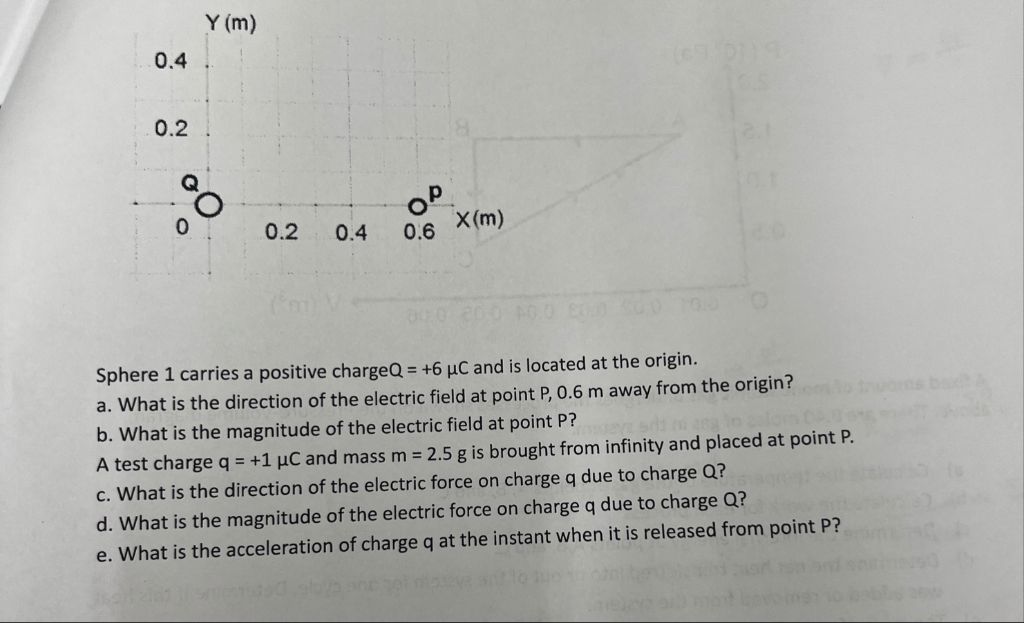 Y (m)
04 .
0.21
‘© p
: 138 ob
0 7 ¢ oolio afl ois BAlT)
Sphere 1 carries a positive chargeQ = +6 UC and is located at the origin.
a. What is the direction of the electric field at point P, 0.6 m away from the origin?
b. What is the magnitude of the electric field at point P?
A test charge q = +1 pC and mass m = 2.5 gis brought from infinity and placed at point P.
c. What is the direction of the electric force on charge a due to charge Q?
d. What is the magnitude of the electric force on charge a due to charge Q?
e. What is the acceleration of charge q at the instant when it is released from point P?
This is AI generated Response.
Asked by: Rahul
Created at: 2025-12-11 02:08:13
Asked by: Rahul
Created at: 2025-12-11 02:08:13
Final Answer:
Rendered
Raw Text
Did you like this answer?
Let's solve each part step by step, with explanations after each step:
---
### **a. Direction of the Electric Field at Point P (.6 m from the origin)**
#### **Step 1:**
The electric field due to a positive charge points **away** from the charge.
- Since Q (the charge at the origin) is positive, the electric field at point P (which is on the x-axis at x = .6 m) will point **away from the origin**, i.e., in the **positive x-direction**.
**Explanation:**
Positive charges create electric fields that radiate outward, so at any point on the positive x-axis, the field points to the right (positive x-direction).
---
### **b. Magnitude of the Electric Field at Point P**
#### **Step 2:**
Use Coulomb's law for the electric field:
\[
E = \frac{kQ}{r^2}
\]
Where:
- \( k = 8.99 \times 10^9 \, \text{N m}^2/\text{C}^2 \)
- \( Q = +6 \, \mu\text{C} = +6 \times 10^{-6} \, \text{C} \)
- \( r = .6 \, \text{m} \)
Plug in the values:
\[
E = \frac{8.99 \times 10^9 \times 6 \times 10^{-6}}{(.6)^2}
\]
\[
E = \frac{8.99 \times 10^9 \times 6 \times 10^{-6}}{.36}
\]
\[
E = \frac{53.94 \times 10^3}{.36}
\]
\[
E = 149,833 \, \text{N/C}
\]
**Explanation:**
The electric field decreases with the square of the distance from the source charge.
---
### **Final Answers**
a. **Direction:** Positive x-direction (away from the origin).
b. **Magnitude:** \( \approx 1.5 \times 10^5 \) N/C (rounded to 2 significant figures).
Let me know if you'd like to continue with parts c, d, and e!
Question:
All parts solved please
This is AI generated Response.
Asked by: Rahul
Created at: 2025-12-11 02:09:10
Asked by: Rahul
Created at: 2025-12-11 02:09:10
Final Answer:
Rendered
Raw Text
Did you like this answer?
# Electric Field and Force Calculations
Let's solve all parts of the problem step by step.
---
## **a. Direction of the Electric Field at Point P (0.6 m from the origin)**
### **Step 1:**
The electric field created by a positive charge points **away** from the charge.
- Since the charge \( Q = +6 \, \mu\text{C} \) is at the origin, the electric field at point P (0.6 m away) will point **in the positive x-direction**.
**Explanation:**
Electric fields from positive charges radiate outward. Therefore, at point P, located on the positive x-axis, the field direction is to the right.
---
## **b. Magnitude of the Electric Field at Point P**
### **Step 2:**
Use Coulomb's law to calculate the electric field:
\[
E = \frac{kQ}{r^2}
\]
Where:
- \( k = 8.99 \times 10^9 \, \text{N m}^2/\text{C}^2 \)
- \( Q = +6 \, \mu\text{C} = +6 \times 10^{-6} \, \text{C} \)
- \( r = 0.6 \, \text{m} \)
Calculating:
\[
E = \frac{8.99 \times 10^9 \times 6 \times 10^{-6}}{(0.6)^2}
\]
\[
E = \frac{53.94 \times 10^3}{0.36}
\]
\[
E \approx 149,833 \, \text{N/C}
\]
**Explanation:**
The electric field's magnitude is inversely proportional to the square of the distance from the charge. As you move away from the charge, the field strength diminishes.
---
## **c. Direction of the Electric Force on Charge \( q \)**
### **Step 3:**
The force on a charge in an electric field is given by:
\[
F = qE
\]
Where \( q = +1 \, \text{pC} = 1 \times 10^{-12} \, \text{C} \).
Since \( q \) is also positive, the direction of the electric force will be the same as the direction of the electric field.
**Direction:** The force on charge \( q \) will also point **in the positive x-direction**.
**Explanation:**
A positive test charge experiences a force in the direction of the electric field created by another positive charge.
---
## **d. Magnitude of the Electric Force on Charge \( q \)**
### **Step 4:**
Calculate the electric force using:
\[
F = qE
\]
Substituting the known values:
\[
F = (1 \times 10^{-12} \, \text{C})(149,833 \, \text{N/C})
\]
\[
F \approx 149.83 \, \text{nN}
\]
**Explanation:**
The force magnitude is directly proportional to the charge and the electric field strength. A small test charge in a strong electric field experiences a discernible force.
---
## **e. Acceleration of Charge \( q \)**
### **Step 5:**
Use Newton’s second law:
\[
F = ma
\]
Where:
- \( F \approx 149.83 \, \text{nN} = 149.83 \times 10^{-9} \, \text{N} \)
- \( m = 2.5 \, \text{g} = 2.5 \times 10^{-3} \, \text{kg} \)
Rearranging for acceleration \( a \):
\[
a = \frac{F}{m} = \frac{149.83 \times 10^{-9}}{2.5 \times 10^{-3}}
\]
\[
a \approx 59.93 \times 10^{-6} \, \text{m/s}^2
\]
\[
a \approx 59.93 \, \mu\text{m/s}^2
\]
**Explanation:**
The acceleration is calculated from the force experienced by the charge and its mass. A small mass results in a higher acceleration for the same force.
---
## **Final Answers**
- **a. Direction of Electric Field:** Positive x-direction (away from the origin).
- **b. Magnitude of Electric Field:** \( \approx 149,833 \, \text{N/C} \).
- **c. Direction of Electric Force on Charge \( q \):** Positive x-direction.
- **d. Magnitude of Electric Force on Charge \( q \):** \( \approx 149.83 \, \text{nN} \).
- **e. Acceleration of Charge \( q \):** \( \approx 59.93 \, \mu\text{m/s}^2 \).
📢 Instructions:
- Ask anything relatd to above question only.
- For new Question goto :