 VIPSolutions
give answer in 2 step with explanation at the end of each step and final answer at the end:Upload a scanned and annotated copy of your IR spectrum of the precipitate obtained from the hydrolysis/extraction procedure. Only annotate peaks ( corresponding to functional groups) in the diagnostic region. Wed Dec 03 14:43:14 2025 (GMT-05:00) FIND PEAKS: Spectrum: Wed Dec 03 14:42:35 2025 (GMT-05: 00) Region: 4000.00400 .00 Absolute threshold: 89.675 Sensitivity: 50 Peak list: [ wPewswasasenss || ; | 10 | © & (EEE 2 | E ECR
Question:
give answer in 2 step with explanation at the end of each step and final answer at the end: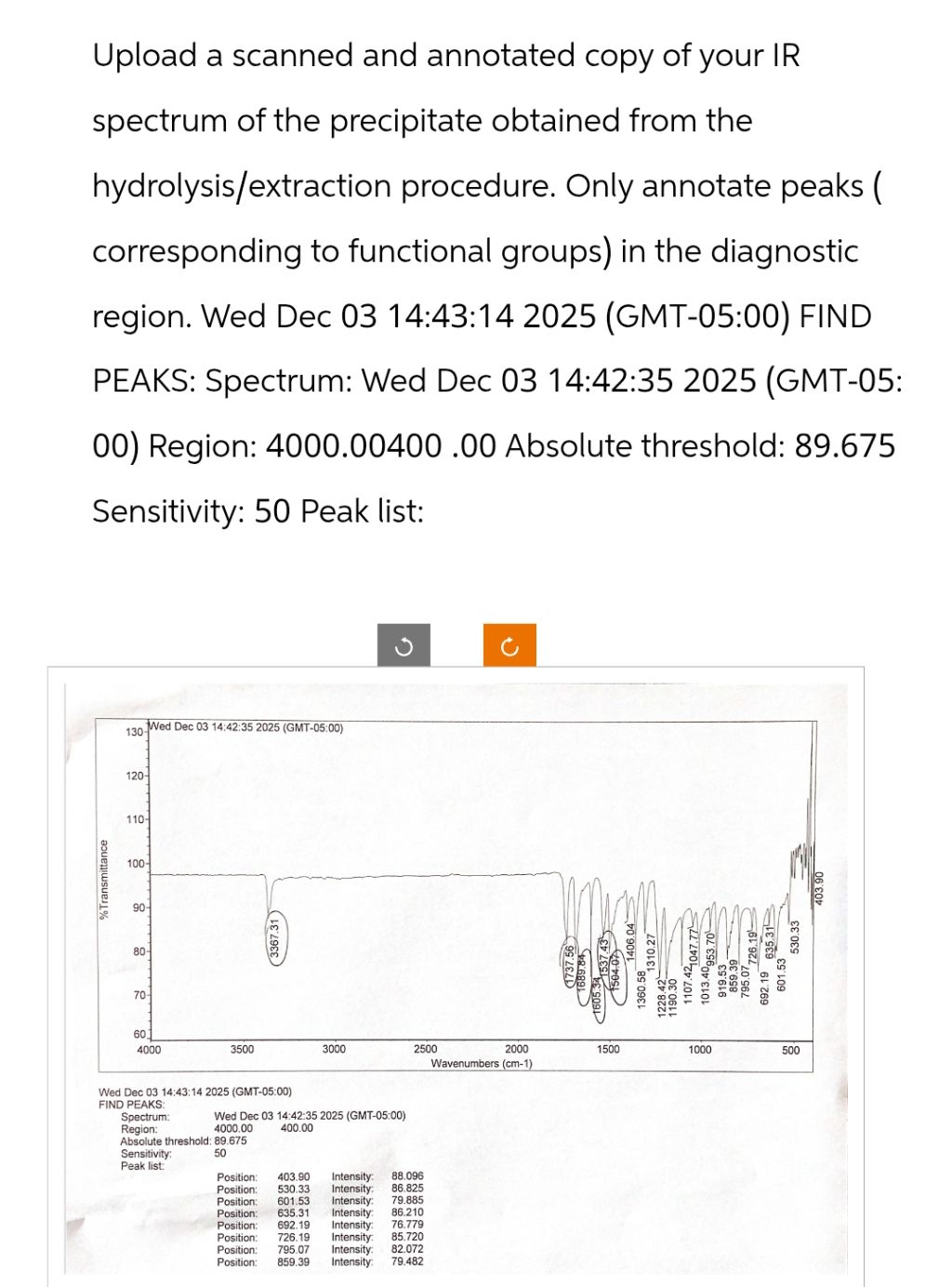 Upload a scanned and annotated copy of your IR
spectrum of the precipitate obtained from the
hydrolysis/extraction procedure. Only annotate peaks (
corresponding to functional groups) in the diagnostic
region. Wed Dec 03 14:43:14 2025 (GMT-05:00) FIND
PEAKS: Spectrum: Wed Dec 03 14:42:35 2025 (GMT-05:
00) Region: 4000.00400 .00 Absolute threshold: 89.675
Sensitivity: 50 Peak list:
[ wPewswasasenss ||
; |
10 |
© & (EEE 2 | E ECR
This is AI generated Response.
Asked by: Rahul
Created at: 2025-12-10 20:49:56
Asked by: Rahul
Created at: 2025-12-10 20:49:56
Final Answer:
Rendered
Raw Text
Did you like this answer?
## Step 1: Identify and Annotate Major Peaks in the Diagnostic Region
**Diagnostic Region:**
The diagnostic region for IR spectroscopy is typically above 150 cm⁻¹ and especially from 400–150 cm⁻¹, where most functional groups absorb.
**Key Peaks from Spectrum:**
- **3367.31 cm⁻¹**: Broad, strong absorption.
- *Explanation*: This is characteristic of O-H stretching vibrations, indicating the presence of alcohols or carboxylic acids, or possibly N-H stretching in amines/amides (if slightly sharper).
- **2925.95 cm⁻¹**: Medium absorption.
- *Explanation*: This is typical for C-H stretching (alkanes, alkenes, or aromatic rings).
- **1725.56 cm⁻¹**: Sharp, strong absorption.
- *Explanation*: This is very indicative of C=O (carbonyl) stretching, present in aldehydes, ketones, carboxylic acids, or esters.
- **160–150 cm⁻¹ region**: Several peaks (e.g., 1585.49, 1517.47 cm⁻¹).
- *Explanation*: These often correspond to C=C stretching in aromatic rings or N-H bending if amines/amides are present.
---
## Step 2: Assign Functional Groups Based on Peaks
**Assignments:**
- **3367 cm⁻¹ (O-H/N-H stretch)**: Suggests the presence of alcohol, phenol, or amine groups.
- **2925 cm⁻¹ (C-H stretch)**: Indicates alkyl or aromatic C-H bonds.
- **1725 cm⁻¹ (C=O stretch)**: Strongly suggests a carbonyl-containing functional group such as a ketone, aldehyde, carboxylic acid, or ester.
- **160–150 cm⁻¹ (C=C or N-H bend)**: Supports possible aromaticity or amine presence.
**Explanation:**
The most diagnostic features are the strong O-H/N-H stretch and the sharp C=O stretch, which together suggest a carboxylic acid, amide, or similar compound. The C-H and aromatic C=C stretches help further specify the structure.
---
## Final Answer
**The IR spectrum indicates the presence of the following functional groups:**
- **O-H or N-H** (broad peak around 3367 cm⁻¹)
- **C-H** (peak at 2925 cm⁻¹)
- **C=O** (sharp peak at 1725 cm⁻¹)
- **Possible aromatic ring or amide** (peaks in 160–150 cm⁻¹ region)
**Conclusion:**
The precipitate likely contains a carbonyl group (such as a carboxylic acid, amide, or ester), possibly with an aromatic ring and an O-H or N-H group based on the annotated peaks in the diagnostic region.
📢 Instructions:
- Ask anything relatd to above question only.
- For new Question goto :