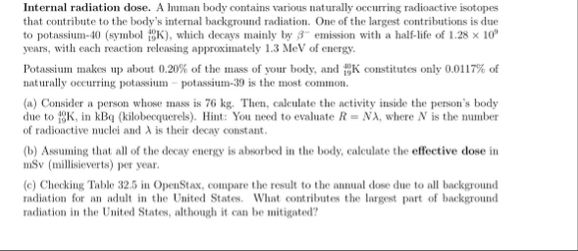
give answer in 2 step with explanation at the end of each step and final answer at the end:Internal radistion dose. A lumen body contains various naturally occuring radioactive isotopes.
hat contribute to he borly's internal background radition. One of the largest contributions is doe
10 potassium-40 (symbol 5K), which decays mainly by 3 emission with a half-life of 1.2% x 10"
years, with cach action reloasing approximately 1.3 MeV of cnrgy.
Potassium makes up abet 0205 of the sass of our bods. ane SK constitutes ody 001175 of
saturally ocr potas potas. the nt common,
(a) Comer perc who sas is 76 kg “Then, calculate the activity nse the pens bly
de to 8K. in Kg (lobeequere). Hin: You ne to evaluate 7 = NA. where N a the munber
of rdionctive mca A thei decay constant
(0) Amin hat all of tho decay ener is abserbed the bod: cleulte the offoctive dove in
nS (millievets) pes eur
(6) Clocking Table 325 in Open, compare the rest tthe sum dose de 1 il ockgzod
wndiation for mn adult in the United States. What contributes the largest part of background
ain the United Staten, altho can be it gato?
Question:
give answer in 2 step with explanation at the end of each step and final answer at the end:Internal radistion dose. A lumen body contains various naturally occuring radioactive isotopes.
hat contribute to he borly's internal background radition. One of the largest contributions is doe
10 potassium-40 (symbol 5K), which decays mainly by 3 emission with a half-life of 1.2% x 10"
years, with cach action reloasing approximately 1.3 MeV of cnrgy.
Potassium makes up abet 0205 of the sass of our bods. ane SK constitutes ody 001175 of
saturally ocr potas potas. the nt common,
(a) Comer perc who sas is 76 kg “Then, calculate the activity nse the pens bly
de to 8K. in Kg (lobeequere). Hin: You ne to evaluate 7 = NA. where N a the munber
of rdionctive mca A thei decay constant
(0) Amin hat all of tho decay ener is abserbed the bod: cleulte the offoctive dove in
nS (millievets) pes eur
(6) Clocking Table 325 in Open, compare the rest tthe sum dose de 1 il ockgzod
wndiation for mn adult in the United States. What contributes the largest part of background
ain the United Staten, altho can be it gato?
This is AI generated Response.
Asked by: Rahul
Created at: 2025-12-10 19:56:34
Final Answer:
RenderedRaw Text
Did you like this answer?
Let's break down part (a) and (b) into two clear steps as requested:
---
## **Step 1: Calculate the Activity (R) Due to ⁴⁰K**
### **Given Data**
- **Person's mass (m):** 76 kg
- **Fraction of body mass that is potassium:** .20% = .002
- **Fraction of potassium that is ⁴⁰K:** .0117% = .000117
- **Molar mass of potassium:** ~39.1 g/mol
- **Half-life (T₁/₂) of ⁴⁰K:** 1.28 × 10⁹ years
- **Decay energy per reaction:** 1.3 MeV (for next step)
- **Avogadro's Number (Nₐ):** 6.022 × 10²³ mol⁻¹
### **Find the Number of ⁴⁰K Nuclei (N)**
- Mass of potassium in body:
\( m_{\text{K}} = 76\,\text{kg} \times .002 = .152\,\text{kg} = 152\,\text{g} \)
- Moles of potassium:
\( n_{\text{K}} = \frac{152\,\text{g}}{39.1\,\text{g/mol}} = 3.89\,\text{mol} \)
- Number of potassium atoms:
\( N_{\text{K}} = 3.89\,\text{mol} \times 6.022 \times 10^{23}\,\text{atoms/mol} = 2.34 \times 10^{24}\,\text{atoms} \)
- Number of ⁴⁰K nuclei:
\( N_{40K} = 2.34 \times 10^{24} \times .000117 = 2.74 \times 10^{20} \)
### **Decay Constant (λ)**
\[
λ = \frac{\ln(2)}{T_{1/2}}
\]
- \(T_{1/2} = 1.28 \times 10^9\,\text{years} = 1.28 \times 10^9 \times 3.156 \times 10^7\,\text{s} = 4.04 \times 10^{16}\,\text{s}\)
- \(λ = \frac{.693}{4.04 \times 10^{16}\,\text{s}} = 1.71 \times 10^{-17}\,\text{s}^{-1}\)
### **Calculate Activity (R)**
\[
R = N \lambda = 2.74 \times 10^{20} \times 1.71 \times 10^{-17} = 4.68 \times 10^3\,\text{Bq}
\]
**Convert to kBq:**
\( 4.68 \times 10^3\,\text{Bq} = 4.68\,\text{kBq} \)
---
### **End of Step 1 Explanation**
We found the activity of ⁴⁰K in a 76 kg person is **4.68 kBq**.
---
## **Step 2: Calculate the Effective Dose in mSv/year**
### **Energy per decay:**
- \( E_{\text{decay}} = 1.3\,\text{MeV} = 1.3 \times 1.602 \times 10^{-13}\,\text{J} = 2.08 \times 10^{-13}\,\text{J} \)
### **Total energy per year:**
- Decays per year:
\( 4.68 \times 10^3\,\text{decays/s} \times 3.156 \times 10^7\,\text{s/year} = 1.48 \times 10^{11}\,\text{decays/year} \)
- Total energy:
\( 1.48 \times 10^{11} \times 2.08 \times 10^{-13}\,\text{J} = .0308\,\text{J/year} \)
### **Dose (Gy):**
\[
\text{Dose} = \frac{\text{Energy}}{\text{mass}} = \frac{.0308\,\text{J}}{76\,\text{kg}} = 4.05 \times 10^{-4}\,\text{Gy/year}
\]
- 1 Gy = 1 J/kg
### **Effective Dose (mSv):**
- For beta and gamma, quality factor \( Q = 1 \)
\[
\text{Effective Dose} = 4.05 \times 10^{-4}\,\text{Gy/year} \times 100 = .405\,\text{mSv/year}
\]
---
### **End of Step 2 Explanation**
The effective dose due to ⁴⁰K is **.405 mSv/year**.
---
## **Final Answers**
- **(a) Activity inside the body due to ⁴⁰K:**
\(\boxed{4.68\,\text{kBq}}\)
- **(b) Effective dose:**
\(\boxed{.405\,\text{mSv/year}}\)
Question:
All parts solved please
This is AI generated Response.
Asked by: Rahul
Created at: 2025-12-10 19:57:18
Final Answer:
RenderedRaw Text
Did you like this answer?
# Internal Radiation Dose Calculation
We will calculate the activity due to potassium-40 (⁴⁰K) and the effective dose in two steps, providing explanations after each step.
---
## **Step 1: Calculate the Activity (R) Due to ⁴⁰K**
### **Given Data**
- **Person's mass (m):** 76 kg
- **Fraction of body mass that is potassium:** 0.20% = 0.002
- **Fraction of potassium that is ⁴⁰K:** 0.0117% = 0.000117
- **Molar mass of potassium:** ~39.1 g/mol
- **Half-life (T₁/₂) of ⁴⁰K:** 1.28 × 10⁹ years
- **Decay energy per reaction:** 1.3 MeV
- **Avogadro's Number (Nₐ):** 6.022 × 10²³ mol⁻¹
### **Calculations**
1. **Mass of potassium in the body:**
\[
m_{\text{K}} = 76\,\text{kg} \times 0.002 = 0.152\,\text{kg} = 152\,\text{g}
\]
2. **Moles of potassium:**
\[
n_{\text{K}} = \frac{152\,\text{g}}{39.1\,\text{g/mol}} = 3.89\,\text{mol}
\]
3. **Number of potassium atoms:**
\[
N_{\text{K}} = 3.89\,\text{mol} \times 6.022 \times 10^{23}\,\text{atoms/mol} = 2.34 \times 10^{24}\,\text{atoms}
\]
4. **Number of ⁴⁰K nuclei:**
\[
N_{40K} = 2.34 \times 10^{24} \times 0.000117 = 2.74 \times 10^{20}
\]
5. **Decay Constant (λ):**
\[
λ = \frac{\ln(2)}{T_{1/2}} = \frac{0.693}{1.28 \times 10^9\,\text{years} \times 3.156 \times 10^7\,\text{s/year}} = 1.71 \times 10^{-17}\,\text{s}^{-1}
\]
6. **Calculate Activity (R):**
\[
R = N_{40K} \lambda = 2.74 \times 10^{20} \times 1.71 \times 10^{-17} = 4.68 \times 10^3\,\text{Bq}
\]
**Convert to kBq:**
\[
4.68 \times 10^3\,\text{Bq} = 4.68\,\text{kBq}
\]
### **End of Step 1 Explanation**
We have calculated the activity of ⁴⁰K in a 76 kg person to be **4.68 kBq**.
---
## **Step 2: Calculate the Effective Dose in mSv/year**
### **Given Data**
- **Energy per decay:**
\[
E_{\text{decay}} = 1.3\,\text{MeV} = 1.3 \times 1.602 \times 10^{-13}\,\text{J} = 2.08 \times 10^{-13}\,\text{J}
\]
### **Calculations**
1. **Total decays per year:**
\[
\text{Decays per year} = 4.68 \times 10^3\,\text{decays/s} \times 3.156 \times 10^7\,\text{s/year} = 1.48 \times 10^{11}\,\text{decays/year}
\]
2. **Total energy from decays per year:**
\[
\text{Total energy} = 1.48 \times 10^{11} \times 2.08 \times 10^{-13}\,\text{J} = 0.0308\,\text{J/year}
\]
3. **Dose (Gy):**
\[
\text{Dose} = \frac{\text{Energy}}{\text{mass}} = \frac{0.0308\,\text{J}}{76\,\text{kg}} = 4.05 \times 10^{-4}\,\text{Gy/year}
\]
4. **Effective Dose (mSv):**
\[
\text{Effective Dose} = 4.05 \times 10^{-4}\,\text{Gy/year} \times 1000 = 0.405\,\text{mSv/year}
\]
### **End of Step 2 Explanation**
The effective dose due to ⁴⁰K is **0.405 mSv/year**.
---
## **Final Answers**
- **(a) Activity inside the body due to ⁴⁰K:**
\(\boxed{4.68\,\text{kBq}}\)
- **(b) Effective dose:**
\(\boxed{0.405\,\text{mSv/year}}\)
VIPSolutions focuses on clear, step‑by‑step explanations so you can learn quickly. Whether you need an AI‑generated walkthrough or a short hint to get unstuck, each solution is organized for fast reading and easy review later.
Search similar questions, compare approaches, and bookmark the best answers for revision. Our goal is simple: quick, reliable study help that feels natural—not noisy.
 VIPSolutions
 Internal radistion dose. A lumen body contains various naturally occuring radioactive isotopes.
hat contribute to he borly's internal background radition. One of the largest contributions is doe
10 potassium-40 (symbol 5K), which decays mainly by 3 emission with a half-life of 1.2% x 10"
years, with cach action reloasing approximately 1.3 MeV of cnrgy.
Potassium makes up abet 0205 of the sass of our bods. ane SK constitutes ody 001175 of
saturally ocr potas potas. the nt common,
(a) Comer perc who sas is 76 kg “Then, calculate the activity nse the pens bly
de to 8K. in Kg (lobeequere). Hin: You ne to evaluate 7 = NA. where N a the munber
of rdionctive mca A thei decay constant
(0) Amin hat all of tho decay ener is abserbed the bod: cleulte the offoctive dove in
nS (millievets) pes eur
(6) Clocking Table 325 in Open, compare the rest tthe sum dose de 1 il ockgzod
wndiation for mn adult in the United States. What contributes the largest part of background
ain the United Staten, altho can be it gato?