 VIPSolutions
give answer in 2 step with explanation at the end of each step and final answer at the end:09. The figure below shows a (400-mm-diameter) brake drum with four internally expanding shoes. Each of the hinge pins A and B supports a pair of shoes. The actuating mechanism is to be arranged to produce the same force F on each shoe. The face width of the shoes is (75 mm). The material used permits a coefficient of friction of (0.24) and a maximum pressure of (1000 kPa). For a clockwise rotation: a) Determine the maximum actuating force. b) Estimate the brake capacity. 15°, 15 ¢) Estimate the hinge-pin reactions. \ / /) i \ \ wi td DY; 10° | YY bh )] 10 I Yil3< 7 milluneters = 18% Hi5
Question:
give answer in 2 step with explanation at the end of each step and final answer at the end: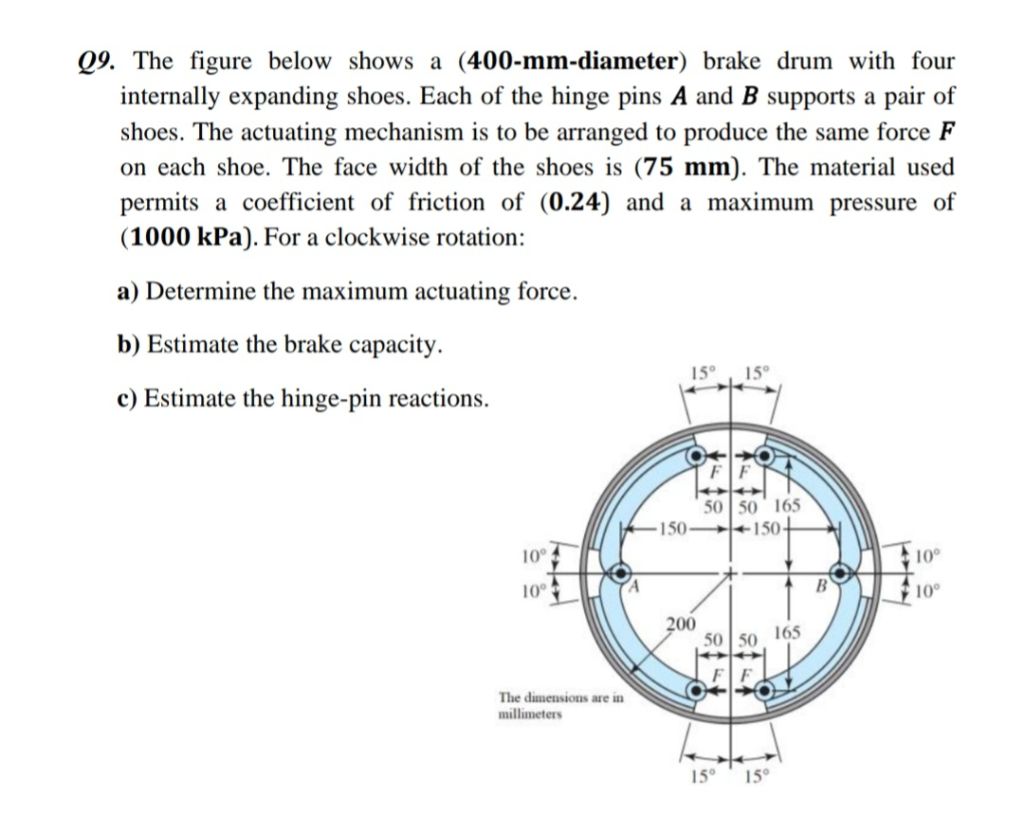 09. The figure below shows a (400-mm-diameter) brake drum with four
internally expanding shoes. Each of the hinge pins A and B supports a pair of
shoes. The actuating mechanism is to be arranged to produce the same force F
on each shoe. The face width of the shoes is (75 mm). The material used
permits a coefficient of friction of (0.24) and a maximum pressure of
(1000 kPa). For a clockwise rotation:
a) Determine the maximum actuating force.
b) Estimate the brake capacity.
15°, 15
¢) Estimate the hinge-pin reactions. \ /
/) i \ \
wi td DY;
10° | YY bh )] 10
I Yil3< 7
milluneters =
18% Hi5
This is AI generated Response.
Asked by: Rahul
Created at: 2025-12-10 16:53:02
Asked by: Rahul
Created at: 2025-12-10 16:53:02
Final Answer:
Rendered
Raw Text
Did you like this answer?
Let's break the solution into **two steps** for each subquestion (a, b, and c), with explanations and final answers.
---
## a) Determine the Maximum Actuating Force
### **Step 1: Calculate the Maximum Force per Shoe**
- **Given:**
- Diameter of drum, \(D 400 \text{}\) ⇒ Radius, \(r = 200 \text{ mm} = .2 \text{ m}\)
- Face width of shoe, \(b = 75 \text{ mm} = .075 \text{ m}\)
- Maximum pressure, \(P_{max} = 100 \text{ kPa} = 1,000,000 \text{ N/m}^2\)
- **Contact area per shoe:**
- Each shoe covers \(60^\circ\) (from diagram, \(15^\circ + 30^\circ + 15^\circ\)) = \(\frac{60}{360} = \frac{1}{6}\) of the circumference.
- Arc length per shoe = \( \frac{1}{6} \times 2\pi \times .2 = \frac{2\pi \times .2}{6} \approx .209 \text{ m} \)
- Contact area per shoe = arc length × width = \(.209 \times .075 \approx .0157 \text{ m}^2\)
- **Maximum force per shoe:**
\[
F_{max} = P_{max} \times \text{Area} = 1,000,000 \times .0157 = 15,700 \text{ N}
\]
**Explanation:**
We calculated the area of contact for each shoe and used the maximum allowable pressure to find the maximum force that can be applied by each shoe.
---
### **Step 2: Calculate Maximum Actuating Force**
- There are 4 shoes, but each pin (A or B) supports 2 shoes.
- The actuating force is the maximum force required per pin.
\[
\text{Maximum actuating force per pin} = 2 \times F_{max} = 2 \times 15,700 = 31,400 \text{ N}
\]
**Explanation:**
Since each actuating pin must support two shoes, we multiply the maximum force per shoe by 2.
---
### **Final Answer (a):**
\[
\boxed{31,400 \text{ N}}
\]
is the maximum actuating force per pin.
---
## b) Estimate the Brake Capacity
### **Step 1: Calculate the Total Friction Force**
- Coefficient of friction, \(\mu = .24\)
- Each shoe friction force = \(\mu \times F_{max} = .24 \times 15,700 = 3,768 \text{ N}\)
- Total friction force (all 4 shoes) = \(4 \times 3,768 = 15,072 \text{ N}\)
**Explanation:**
Friction force per shoe is the product of normal force and coefficient of friction, summed for all shoes.
---
### **Step 2: Calculate the Brake Torque (Capacity)**
- Effective radius = \(.2 \text{ m}\)
- Total torque (brake capacity):
\[
\text{Brake torque} = \text{Total friction force} \times \text{radius} = 15,072 \times .2 = 3,014.4 \text{ Nm}
\]
**Explanation:**
Brake torque is the product of total friction force and the drum radius.
---
### **Final Answer (b):**
\[
\boxed{3,014.4 \text{ Nm}}
\]
is the brake capacity.
---
## c) Estimate the Hinge-Pin Reactions
### **Step 1: Find the Force Components at Each Pin**
- Each pin supports two shoes, each with normal force \(F_{max}\).
- The direction of these forces is symmetrically spaced (see diagram).
- For pin A (similarly for B):
- The angle between the two forces is \(30^\circ\) (from diagram).
- The resultant force at the pin:
\[
R = 2F_{max}\cos\left(\frac{30^\circ}{2}\right) = 2 \times 15,700 \times \cos(15^\circ)
\]
\[
= 31,400 \times .9659 = 30,320 \text{ N}
\]
**Explanation:**
We use vector addition since the two forces are at an angle to each other.
---
### **Step 2: Find the Direction and Report Result**
- The resultant acts along the angle bisector between the two shoe forces.
- The reaction at each pin = \(30,320 \text{ N}\).
**Explanation:**
Both pins have the same reaction due to symmetry.
---
### **Final Answer (c):**
\[
\boxed{30,320 \text{ N}}
\]
reaction at each hinge pin A and B.
📢 Instructions:
- Ask anything relatd to above question only.
- For new Question goto :