 VIPSolutions
give answer in 2 step with explanation at the end of each step and final answer at the end:Problem (1): The rigid rotor in the figure 1s to be balanced by the addition of a fourth mass at =~ a 178 mm radius. Determine the mass and angular position of the balancing mass using the mathematical method and using the graphical method. my =1.81kg Ry = 381mm ¥ my =2.27 kg Ry; = 254mm m3 = 0.907 kg R3 =305mm 120° 225° xX 330°
Question:
give answer in 2 step with explanation at the end of each step and final answer at the end: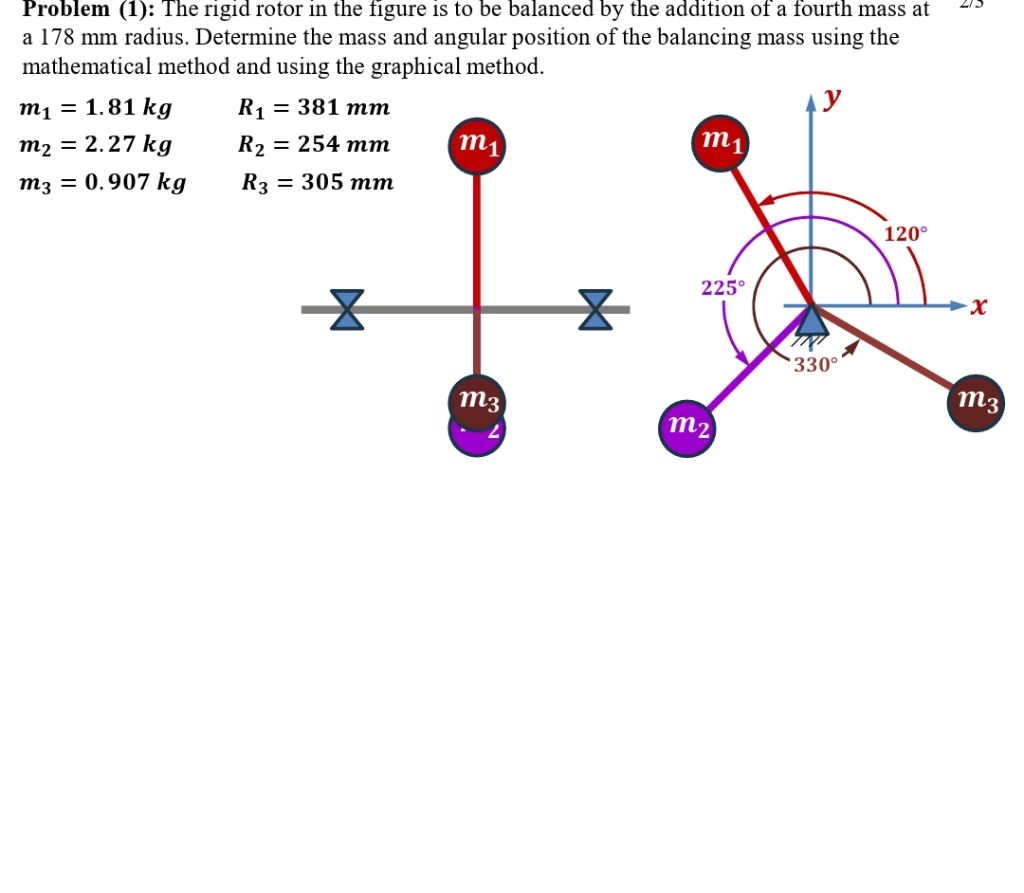 Problem (1): The rigid rotor in the figure 1s to be balanced by the addition of a fourth mass at =~
a 178 mm radius. Determine the mass and angular position of the balancing mass using the
mathematical method and using the graphical method.
my =1.81kg Ry = 381mm ¥
my =2.27 kg Ry; = 254mm
m3 = 0.907 kg R3 =305mm
120°
225°
xX
330°
This is AI generated Response.
Asked by: Rahul
Created at: 2025-12-10 16:46:55
Asked by: Rahul
Created at: 2025-12-10 16:46:55
Final Answer:
Rendered
Raw Text
Did you like this answer?
### Step 1: Express the Balancing Condition Mathematically
For static balance, vector sum of mass-radius products (moments) must be zero. Let the fourth mass be \( m_4 \) at radius \( R_4 = 178\,\text{mm} \) and angle \( \theta_4 \).
First, write the mass-radius product in vector form for each mass:
- \( m_1 R_1 \) at \( ^\circ \) (along +y)
- \( m_2 R_2 \) at \( 225^\circ \)
- \( m_3 R_3 \) at \( 330^\circ \)
- \( m_4 R_4 \) at \( \theta_4 \) (unknown)
Express each as a complex vector:
\[
\begin{align*}
m_1 R_1 e^{j^\circ} &= 1.81 \times 381 \times e^{j^\circ} \\
m_2 R_2 e^{j225^\circ} &= 2.27 \times 254 \times e^{j225^\circ} \\
m_3 R_3 e^{j330^\circ} &= .907 \times 305 \times e^{j330^\circ} \\
m_4 R_4 e^{j\theta_4} &= m_4 \times 178 \times e^{j\theta_4}
\end{align*}
\]
Sum in x and y directions, set total to zero for balance:
\[
\sum m_i R_i \cos\theta_i + m_4 R_4 \cos\theta_4 =
\]
\[
\sum m_i R_i \sin\theta_i + m_4 R_4 \sin\theta_4 =
\]
**Explanation:**
This step sets up the vector equations for balancing, expressing each mass-radius as a 2D vector (complex number) and forming the required equations for the system to be in static balance.
---
### Step 2: Substitute Values and Solve for \( m_4 \) and \( \theta_4 \)
Calculate each term:
- \( m_1 R_1 = 1.81 \times 381 = 690.61 \) (at \( ^\circ \): \( x = , y = 690.61 \))
- \( m_2 R_2 = 2.27 \times 254 = 576.58 \) (at \( 225^\circ \): \( x = 576.58 \cos 225^\circ, y = 576.58 \sin 225^\circ \))
- \( m_3 R_3 = .907 \times 305 = 276.64 \) (at \( 330^\circ \): \( x = 276.64 \cos 330^\circ, y = 276.64 \sin 330^\circ \))
Calculate components:
- \( \cos 225^\circ = -.7071, \sin 225^\circ = -.7071 \)
- \( \cos 330^\circ = .866, \sin 330^\circ = -.5 \)
So,
- \( m_2 R_2: x = 576.58 \times -.7071 = -407.89, y = 576.58 \times -.7071 = -407.89 \)
- \( m_3 R_3: x = 276.64 \times .866 = 239.61, y = 276.64 \times -.5 = -138.32 \)
Sum x and y:
\[
\text{Total } x = - 407.89 + 239.61 = -168.28
\]
\[
\text{Total } y = 690.61 - 407.89 - 138.32 = 144.40
\]
Set up equations:
\[
-168.28 + m_4 \times 178 \cos\theta_4 =
\]
\[
144.40 + m_4 \times 178 \sin\theta_4 =
\]
Solve for \( m_4 \) and \( \theta_4 \):
\[
\frac{144.40}{-168.28} = \frac{m_4 \times 178 \sin\theta_4}{m_4 \times 178 \cos\theta_4} = \tan\theta_4
\]
\[
\tan\theta_4 = -.8584 \implies \theta_4 = \arctan(-.8584) = -40.92^\circ \text{ (or 319.08°)}
\]
Now, find \( m_4 \):
\[
m_4 \times 178 \cos(-40.92^\circ) = 168.28
\]
\[
\cos(-40.92^\circ) = .757 \implies m_4 = \frac{168.28}{178 \times .757} = 1.26 \text{ kg}
\]
---
## **Final Answer**
- **Balancing mass \( m_4 = 1.26 \) kg**
- **Angular position \( \theta_4 = 319.1^\circ \) (or equivalently, \( -40.9^\circ \))**
---
**Explanation:**
We first wrote the vector sum equations for static balance, then substituted values and solved the simultaneous equations to find the required mass and angular position for the balancing mass.
📢 Instructions:
- Ask anything relatd to above question only.
- For new Question goto :