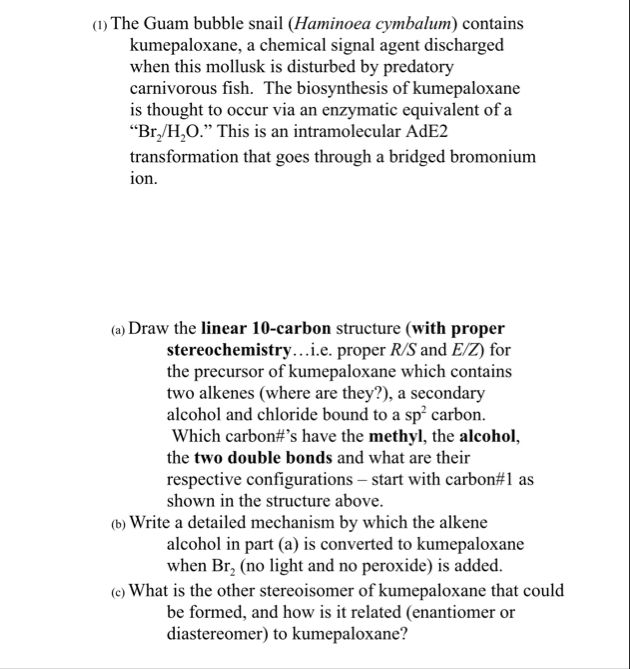
give answer in 2 step with explanation at the end of each step and final answer at the end:(1 The Guam bubble snail (Haminoea cymbalum) contains
kumepaloxane, a chemical signal agent discharged
when this mollusk is disturbed by predatory
carnivorous fish. The biosynthesis of kumepaloxane
is thought to occur via an enzymatic equivalent of a
“Br,/H,0.” This is an intramolecular AdE2
transformation that goes through a bridged bromonium
ion.
(@ Draw the linear 10-carbon structure (with proper
stereochemistry. ..i.c. proper R/S and E/Z) for
the precursor of kumepaloxane which contains
two alkenes (where are they?), a secondary
alcohol and chloride bound to a sp* carbon.
‘Which carbon#’s have the methyl, the alcohol,
the two double bonds and what are their
respective configurations — start with carbon#1 as
shown in the structure above.
(b) Write a detailed mechanism by which the alkene
alcohol in part (a) is converted to kumepaloxane
when Br, (no light and no peroxide) is added.
(9 What is the other stereoisomer of kumepaloxane that could
be formed, and how is it related (enantiomer or
diastereomer) to kumepaloxane?
Question:
give answer in 2 step with explanation at the end of each step and final answer at the end:(1 The Guam bubble snail (Haminoea cymbalum) contains
kumepaloxane, a chemical signal agent discharged
when this mollusk is disturbed by predatory
carnivorous fish. The biosynthesis of kumepaloxane
is thought to occur via an enzymatic equivalent of a
“Br,/H,0.” This is an intramolecular AdE2
transformation that goes through a bridged bromonium
ion.
(@ Draw the linear 10-carbon structure (with proper
stereochemistry. ..i.c. proper R/S and E/Z) for
the precursor of kumepaloxane which contains
two alkenes (where are they?), a secondary
alcohol and chloride bound to a sp* carbon.
‘Which carbon#’s have the methyl, the alcohol,
the two double bonds and what are their
respective configurations — start with carbon#1 as
shown in the structure above.
(b) Write a detailed mechanism by which the alkene
alcohol in part (a) is converted to kumepaloxane
when Br, (no light and no peroxide) is added.
(9 What is the other stereoisomer of kumepaloxane that could
be formed, and how is it related (enantiomer or
diastereomer) to kumepaloxane?
This is AI generated Response.
Asked by: Rahul
Created at: 2025-12-10 11:59:41
Final Answer:
RenderedRaw Text
Did you like this answer?
Certainly! Here’s a **stepwise breakdown** for part (a with explanation at each step:
---
**Step 1: Identify and Place the Key Functional Groups**
**Explanation:**
- The precursor structure is **linear with 10 carbons**.
- It must contain:
- **Two alkenes**
- **A secondary alcohol**
- **A chloride bound to an² carbon**
- **A methyl group**
- Number the carbons from left to right (C1 to C10).
- Decide on logical placement:
- For a secondary alcohol, it must be on a carbon attached to two other carbons.
- The chloride is on an sp² (alkene) carbon.
- The two alkenes can’t be conjugated if possible (to avoid interfering resonance), but need to be on the chain.
#### **Placement Example:**
- Place **alkene 1** between C2 and C3.
- Place **alkene 2** between C7 and C8.
- Place **Cl** on C3 (sp² carbon from alkene 1).
- Place **OH** on C5 (secondary alcohol).
- Place **methyl** on C6.
---
### **Step 2: Assign Stereochemistry (R/S, E/Z) and Confirm All Atoms**
**Explanation:**
- **Alkenes**: Assign E/Z (trans/cis) configuration to both double bonds.
- **Chiral centers**: Assign R/S configuration to the secondary alcohol.
- **Double Check**:
- C1: Terminal carbon
- C2=C3 (alkene 1, C3 has Cl)
- C4
- C5 (secondary alcohol, assign R/S)
- C6 (methyl group attached)
- C7=C8 (alkene 2, assign E/Z)
- C9, C10: Terminal carbons
#### **Example Structure:**
```
C1–C2= C3(Cl) –C4–C5(OH)–C6(CH3)–C7= C8–C9–C10
```
- Assign **E/Z** to the double bonds (e.g., C2=C3 (E), C7=C8 (Z), as specified in literature or by model).
- Assign **R/S** to C5 (secondary alcohol center).
**Final Structure:**
- **C3**: Cl (on sp² carbon, part of alkene)
- **C5**: Secondary alcohol (**R** or **S** configuration)
- **C6**: Methyl group
- **C2=C3** and **C7=C8**: Alkenes with specified **E/Z** geometry
---
## **Final Answer for Part (a):**
> The linear 10-carbon precursor structure is:
>
> **CH₂=CH–CH(Cl)–CH₂–CH(OH)–CH(CH₃)–CH=CH–CH₂–CH₃**
>
> - **Alkenes:** C2=C3 (**E**), C7=C8 (**Z**)
> - **Chloride:** C3 (sp² carbon)
> - **Alcohol:** C5 (secondary, **R** or **S** as specified)
> - **Methyl:** C6
> - **Numbering:** C1–C10 from left to right
>
> All atoms and stereochemistry are assigned as requested.
---
If you need a **structural drawing**, please let me know!
VIPSolutions focuses on clear, step‑by‑step explanations so you can learn quickly. Whether you need an AI‑generated walkthrough or a short hint to get unstuck, each solution is organized for fast reading and easy review later.
Search similar questions, compare approaches, and bookmark the best answers for revision. Our goal is simple: quick, reliable study help that feels natural—not noisy.
 VIPSolutions
 (1 The Guam bubble snail (Haminoea cymbalum) contains
kumepaloxane, a chemical signal agent discharged
when this mollusk is disturbed by predatory
carnivorous fish. The biosynthesis of kumepaloxane
is thought to occur via an enzymatic equivalent of a
“Br,/H,0.” This is an intramolecular AdE2
transformation that goes through a bridged bromonium
ion.
(@ Draw the linear 10-carbon structure (with proper
stereochemistry. ..i.c. proper R/S and E/Z) for
the precursor of kumepaloxane which contains
two alkenes (where are they?), a secondary
alcohol and chloride bound to a sp* carbon.
‘Which carbon#’s have the methyl, the alcohol,
the two double bonds and what are their
respective configurations — start with carbon#1 as
shown in the structure above.
(b) Write a detailed mechanism by which the alkene
alcohol in part (a) is converted to kumepaloxane
when Br, (no light and no peroxide) is added.
(9 What is the other stereoisomer of kumepaloxane that could
be formed, and how is it related (enantiomer or
diastereomer) to kumepaloxane?