 VIPSolutions
give answer in 2 step with explanation at the end of each step and final answer at the end:1. What is the practical benefit (in terms of time savings and efficiency) of defining the potential energy? Be clear about what is required in terms of calculation if we do not use the concept of potential energy. 2. For what type of force is it not possible to define a potential energy expression? 3. For the following forces that can do work, indicate if they are conservative or non-conservative: a. A human lifting a box b. An engine propelling a car down the road
Question:
give answer in 2 step with explanation at the end of each step and final answer at the end: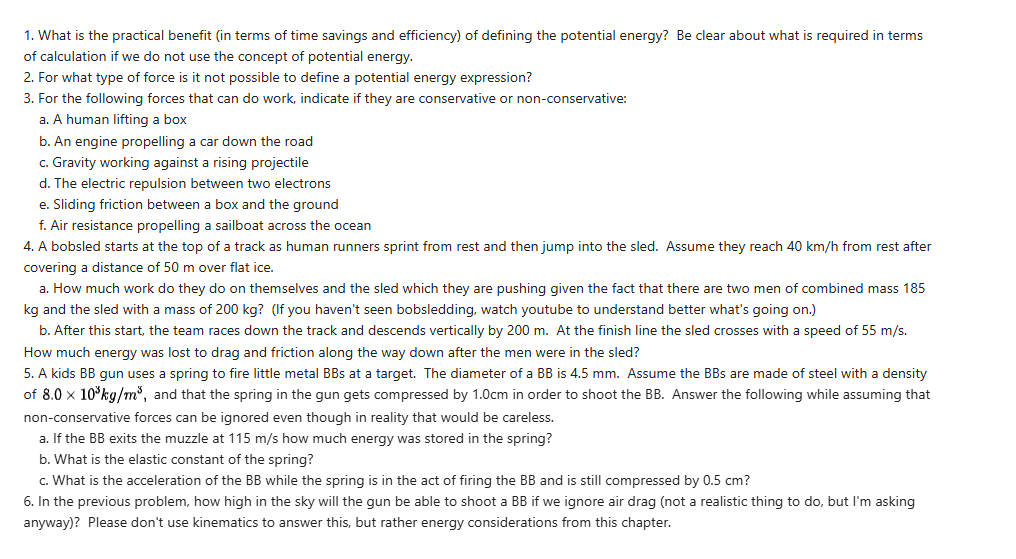 1. What is the practical benefit (in terms of time savings and efficiency) of defining the potential energy? Be clear about what is required in terms
of calculation if we do not use the concept of potential energy.
2. For what type of force is it not possible to define a potential energy expression?
3. For the following forces that can do work, indicate if they are conservative or non-conservative:
a. A human lifting a box
b. An engine propelling a car down the road
This is AI generated Response.
Asked by: Rahul
Created at: 2025-12-10 07:18:47
Asked by: Rahul
Created at: 2025-12-10 07:18:47
Final Answer:
Rendered
Raw Text
Did you like this answer?
Let's answer each question in **two clear steps** with explanations after each step, and provide the final answer at the end.
---
## 1. Practical Benefit of Using Potential Energy
### Step 1:
**If we do not use potential energy,** we must calculate the work done by all forces at each point along the path, integrating force over distance.
**Explanation:** This requires knowing the force at every instant and the exact path taken, making calculations much more complex and time-consuming.
### Step 2:
**If we use potential energy,** we can simply compare the potential energy at the start and end points to find the work done by conservative forces, without worrying about the path.
**Explanation:** This simplifies calculations, as only the initial and final states matter for conservative forces.
**Final Answer:**
The practical benefit is that using potential energy simplifies calculations by allowing us to consider only initial and final positions for conservative forces, rather than calculating work along the entire path.
---
## 2. For What Type of Force Is Potential Energy Not Defined?
### Step 1:
Potential energy can only be defined for **conservative forces.**
**Explanation:** Conservative forces have the property that the work done is path-independent.
### Step 2:
For **non-conservative forces** (e.g., friction, air resistance), potential energy cannot be defined.
**Explanation:** These forces dissipate energy, and the work done depends on the path, not just the initial and final positions.
**Final Answer:**
Potential energy cannot be defined for non-conservative forces.
---
## 3. Conservative or Non-conservative Forces
### Step 1:
Analyze each force:
- **a. Human lifting a box:** Non-conservative (depends on path, energy lost as heat, etc.)
- **b. Engine propelling a car:** Non-conservative (energy lost as heat, friction)
- **c. Gravity working against projectile:** Conservative (work done is path-independent)
- **d. Electric repulsion between electrons:** Conservative (electrostatic force is conservative)
- **e. Sliding friction:** Non-conservative (energy dissipated as heat)
- **f. Air resistance on sailboat:** Non-conservative (energy lost as heat, turbulence)
### Step 2:
Summarize:
- Conservative: c, d
- Non-conservative: a, b, e, f
**Final Answer:**
- Conservative: Gravity (c), Electric repulsion (d)
- Non-conservative: Human lifting box (a), Engine (b), Sliding friction (e), Air resistance (f)
---
## 4. Bobsled Work and Energy
### 4a. Work Done by Runners
#### Step 1:
Find final speed: \(40\, \text{km/h} = 11.11\, \text{m/s}\).
Total mass = \(185 + 200 = 385\, \text{kg}\)
#### Step 2:
Use kinetic energy:
\[
\text{Work} = \Delta K = \frac{1}{2}mv^2 = \frac{1}{2}(385)(11.11^2) = 23,769\, \text{J}
\]
**Final Answer:**
Work done = **23,769 J** (rounded to 23.8 kJ)
---
### 4b. Energy Lost to Drag and Friction
#### Step 1:
Initial kinetic energy = (at rest).
At finish:
\[
v = 55\, \text{m/s},\, d = 200\, \text{m}
\]
Kinetic energy at finish:
\[
K_f = \frac{1}{2}(385)(55^2) = 581,187.5\, \text{J}
\]
The sled descends 200 m: gain in gravitational potential energy:
\[
U = mgh = 385 \times 9.8 \times 200 = 754,600\, \text{J}
\]
#### Step 2:
Total energy input = initial kinetic + gained potential + work done by runners = \( + 754,600 + 23,769 = 778,369\, \text{J}\)
Energy at finish = 581,188 J
Energy lost = \(778,369 - 581,188 = 197,181\, \text{J}\)
**Final Answer:**
Energy lost to drag and friction = **197,181 J** (rounded to 197 kJ)
---
## 5. BB Gun with Spring
### 5a. Mass of BB
#### Step 1:
Volume of BB:
Radius \(r = 4.5\, \text{mm} = .0045\, \text{m}\)
\[
V = \frac{4}{3}\pi r^3 = \frac{4}{3}\pi (.0045^3) = 3.82 \times 10^{-7} \, m^3
\]
#### Step 2:
Mass = density × volume
\[
m = 8. \times 10^3 \times 3.82 \times 10^{-7} = 3.06 \times 10^{-3} \, \text{kg}
\]
**Final Answer:**
Mass of BB = **\(3.06 \times 10^{-3}\) kg** (or 3.06 grams)
---
### 5b. Energy Stored in Spring
#### Step 1:
Kinetic energy at muzzle:
\[
E = \frac{1}{2}mv^2 = \frac{1}{2}(3.06 \times 10^{-3})(115^2) = 20.2\, \text{J}
\]
#### Step 2:
Assuming all spring energy converts to kinetic energy:
\[
\text{Energy in spring} = 20.2\, \text{J}
\]
**Final Answer:**
Energy stored in spring = **20.2 J**
---
### 5c. Elastic Constant of Spring
#### Step 1:
Spring compressed \(x = .01\, \text{m}\) (1 cm)
\[
E = \frac{1}{2}kx^2 \rightarrow 20.2 = .5k(.01^2)
\]
#### Step 2:
\[
k = \frac{20.2}{.5 \times .0001} = \frac{20.2}{.00005} = 404,000\, \text{N/m}
\]
**Final Answer:**
Elastic constant \(k = 404,000\, \text{N/m}\)
---
### 5d. Acceleration of BB at .5 cm Compression
#### Step 1:
Spring force at \(x = .005\, \text{m}\):
\[
F = kx = 404,000 \times .005 = 202\, \text{N}
\]
#### Step 2:
Acceleration:
\[
a = \frac{F}{m} = \frac{202}{3.06 \times 10^{-3}} = 660,000\, \text{m/s}^2
\]
**Final Answer:**
Acceleration = **660,000 m/s²**
---
## 6. Maximum Height Attained by BB
### Step 1:
All kinetic energy converts to gravitational potential energy at max height:
\[
K = U \implies \frac{1}{2}mv^2 = mgh
\]
### Step 2:
\[
h = \frac{v^2}{2g} = \frac{115^2}{2 \times 9.8} = \frac{13,225}{19.6} = 675\, \text{m}
\]
**Final Answer:**
Maximum height = **675 m**
---
Let me know if you need further clarifications or calculations!
📢 Instructions:
- Ask anything relatd to above question only.
- For new Question goto :