 VIPSolutions
give answer in 2 step with explanation at the end of each step and final answer at the end:1 Required information Two steels are being considered for the manufacture of as-forged connecting rods subjected to bending loads. One is. AISI 4340 Cr-Mo-Ni steel capable of being heat-treated to a tensile strength of 260 kpsi. The other is a plain carbon steel AISI 1040 with an attainable S,, of 113 kpsi. Each rod is to have a size giving an equivalent diameter d, of 0.850 in. Determine the endurance limit for each material. Is there any advantage of using the alloy steel for this fatigue application? What are the estimated values of the endurance limits for the 4340 and 1040 steels? The endurance limit for the 4340 steel is [J kpsi. The endurance limit for the 1040 steel is [| kpsi. What is the surface modification factor value for each of the materials? The surface modification factor value for the 4340 steel is[ |. The surface modification factor value for the 1040 steelis[ |. What is the size modification factor value for each of the components? The size modification factor value for the 4340 steelis| |. The size modification factor value for the 1040 steel is]. Given that all other modifying factors are equal to 1, except surface modification factor and size modification factor, what are the ‘endurance limits for each of the components? The endurance limit for the 4340 steel is [J kpsi. The endurance limit for the 1040 steel is kpsi.
Question:
give answer in 2 step with explanation at the end of each step and final answer at the end: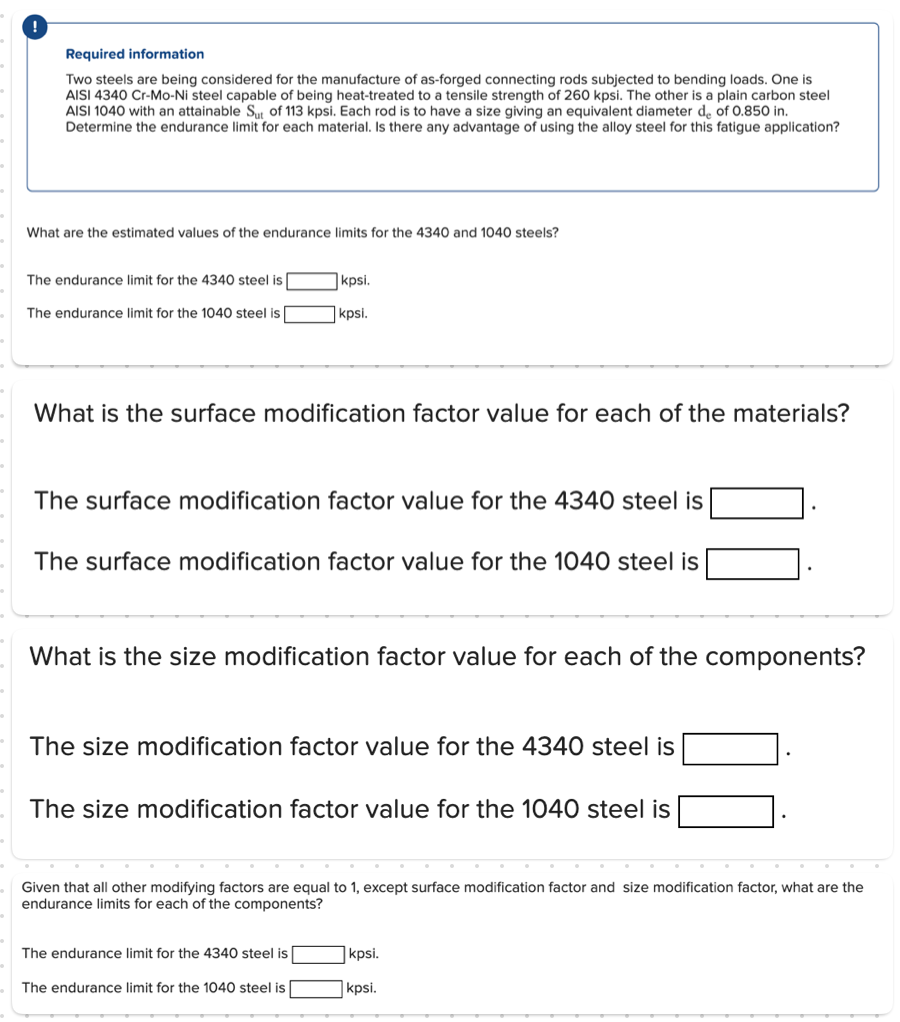 1
Required information
Two steels are being considered for the manufacture of as-forged connecting rods subjected to bending loads. One is.
AISI 4340 Cr-Mo-Ni steel capable of being heat-treated to a tensile strength of 260 kpsi. The other is a plain carbon steel
AISI 1040 with an attainable S,, of 113 kpsi. Each rod is to have a size giving an equivalent diameter d, of 0.850 in.
Determine the endurance limit for each material. Is there any advantage of using the alloy steel for this fatigue application?
What are the estimated values of the endurance limits for the 4340 and 1040 steels?
The endurance limit for the 4340 steel is [J kpsi.
The endurance limit for the 1040 steel is [| kpsi.
What is the surface modification factor value for each of the materials?
The surface modification factor value for the 4340 steel is[ |.
The surface modification factor value for the 1040 steelis[ |.
What is the size modification factor value for each of the components?
The size modification factor value for the 4340 steelis| |.
The size modification factor value for the 1040 steel is].
Given that all other modifying factors are equal to 1, except surface modification factor and size modification factor, what are the
‘endurance limits for each of the components?
The endurance limit for the 4340 steel is [J kpsi.
The endurance limit for the 1040 steel is kpsi.
Asked by: Rahul
Created at: 2025-12-10 07:10:44
Final Answer:
📢 Instructions:
- Ask anything relatd to above question only.
- For new Question goto :