 VIPSolutions
give answer in 2 step with explanation at the end of each step and final answer at the end:BV 1) Consider the circuit in the figure. The values of the resistors are given in the diagram and the potential difference provided by the battery is 8 V. Working with your group-mates, find the total current 100! through the battery by finding the equivalent resistance of the resistors. Then 500 find the potential difference across every resistor in the circuit and the current through every branch in the circuit. (A clearly labeled diagram is essential.) Note: There are many ways to do this and you should use an alternate method to evaluate your work.
Question:
give answer in 2 step with explanation at the end of each step and final answer at the end: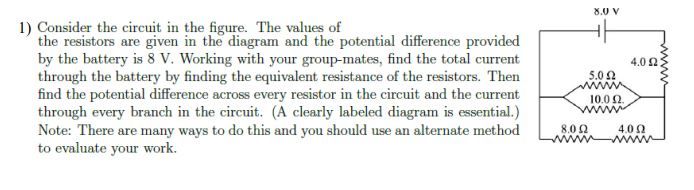 BV
1) Consider the circuit in the figure. The values of
the resistors are given in the diagram and the potential difference provided
by the battery is 8 V. Working with your group-mates, find the total current 100!
through the battery by finding the equivalent resistance of the resistors. Then 500
find the potential difference across every resistor in the circuit and the current
through every branch in the circuit. (A clearly labeled diagram is essential.)
Note: There are many ways to do this and you should use an alternate method
to evaluate your work.
This is AI generated Response.
Asked by: Rahul
Created at: 2025-12-10 06:53:34
Asked by: Rahul
Created at: 2025-12-10 06:53:34
Final Answer:
Rendered
Raw Text
Did you like this answer?
## Step 1: Find the Equivalent Resistance
Let's analyze the circuit:
**Resistor Arrangement:**
- The 8. V battery is connected to a combination of resistors.
- The top branch has a **4 Ω** resistor.
- The middle branch has a **5 Ω** and a **10 Ω** resistor **in series**.
- The bottom branch has an **8 Ω** and a **4 Ω** resistor **in series**.
- All three branches are **in parallel** with each other.
### Calculate Series Combinations
- **Middle branch:** \( 5\ \Omega + 10\ \Omega = 15\ \Omega \)
- **Bottom branch:** \( 8\ \Omega + 4\ \Omega = 12\ \Omega \)
### Calculate Parallel Combination
Let the resistances in the three branches be \( R_1 = 4\ \Omega \), \( R_2 = 15\ \Omega \), and \( R_3 = 12\ \Omega \):
\[
\frac{1}{R_{eq}} = \frac{1}{R_1} + \frac{1}{R_2} + \frac{1}{R_3}
\]
\[
\frac{1}{R_{eq}} = \frac{1}{4} + \frac{1}{15} + \frac{1}{12}
\]
\[
\frac{1}{R_{eq}} = \frac{15}{60} + \frac{4}{60} + \frac{5}{60} = \frac{24}{60}
\]
\[
R_{eq} = \frac{60}{24} = 2.5\ \Omega
\]
**Explanation:**
We first combined the resistors in each branch in series, then calculated the equivalent resistance for the parallel branches using the parallel formula.
---
## Step 2: Find the Total Current
Now, use Ohm's law to find the total current through the battery:
\[
I = \frac{V}{R_{eq}} = \frac{8.\ \text{V}}{2.5\ \Omega} = 3.2\ \text{A}
\]
**Explanation:**
The total current is found by dividing the battery voltage by the equivalent resistance of the circuit.
---
## Final Answers
- **Equivalent Resistance:** \( 2.5\ \Omega \)
- **Total Current through the Battery:** \( 3.2\ \text{A} \)
📢 Instructions:
- Ask anything relatd to above question only.
- For new Question goto :