 VIPSolutions
give answer in 2 step with explanation at the end of each step and final answer at the end:QUESTION 1 — Total: 40 Marks repaint mid pect tact Sine ly Er aye (E-1 . hee C, demote consumption an I, denotes abou suppl, subi 10 the pred bet constant PC + QB = By y+ WN -T,, where P is the price level Q; the price of a one-period nominal bond (which pays one unit of money next. period). W, the nominal wage. BB; nominal bond holdings. and T, lump-sum taxes. The representative firm is perfectly competitive and produces output using the production function Y= ANY, 0
Question:
give answer in 2 step with explanation at the end of each step and final answer at the end: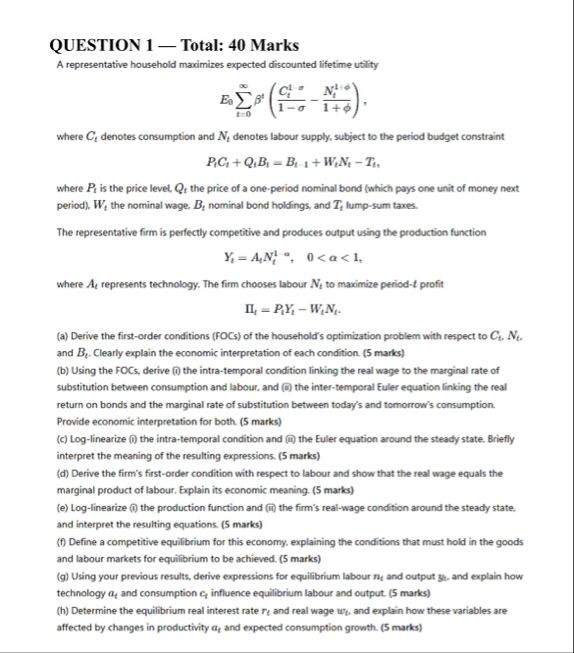 QUESTION 1 — Total: 40 Marks
repaint mid pect tact Sine ly
Er
aye (E-1 .
hee C, demote consumption an I, denotes abou suppl, subi 10 the pred bet constant
PC + QB = By y+ WN -T,,
where P is the price level Q; the price of a one-period nominal bond (which pays one unit of money next.
period). W, the nominal wage. BB; nominal bond holdings. and T, lump-sum taxes.
The representative firm is perfectly competitive and produces output using the production function
Y= ANY, 0
This is AI generated Response.
Asked by: Rahul
Created at: 2025-12-09 02:15:01
Asked by: Rahul
Created at: 2025-12-09 02:15:01
Final Answer:
Rendered
Raw Text
Did you like this answer?
Certainly! I'll address **part (a)** of the question in **two steps** with explanations after each step, and provide the final answer at the end.
---
## Step 1: **Set Up the Lagrangian**
The household maximizes expected discounted utility:
\[
E_ \sum_{t=}^\infty \beta^t \left( \frac{C_t^{1-\sigma}}{1-\sigma} - \frac{N_t^{1+\varphi}}{1+\varphi} \right)
\]
subject to the budget constraint:
\[
P_tC_t + Q_t B_{t} = B_{t-1} + W_t N_t - T_t
\]
Let \(\lambda_t\) be the Lagrange multiplier for the budget constraint. The Lagrangian is:
\[
\mathcal{L} = E_ \sum_{t=}^\infty \beta^t \left[ \frac{C_t^{1-\sigma}}{1-\sigma} - \frac{N_t^{1+\varphi}}{1+\varphi} + \lambda_t \left( B_{t-1} + W_t N_t - T_t - P_tC_t - Q_t B_t \right) \right]
\]
**Explanation:**
Here, we’ve set up the household’s maximization problem using a Lagrangian, introducing the multiplier to handle the budget constraint. This sets the stage for finding the first-order conditions (FOCs) by differentiating with respect to each choice variable.
---
## Step 2: **Find the First-Order Conditions (FOCs)**
**With Respect to \(C_t\):**
\[
\frac{\partial \mathcal{L}}{\partial C_t} = \beta^t C_t^{-\sigma} - \lambda_t P_t = \implies \lambda_t = \frac{\beta^t}{P_t} C_t^{-\sigma}
\]
**With Respect to \(N_t\):**
\[
\frac{\partial \mathcal{L}}{\partial N_t} = -\beta^t N_t^{\varphi} + \lambda_t W_t = \implies \lambda_t = \frac{\beta^t}{W_t} N_t^{\varphi}
\]
**With Respect to \(B_t\):**
\[
\frac{\partial \mathcal{L}}{\partial B_t} = -\lambda_t Q_t + \beta E_t [\lambda_{t+1}] = \implies Q_t \lambda_t = \beta E_t[\lambda_{t+1}]
\]
**Economic Interpretation:**
- The **\(C_t\) condition** equates the marginal utility of consumption to the marginal utility of wealth (in terms of the price level).
- The **\(N_t\) condition** equates the marginal disutility of labor to the marginal utility of wealth (in terms of the wage).
- The **\(B_t\) condition** is the Euler equation: the value of investing a unit of wealth in bonds today equals the expected discounted marginal value of wealth tomorrow.
---
## **Final Answer (Part a):**
**First-order conditions:**
1. \(\lambda_t = \frac{\beta^t}{P_t} C_t^{-\sigma}\)
2. \(\lambda_t = \frac{\beta^t}{W_t} N_t^{\varphi}\)
3. \(Q_t \lambda_t = \beta E_t[\lambda_{t+1}]\)
**Economic interpretation:**
- The household chooses consumption and labor such that the value of the marginal utility of consumption and labor aligns with the budget constraint, and allocates savings (bonds) to equate the marginal utility of wealth across periods.
---
Let me know if you’d like to proceed step-by-step for the next part!
📢 Instructions:
- Ask anything relatd to above question only.
- For new Question goto :