 VIPSolutions
give answer in 2 step with explanation at the end of each step and final answer at the end:5. (12/2/25 Sec 10.4) Consider the curve given by the polar equat 2 Fill in the tab valles below, and use those points to sketch the curve on ach point P| 0 no 9 | = 7 D | 37/4
Question:
give answer in 2 step with explanation at the end of each step and final answer at the end: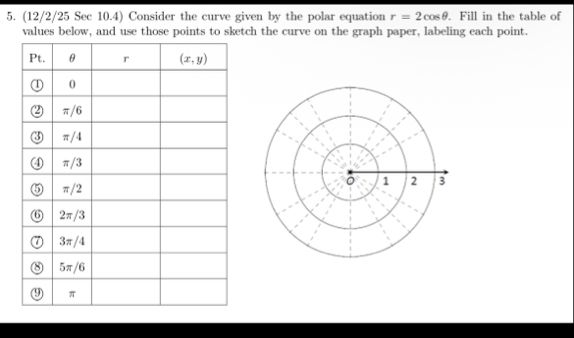 5. (12/2/25 Sec 10.4) Consider the curve given by the polar equat 2 Fill in the tab
valles below, and use those points to sketch the curve on ach point
P| 0
no
9 | =
7
D | 37/4
This is AI generated Response.
Asked by: Rahul
Created at: 2025-12-08 19:56:44
Asked by: Rahul
Created at: 2025-12-08 19:56:44
Final Answer:
Rendered
Raw Text
Did you like this answer?
## Step 1: Calculate \( r \) for Each \( \theta \)
The polar equation is:
\[ r = 2 \cos \theta \]
Let's compute \( r \) for each \( \theta \):
| Pt. | \( \theta \) | \( r = 2\cos\theta \) |
|-----|------------------|-----------------------|
| ① | \( \) | \( 2\cos = 2 \) |
| ② | \( \frac{\pi}{6} \) | \( 2\cos\frac{\pi}{6} = 2 \times \frac{\sqrt{3}}{2} = \sqrt{3} \) |
| ③ | \( \frac{\pi}{4} \) | \( 2\cos\frac{\pi}{4} = 2 \times \frac{\sqrt{2}}{2} = \sqrt{2} \) |
| ④ | \( \frac{\pi}{3} \) | \( 2\cos\frac{\pi}{3} = 2 \times \frac{1}{2} = 1 \) |
| ⑤ | \( \frac{\pi}{2} \) | \( 2\cos\frac{\pi}{2} = 2 \times = \) |
| ⑥ | \( \frac{2\pi}{3} \) | \( 2\cos\frac{2\pi}{3} = 2 \times (-\frac{1}{2}) = -1 \) |
| ⑦ | \( \frac{3\pi}{4} \) | \( 2\cos\frac{3\pi}{4} = 2 \times -\frac{\sqrt{2}}{2} = -\sqrt{2} \) |
| ⑧ | \( \frac{5\pi}{6} \) | \( 2\cos\frac{5\pi}{6} = 2 \times -\frac{\sqrt{3}}{2} = -\sqrt{3} \) |
| ⑨ | \( \pi \) | \( 2\cos\pi = 2 \times -1 = -2 \) |
**Explanation:**
We used the cosine values at standard angles to evaluate \( r \) for each \( \theta \).
---
## Step 2: Convert to Cartesian Coordinates \((x, y)\)
Recall:
\[ x = r\cos\theta \]
\[ y = r\sin\theta \]
Let's compute \((x, y)\):
| Pt. | \( \theta \) | \( r \) | \( x = r\cos\theta \) | \( y = r\sin\theta \) |
|-----|--------------------|-----------------|-------------------------------|-------------------------------|
| ① | \( \) | 2 | \( 2 \times 1 = 2 \) | \( 2 \times = \) |
| ② | \( \frac{\pi}{6} \)| \( \sqrt{3} \) | \( \sqrt{3} \times \frac{\sqrt{3}}{2} = \frac{3}{2} \) | \( \sqrt{3} \times \frac{1}{2} = \frac{\sqrt{3}}{2} \) |
| ③ | \( \frac{\pi}{4} \)| \( \sqrt{2} \) | \( \sqrt{2} \times \frac{\sqrt{2}}{2} = 1 \) | \( \sqrt{2} \times \frac{\sqrt{2}}{2} = 1 \) |
| ④ | \( \frac{\pi}{3} \)| 1 | \( 1 \times \frac{1}{2} = .5 \) | \( 1 \times \frac{\sqrt{3}}{2} = \frac{\sqrt{3}}{2} \) |
| ⑤ | \( \frac{\pi}{2} \)| | | |
| ⑥ | \( \frac{2\pi}{3} \)| -1 | \( -1 \times -\frac{1}{2} = .5 \) | \( -1 \times \frac{\sqrt{3}}{2} = -\frac{\sqrt{3}}{2} \) |
| ⑦ | \( \frac{3\pi}{4} \)| \(-\sqrt{2}\) | \( -\sqrt{2} \times -\frac{\sqrt{2}}{2} = 1 \) | \( -\sqrt{2} \times \frac{\sqrt{2}}{2} = -1 \) |
| ⑧ | \( \frac{5\pi}{6} \)| \(-\sqrt{3}\) | \( -\sqrt{3} \times -\frac{\sqrt{3}}{2} = \frac{3}{2} \) | \( -\sqrt{3} \times \frac{1}{2} = -\frac{\sqrt{3}}{2} \) |
| ⑨ | \( \pi \) | -2 | \( -2 \times -1 = 2 \) | \( -2 \times = \) |
**Explanation:**
We used the coordinates conversion formulas to find each \((x, y)\) pair.
---
## Final Answer: Table of Values
| Pt. | \( \theta \) | \( r \) | \( (x, y) \) |
|-----|--------------------|-----------------|-------------------------------|
| ① | \( \) | 2 | \( (2, ) \) |
| ② | \( \frac{\pi}{6} \)| \( \sqrt{3} \) | \( (\frac{3}{2}, \frac{\sqrt{3}}{2}) \) |
| ③ | \( \frac{\pi}{4} \)| \( \sqrt{2} \) | \( (1, 1) \) |
| ④ | \( \frac{\pi}{3} \)| 1 | \( (.5, \frac{\sqrt{3}}{2}) \) |
| ⑤ | \( \frac{\pi}{2} \)| | \( (, ) \) |
| ⑥ | \( \frac{2\pi}{3} \)| -1 | \( (.5, -\frac{\sqrt{3}}{2}) \) |
| ⑦ | \( \frac{3\pi}{4} \)| \(-\sqrt{2}\) | \( (1, -1) \) |
| ⑧ | \( \frac{5\pi}{6} \)| \(-\sqrt{3}\) | \( (\frac{3}{2}, -\frac{\sqrt{3}}{2}) \) |
| ⑨ | \( \pi \) | -2 | \( (2, ) \) |
You can now plot these points on the polar graph.
📢 Instructions:
- Ask anything relatd to above question only.
- For new Question goto :