 VIPSolutions
give answer in 2 step with explanation at the end of each step and final answer at the end:i tion? p: 3. What is the most likely product of the following reac i Pr 0 i AS 3 IA cs : 1 n mw w v 4 gl dv p b. II er Vi % co III ¥ 3 9. 1denti & lentify the reagent(s) needed to complete the following reaction scheme. E i | ] | i 3 3 — 5 i © NaO d b. oo ETS 3 AGE c. : AN HO/ 10. Which the follow “i 2 ing contains Lat a a an electrophilic addition reactions +P: 20nd that is likely to partici 1 IR =a HEY to participate jp bE NH 7 GAR Sea CF a. ’ Wj a == b. II Sisal dS TV v 1 le FW naa c Ir Ch Har SRR eV a LE a,
Question:
give answer in 2 step with explanation at the end of each step and final answer at the end: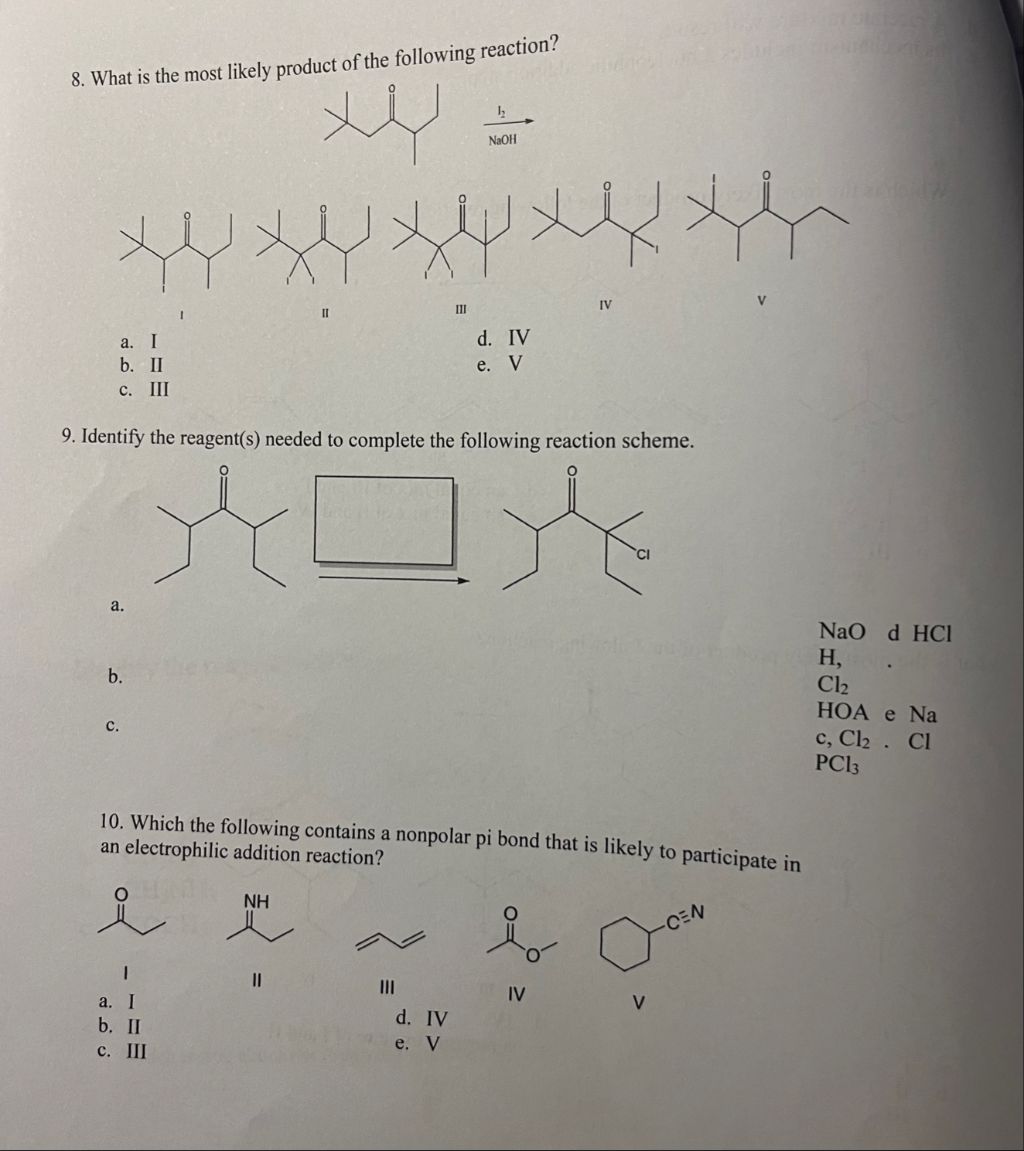 i tion? p:
3. What is the most likely product of the following reac i Pr
0
i
AS 3
IA cs :
1 n mw w v 4
gl dv p
b. II er Vi %
co III ¥ 3
9. 1denti &
lentify the reagent(s) needed to complete the following reaction scheme. E
i | ]
| i
3
3
— 5
i
© NaO d
b. oo ETS
3 AGE
c. : AN HO/
10. Which the follow “i
2 ing contains Lat a a
an electrophilic addition reactions +P: 20nd that is likely to partici
1 IR =a HEY to participate jp
bE NH 7 GAR Sea CF
a. ’ Wj a ==
b. II Sisal dS TV v
1 le FW naa
c Ir Ch Har SRR eV
a
LE a,
This is AI generated Response.
Asked by: Firdos
Created at: 2025-12-08 15:45:39
Asked by: Firdos
Created at: 2025-12-08 15:45:39
Final Answer:
Rendered
Raw Text
Did you like this answer?
Let's solve each question step by step with explanations and provide the final answers.
---
## Question 8
**Step 1:**
The reaction shows a ketone with NaOH and I₂. This is the classic **iodoform reaction**, which tests for methyl ketones (R-CO-CH₃). The terminal methyl group is converted to a carboxylate anion, and the rest of the molecule loses the methyl carbon as CHI₃.
**Explanation:**
We look for the product where the methyl group adjacent to the carbonyl is replaced by an -O⁻ group (which can be protonated to -OH).
**Step 2:**
From the options, the correct product is the one where the methyl group adjacent to the carbonyl is replaced by an -O⁻ (or -OH) group.
**Explanation:**
Look for the structure with the correct transformation.
**Final Answer:**
**b. II**
---
## Question 9
**Step 1:**
The starting material is a methyl ketone. The product is an α-chloro ketone (chlorine on the carbon adjacent to the carbonyl).
**Explanation:**
Chlorination at the α-position of a ketone is typically done using Cl₂ in acidic or basic medium.
**Step 2:**
From the options, the reagent pair that accomplishes this is **Cl₂ and NaOH** (haloform/α-halogenation reaction).
**Explanation:**
NaOH deprotonates the α-hydrogen, and Cl₂ introduces the chlorine by electrophilic substitution.
**Final Answer:**
**c. Cl₂, NaOH**
---
## Question 10
**Step 1:**
We are asked for a compound containing a **nonpolar π bond** that can undergo **electrophilic addition**. Nonpolar π bonds are usually found in alkenes (C=C), not in carbonyls (C=O) or nitriles (C≡N).
**Explanation:**
Electrophilic addition is a hallmark reaction of alkenes.
**Step 2:**
Among the options, structure III is an alkene (nonpolar double bond).
**Explanation:**
Other options are carbonyls, nitriles, or amides, which do not undergo simple electrophilic addition like alkenes do.
**Final Answer:**
**c. III**
---
### **Summary Table**
| Q# | Final Answer |
|----|--------------|
| 8 | b. II |
| 9 | c. Cl₂, NaOH |
| 10 | c. III |
📢 Instructions:
- Ask anything relatd to above question only.
- For new Question goto :