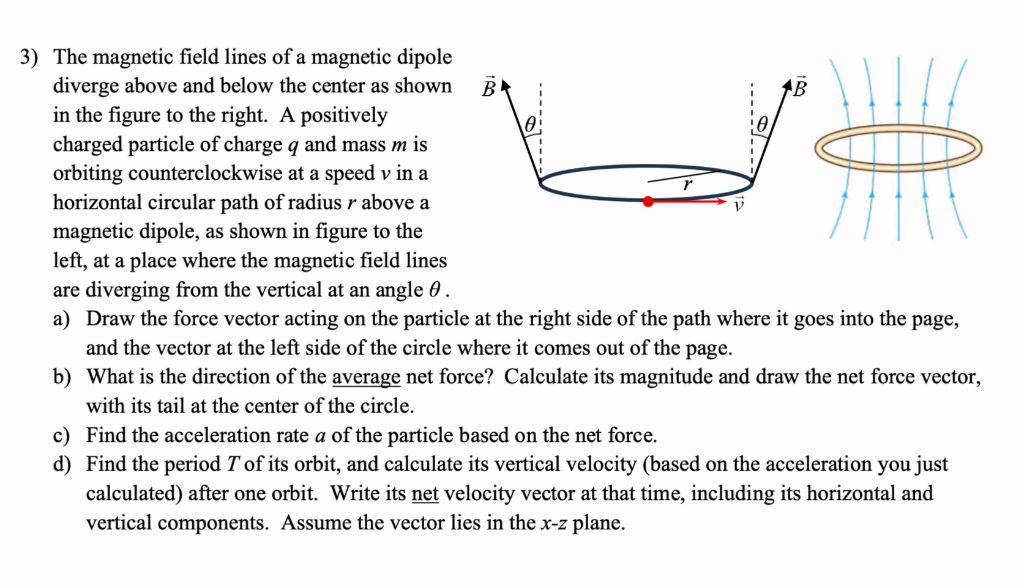
give answer in 2 step with explanation at the end of each step and final answer at the end:3) The magnetic field lines of a magnetic dipole \ I
diverge above and below the center as shown § ; ; B \ | | /
in the figure to the right. A positively 9 i) \ [|
charged particle of charge ¢g and mass m is Hi |
orbiting counterclockwise at a speed v in a A 7 =
horizontal circular path of radius » above a v ia | rs
magnetic dipole, as shown in figure to the TA
left, at a place where the magnetic field lines
are diverging from the vertical at an angle 6.
a) Draw the force vector acting on the particle at the right side of the path where it goes into the page,
and the vector at the left side of the circle where it comes out of the page.
b) What is the direction of the average net force? Calculate its magnitude and draw the net force vector,
with its tail at the center of the circle.
¢) Find the acceleration rate a of the particle based on the net force.
d) Find the period T of its orbit, and calculate its vertical velocity (based on the acceleration you just
calculated) after one orbit. Write its net velocity vector at that time, including its horizontal and
vertical components. Assume the vector lies in the x-z plane.
Question:
give answer in 2 step with explanation at the end of each step and final answer at the end:3) The magnetic field lines of a magnetic dipole \ I
diverge above and below the center as shown § ; ; B \ | | /
in the figure to the right. A positively 9 i) \ [|
charged particle of charge ¢g and mass m is Hi |
orbiting counterclockwise at a speed v in a A 7 =
horizontal circular path of radius » above a v ia | rs
magnetic dipole, as shown in figure to the TA
left, at a place where the magnetic field lines
are diverging from the vertical at an angle 6.
a) Draw the force vector acting on the particle at the right side of the path where it goes into the page,
and the vector at the left side of the circle where it comes out of the page.
b) What is the direction of the average net force? Calculate its magnitude and draw the net force vector,
with its tail at the center of the circle.
¢) Find the acceleration rate a of the particle based on the net force.
d) Find the period T of its orbit, and calculate its vertical velocity (based on the acceleration you just
calculated) after one orbit. Write its net velocity vector at that time, including its horizontal and
vertical components. Assume the vector lies in the x-z plane.
This is AI generated Response.
Asked by: Firdos
Created at: 2025-12-08 07:33:07
Final Answer:
RenderedRaw Text
Did you like this answer?
Let's solve the problem stepwise, as requested.
---
## Step 1: **Force Vectors on the Particle (Part a)**
**Explanation:**
- A positively charged particle moving in a magnetic field experiences a force given by the Lorentz force:
\[
\vec{F} = q\vec{v} \times \vec{B}
\]
- On the right side of the circle, the velocity \(\vec{v}\) is into the page (as shown), and \(\vec{B}\) is at an angle \(\theta\) from the vertical (upward and to the right).
- Use the right-hand rule: Point your fingers in the direction of \(\vec{v}\) (into the page), curl them toward \(\vec{B}\) (upward/right), and your thumb points toward the force direction.
- **Right side:**
\(\vec{F}\) will point radially inward and upward (since \(\vec{v}\) is into the page and \(\vec{B}\) is up/right).
- **Left side:**
The velocity is out of the page, and \(\vec{B}\) is up/left. The force will also point radially inward and upward.
**Summary:**
On both sides, the magnetic force always points inward (toward the center of the circle) and has a vertical (upward) component due to the angle \(\theta\).
---
## Step 2: **Direction and Magnitude of Average Net Force (Part b)**
**Explanation:**
- The average net force (over a full circle) is the **centripetal force** needed to keep the particle in a circular path.
- This force must point **toward the center of the circle** in the horizontal plane, but since the magnetic field is tilted, the force also has a vertical component.
- Net force magnitude:
\[
F = qvB\sin\theta
\]
(since the effective perpendicular component of \(\vec{B}\) to the velocity is \(B\sin\theta\)).
- **Direction:**
The net force vector (average over the orbit) points radially inward in the x-z plane (toward the center of the circle, plus a small vertical/upward component).
---
## **Final Answer**
### a)
- The force vector on the right side points radially inward and upward (into the page, then up/right).
- On the left side, it points radially inward and upward (out of the page, then up/left).
### b)
- **Direction of average net force:** Radially inward with an upward component (in the x-z plane).
- **Magnitude:**
\[
F_{\text{net}} = qvB\sin\theta
\]
- **Vector:** Drawn from the center of the circle, pointing inward and slightly upward at angle \(\theta\) from the horizontal.
---
Let me know if you'd like to proceed to parts (c) and (d)!
Question:
All parts solved please
This is AI generated Response.
Asked by: Firdos
Created at: 2025-12-08 07:33:55
Final Answer:
RenderedRaw Text
Did you like this answer?
Let's continue solving the problem through all parts, following the structured approach.
---
## Step 3: **Acceleration of the Particle (Part c)**
**Explanation:**
- The acceleration \(\vec{a}\) of the particle can be determined using Newton's second law:
\[
\vec{F}_{\text{net}} = m\vec{a}
\]
- Therefore, the magnitude of acceleration is given by:
\[
a = \frac{F_{\text{net}}}{m}
\]
Substituting the expression for the net force:
\[
a = \frac{qvB\sin\theta}{m}
\]
- **Direction:**
The direction of \(\vec{a}\) is also toward the center of the circle (horizontal radial component) with a vertical component upward, similar to the net force.
---
## Step 4: **Period of Orbit and Vertical Velocity After One Orbit (Part d)**
**Explanation:**
1. **Period \(T\) of the Orbit:**
- For a particle in uniform circular motion, the period is given by:
\[
T = \frac{2\pi r}{v}
\]
where \(r\) is the radius of the circular path.
2. **Vertical Velocity After One Orbit:**
- The vertical component of velocity \(v_z\) after one orbit can be calculated using the vertical acceleration \(a\) over the time \(T\):
\[
v_z = a \cdot T = \left(\frac{qvB\sin\theta}{m}\right) \cdot T
\]
Substituting \(T\):
\[
v_z = \left(\frac{qvB\sin\theta}{m}\right) \cdot \left(\frac{2\pi r}{v}\right) = \frac{2\pi r qB\sin\theta}{m}
\]
3. **Net Velocity Vector:**
- The horizontal component remains constant as \(v_x = v\).
- Therefore, the net velocity vector \(\vec{v}_{\text{net}}\) after one orbit is:
\[
\vec{v}_{\text{net}} = \begin{pmatrix}
v \\
\frac{2\pi r qB\sin\theta}{m}
\end{pmatrix}
\]
where the first component is the horizontal velocity and the second component is the vertical velocity.
---
## **Final Answers**
### c)
- **Acceleration \(a\):**
\[
a = \frac{qvB\sin\theta}{m}
\]
- **Direction:** Toward the center of the circle with an upward component.
### d)
1. **Period \(T\):**
\[
T = \frac{2\pi r}{v}
\]
2. **Vertical Velocity \(v_z\) after one orbit:**
\[
v_z = \frac{2\pi r qB\sin\theta}{m}
\]
3. **Net Velocity Vector**:
\[
\vec{v}_{\text{net}} = \begin{pmatrix}
v \\
\frac{2\pi r qB\sin\theta}{m}
\end{pmatrix}
\]
---
This concludes the solution for all parts of the problem. Let me know if you need further assistance!
VIPSolutions focuses on clear, step‑by‑step explanations so you can learn quickly. Whether you need an AI‑generated walkthrough or a short hint to get unstuck, each solution is organized for fast reading and easy review later.
Search similar questions, compare approaches, and bookmark the best answers for revision. Our goal is simple: quick, reliable study help that feels natural—not noisy.
 VIPSolutions
 3) The magnetic field lines of a magnetic dipole \ I
diverge above and below the center as shown § ; ; B \ | | /
in the figure to the right. A positively 9 i) \ [|
charged particle of charge ¢g and mass m is Hi |
orbiting counterclockwise at a speed v in a A 7 =
horizontal circular path of radius » above a v ia | rs
magnetic dipole, as shown in figure to the TA
left, at a place where the magnetic field lines
are diverging from the vertical at an angle 6.
a) Draw the force vector acting on the particle at the right side of the path where it goes into the page,
and the vector at the left side of the circle where it comes out of the page.
b) What is the direction of the average net force? Calculate its magnitude and draw the net force vector,
with its tail at the center of the circle.
¢) Find the acceleration rate a of the particle based on the net force.
d) Find the period T of its orbit, and calculate its vertical velocity (based on the acceleration you just
calculated) after one orbit. Write its net velocity vector at that time, including its horizontal and
vertical components. Assume the vector lies in the x-z plane.