 VIPSolutions
give answer in 2 step with explanation at the end of each step and final answer at the end:5. Solve the given initial value problem. 0-1-1 3 xXM)=] -1 0 -1 x) x(0)=|9 -1-1 0 3 wl]
Question:
give answer in 2 step with explanation at the end of each step and final answer at the end: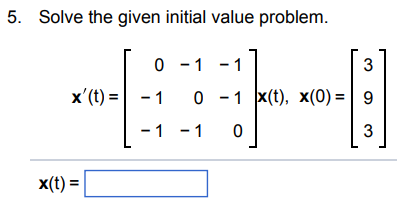 5. Solve the given initial value problem.
0-1-1 3
xXM)=] -1 0 -1 x) x(0)=|9
-1-1 0 3
wl]
This is AI generated Response.
Asked by: Firdos
Created at: 2025-12-08 06:11:54
Asked by: Firdos
Created at: 2025-12-08 06:11:54
Final Answer:
Rendered
Raw Text
Did you like this answer?
Let's solve the initial value problem step by step:
---
## **Step 1: Write the System and Find Eigenvalues/Eigenvectors**
The system is:
\[
\mathbf{x}'(t) =
\begin{bmatrix}
& -1 & -1 \\
-1 & & -1 \\
-1 & -1 & \\
\end{bmatrix}
\mathbf{x}(t), \quad \mathbf{x}() =
\begin{bmatrix}
3 \\ 9 \\ 3
\end{bmatrix}
\]
Let's find the eigenvalues of the matrix \(A\):
Set \(\det(A - \lambda I) = \):
\[
\begin{vmatrix}
-\lambda & -1 & -1 \\
-1 & -\lambda & -1 \\
-1 & -1 & -\lambda \\
\end{vmatrix} =
\]
Expanding the determinant, we get:
\[
-\lambda \left| \begin{matrix} -\lambda & -1 \\ -1 & -\lambda \end{matrix} \right|
- (-1)\left| \begin{matrix} -1 & -1 \\ -1 & -\lambda \end{matrix} \right|
+ (-1)\left| \begin{matrix} -1 & -\lambda \\ -1 & -1 \end{matrix} \right|
\]
Calculate:
- First minor: \((-\lambda)(-\lambda) - (-1)(-1) = \lambda^2 - 1\)
- Second minor: \((-1)(-\lambda) - (-1)(-1) = \lambda - 1\)
- Third minor: \((-1)(-1) - (-1)(-\lambda) = 1 - \lambda\)
So:
\[
-\lambda (\lambda^2 - 1) + (1)(\lambda - 1) + (-1)(1 - \lambda) =
\]
\[
-\lambda^3 + \lambda + \lambda - 1 - 1 + \lambda =
\]
\[
-\lambda^3 + 3\lambda - 2 =
\]
Multiply both sides by -1:
\[
\lambda^3 - 3\lambda + 2 =
\]
This factors as:
\[
(\lambda - 1)^2 (\lambda + 2) =
\]
So, the eigenvalues are \(\lambda = 1\) (multiplicity 2), and \(\lambda = -2\).
**Explanation:**
This step finds the eigenvalues, which are necessary for writing the general solution for the system.
---
## **Step 2: Find the General Solution and Apply Initial Condition**
The general solution is a linear combination of eigenvector solutions:
\[
\mathbf{x}(t) = c_1 \mathbf{v}_1 e^{\lambda_1 t} + c_2 \mathbf{v}_2 e^{\lambda_2 t} + c_3 \mathbf{v}_3 e^{\lambda_3 t}
\]
#### For \(\lambda = 1\):
Solve \((A - I)\mathbf{v} = \):
\[
A - I =
\begin{bmatrix}
-1 & -1 & -1 \\
-1 & -1 & -1 \\
-1 & -1 & -1 \\
\end{bmatrix}
\]
Any vector with components summing to zero works. Try \(\mathbf{v}_1 = [1, -1, ]^T\) and \(\mathbf{v}_2 = [1, , -1]^T\).
#### For \(\lambda = -2\):
Solve \((A + 2I)\mathbf{v} = \):
\[
A + 2I =
\begin{bmatrix}
2 & -1 & -1 \\
-1 & 2 & -1 \\
-1 & -1 & 2 \\
\end{bmatrix}
\]
Set up the equations:
\[
2x - y - z = \\
-x + 2y - z = \\
-x - y + 2z = \\
\]
This system is symmetric; setting \(x = y = z\) works. Try \([1, 1, 1]^T\).
So the general solution:
\[
\mathbf{x}(t) = c_1 \begin{bmatrix} 1 \\ -1 \\ \end{bmatrix} e^{t}
+ c_2 \begin{bmatrix} 1 \\ \\ -1 \end{bmatrix} e^{t}
+ c_3 \begin{bmatrix} 1 \\ 1 \\ 1 \end{bmatrix} e^{-2t}
\]
Plug in \(t = \) and \(\mathbf{x}() = [3, 9, 3]^T\):
\[
c_1 \begin{bmatrix} 1 \\ -1 \\ \end{bmatrix} +
c_2 \begin{bmatrix} 1 \\ \\ -1 \end{bmatrix} +
c_3 \begin{bmatrix} 1 \\ 1 \\ 1 \end{bmatrix} =
\begin{bmatrix} 3 \\ 9 \\ 3 \end{bmatrix}
\]
Add the vectors:
\[
\begin{bmatrix}
c_1 + c_2 + c_3 \\
- c_1 + c_3 \\
- c_2 + c_3
\end{bmatrix}
=
\begin{bmatrix}
3 \\ 9 \\ 3
\end{bmatrix}
\]
Set up the equations:
1. \(c_1 + c_2 + c_3 = 3\)
2. \(-c_1 + c_3 = 9\)
3. \(-c_2 + c_3 = 3\)
From (2): \(c_3 = 9 + c_1\)
From (3): \(c_3 = 3 + c_2\)
So: \(9 + c_1 = 3 + c_2 \implies c_2 = c_1 + 6\)
Plug into (1):
\(c_1 + (c_1 + 6) + (9 + c_1) = 3\)
\(c_1 + c_1 + 6 + 9 + c_1 = 3\)
\(3c_1 + 15 = 3\)
\(3c_1 = -12 \implies c_1 = -4\)
Then \(c_2 = c_1 + 6 = -4 + 6 = 2\)
And \(c_3 = 9 + c_1 = 9 + (-4) = 5\)
So:
\[
\mathbf{x}(t) = -4 \begin{bmatrix} 1 \\ -1 \\ \end{bmatrix} e^{t}
+ 2 \begin{bmatrix} 1 \\ \\ -1 \end{bmatrix} e^{t}
+ 5 \begin{bmatrix} 1 \\ 1 \\ 1 \end{bmatrix} e^{-2t}
\]
Or, combine the two \(e^t\) terms:
\[
-4 \begin{bmatrix} 1 \\ -1 \\ \end{bmatrix}
+ 2 \begin{bmatrix} 1 \\ \\ -1 \end{bmatrix}
=
\begin{bmatrix}
-4 + 2 \\ 4 + \\ - 2
\end{bmatrix}
=
\begin{bmatrix}
-2 \\ 4 \\ -2
\end{bmatrix}
\]
So the final solution:
\[
\boxed{
\mathbf{x}(t) =
\begin{bmatrix}
-2 \\ 4 \\ -2
\end{bmatrix} e^{t}
+
5 \begin{bmatrix}
1 \\ 1 \\ 1
\end{bmatrix} e^{-2t}
}
\]
---
**Explanation:**
This step found the eigenvectors, built the general solution, and solved for the constants using the initial value. The final answer expresses \(\mathbf{x}(t)\) in terms of exponentials and vectors.
---
## **Final Answer**
\[
\boxed{
\mathbf{x}(t) =
\begin{bmatrix}
-2 \\ 4 \\ -2
\end{bmatrix} e^{t}
+
5 \begin{bmatrix}
1 \\ 1 \\ 1
\end{bmatrix} e^{-2t}
}
\]
📢 Instructions:
- Ask anything relatd to above question only.
- For new Question goto :