 VIPSolutions
give answer in 2 step with explanation at the end of each step and final answer at the end:8) An electron is released from rest at a distance of 9.00 cm from a proton. If the proton is held in place, how fast will the electron move when it is 3.00 cm from the proton? (mej = 9.11 x 10⁻³¹ kg, e = 1.60 x 10⁻¹⁹ C, k = 1/470 = 8.99 x 10⁹ N - m2/C2) A) 75.0m/s B) 106 m/s €)130 m/s D) 1.06 x 10³ m/s E) 4.64 x 10⁵ m/s 9) If the electric potential in a region is given by V(x) = 6/x2, the x component of the electric field in that region is A)-12x3. B) -6x. €)12x3, D) 12x. E) 6x. 10) The mutual inductance between two coils is 10.0 mH. The current in the first changes uniformly from 2.70 A to 5.00 Ain 0.160 s. If the second has a resistance of 0.600 Q, what is its induced current? (A)24.0A (B)2.4A (C)240mA (D) 24.0 mA 11) Self-inductance: At what rate would the current in a 100-mH inductor have to change to induce an emf of 1000 V in the inductor? A) 100 A/s B)1A/s C) 1000 A/s D) 10,000 A/s E)10A/s 12) A 45-mH ideal inductor is connected in series with a 60-Q resistor through an ideal 15-V DC power supply and an open switch. If the switch is closed at time t = 0's, what is the current 7.0 ms later? A) 250 mA B) 650 mA €) 550 mA D) 280 mA E) 850 mA 13) A resistor is connected to an ideal ac power supply. The phase angle between the current and voltage is A)O B)n/2 radians C)-nt/2 radians D)nradians E)3n/4 radians 14) In an ac circuit, if the peak value of the voltage is 100 V, what is the rms value of the voltage? A)141V B) 100 V c)210V D)71V E)120V 15) When two or more capacitors are connected in series across a potential difference, A) the potential difference across them is the sum of the potential differences across the individual capacitors. B) each capacitor carries the same amount of charge. C) the equivalent capacitance of the combination is less than the capacitance of any of the capacitors. D) All of the above choices are correct. E) None of the above choices are correct.
Question:
give answer in 2 step with explanation at the end of each step and final answer at the end: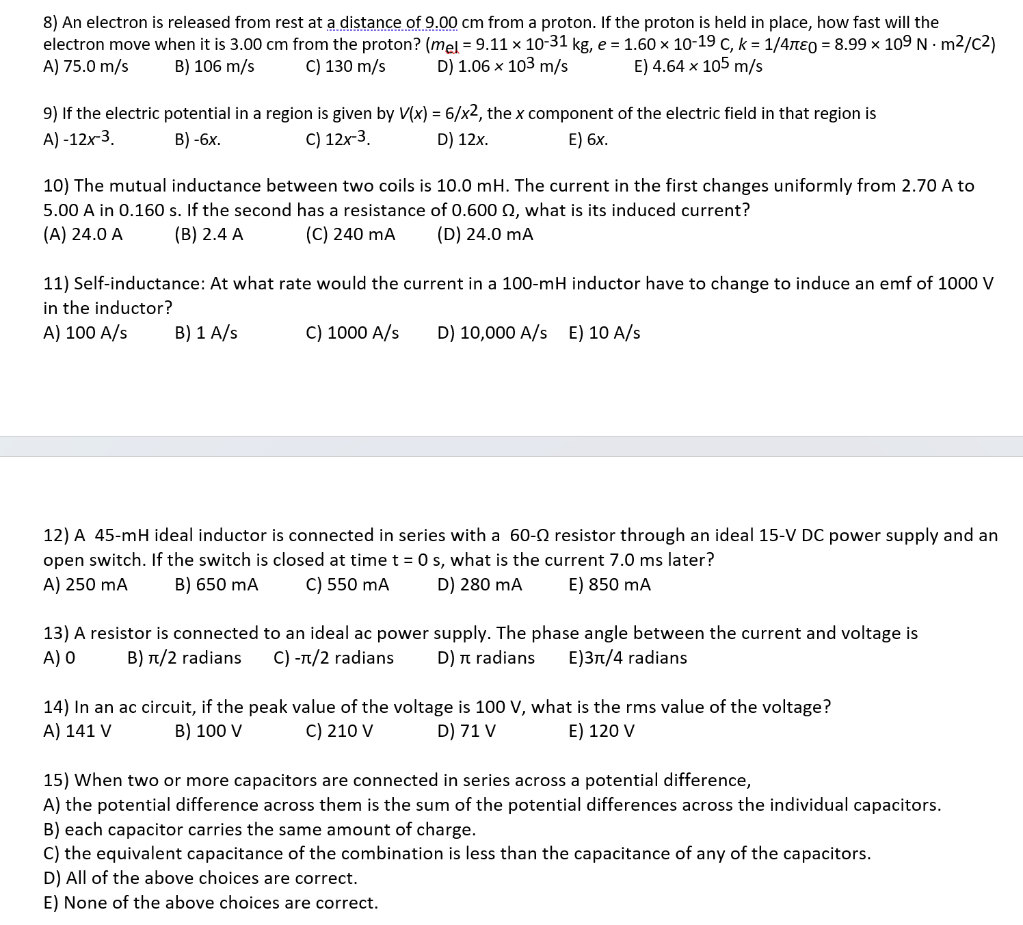 8) An electron is released from rest at a distance of 9.00 cm from a proton. If the proton is held in place, how fast will the
electron move when it is 3.00 cm from the proton? (mej = 9.11 x 10⁻³¹ kg, e = 1.60 x 10⁻¹⁹ C, k = 1/470 = 8.99 x 10⁹ N - m2/C2)
A) 75.0m/s B) 106 m/s €)130 m/s D) 1.06 x 10³ m/s E) 4.64 x 10⁵ m/s
9) If the electric potential in a region is given by V(x) = 6/x2, the x component of the electric field in that region is
A)-12x3. B) -6x. €)12x3, D) 12x. E) 6x.
10) The mutual inductance between two coils is 10.0 mH. The current in the first changes uniformly from 2.70 A to
5.00 Ain 0.160 s. If the second has a resistance of 0.600 Q, what is its induced current?
(A)24.0A (B)2.4A (C)240mA (D) 24.0 mA
11) Self-inductance: At what rate would the current in a 100-mH inductor have to change to induce an emf of 1000 V
in the inductor?
A) 100 A/s B)1A/s C) 1000 A/s D) 10,000 A/s E)10A/s
12) A 45-mH ideal inductor is connected in series with a 60-Q resistor through an ideal 15-V DC power supply and an
open switch. If the switch is closed at time t = 0's, what is the current 7.0 ms later?
A) 250 mA B) 650 mA €) 550 mA D) 280 mA E) 850 mA
13) A resistor is connected to an ideal ac power supply. The phase angle between the current and voltage is
A)O B)n/2 radians C)-nt/2 radians D)nradians E)3n/4 radians
14) In an ac circuit, if the peak value of the voltage is 100 V, what is the rms value of the voltage?
A)141V B) 100 V c)210V D)71V E)120V
15) When two or more capacitors are connected in series across a potential difference,
A) the potential difference across them is the sum of the potential differences across the individual capacitors.
B) each capacitor carries the same amount of charge.
C) the equivalent capacitance of the combination is less than the capacitance of any of the capacitors.
D) All of the above choices are correct.
E) None of the above choices are correct.
Asked by: Firdos
Created at: 2025-12-08 02:53:28
Final Answer:
📢 Instructions:
- Ask anything relatd to above question only.
- For new Question goto :